Sunday, November 10, 2019

Not Quite Rome


     A funny thing happened to us on the way to the forum.  We stopped at a winery somewhere between Florence and Rome.
     We took only our second, and last, bus ride while in Italy.  Quite different from many of the tours which take you to ten places in 12 days.  I think there must be a lot of bus time for those folks.
     As our airplane ride approached its end on our way to Venice, we flew over some really rugged mountains with here and there a village clinging to the slopes.  I kept looking for that territory as we rode from Venice to Florence and from Florence to Rome.  I never did see it.
      We did see mountains, but with rounded peaks and wider valleys than the ones I recalled seeing from the plane window.  We crossed Italy from east to west, but we must have taken a kinder gentler pathway.
       The bus pulled off the interstate and into a village.  We wound through the narrow streets and eventually left the pavement.  We climbed the curvy path upwards and eventually came to the winery.  We weren’t the first tourists to arrive there.  A big sign in the driveway near the yard said “Busses” with an arrow pointing to the left.
      In that section of the yard, there was room to turn a bus around, and probably room to maneuver farm equipment and trucks bearing the farm’s bottled product to the rest of the world.  During the climb up the graveled road, we went through a fog bank.  We climbed through the fog and could see the clouds now beneath us.
       It was still a bit cloudy as we debussed.  There was a ring of chairs in the pleasant yard behind the main farm building, maybe the home, but certainly the business office and the great room to host tourists and wine-tasting events.  Nobody sat since the clouds and fog left everything, including the chairs, dripping wet.  The clearing skies hadn’t had time to dry things off yet.
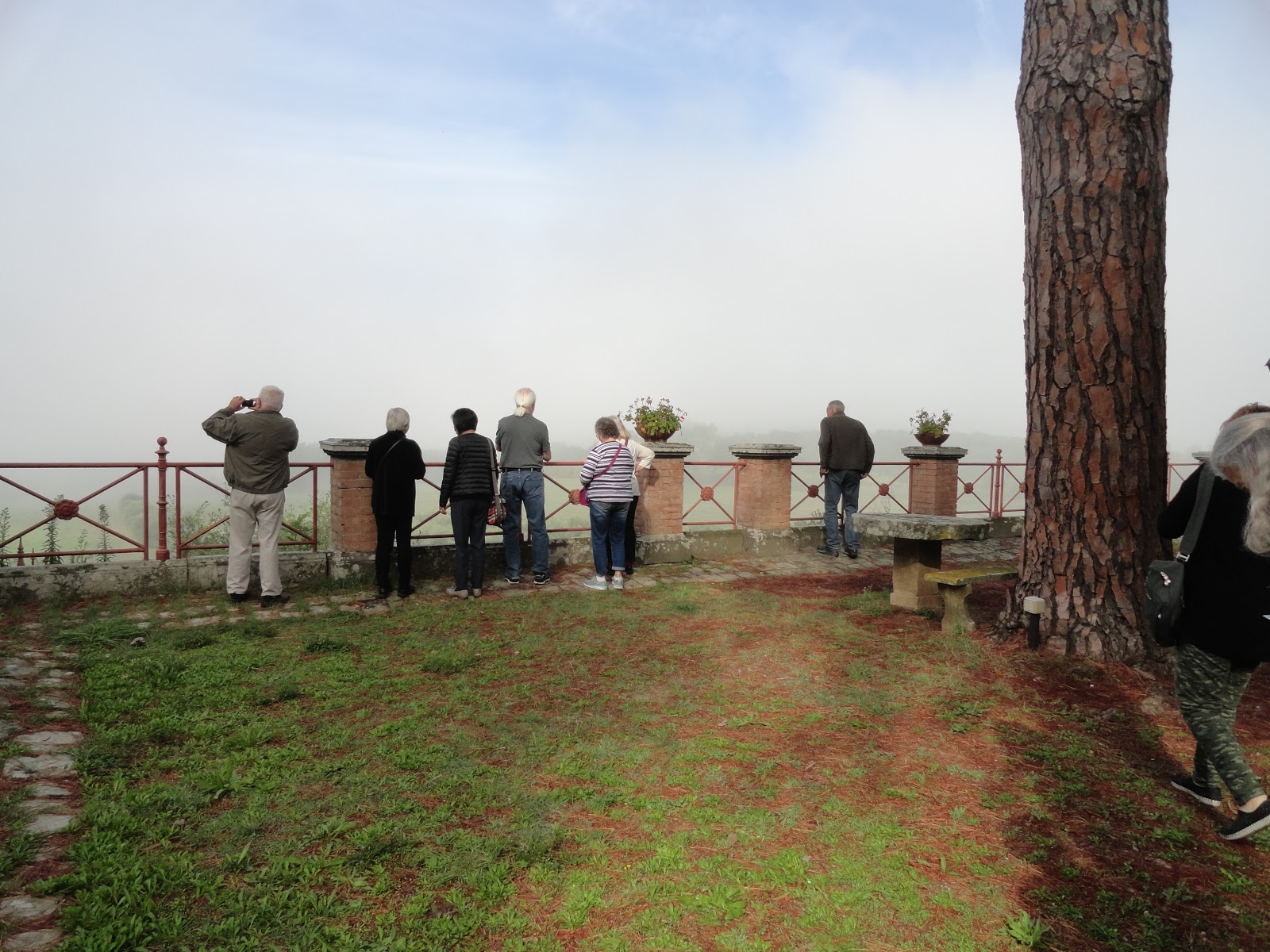


      So our hostess stood, and we stood, under the trees as she told us about the farm.  Grapes were the main crop on a 15-year rotation.  After 15 years, the vines need to be replaced.  When the old vines are torn out, the land is planted to alfalfa to replenish the nitrogen and restore the soil.
     I assumed that there must be something like 15 plots on their 750 acres, a pretty sizable spread compared to most European farms we have seen.  After a year of alfalfa, that crop is turned into the soil and a new crop of grapevines goes in. 
      After about 15 minutes of introduction to the agricultural portion of the place, we went into the great room which had a huge table in the center and chairs all around the walls.  In one corner was another table with wine glasses and bottles of wine.
      We got a lecture on wines and wine tasting.  Our hostess demonstrated wine appreciation:  first with the eye—hold up the glass and look at the color.  Next, with the nose, smell the contents of the glass and try to determine what fruits the wine was made from.  Then, you taste it, with sucking sound as you draw in air and roll the wine over your tongue.  Finally, you spit it out.  The lady held a crockery jar and used it as a spittoon.
      We were invited to taste, and swallow, and pour out what remained in our glass into the crockery jar, if we didn’t want to swallow it, rather than spitting it out.  That seemed a much better solution for wasting the wine we didn’t want to drink.  I knew if I drank all of it, there would be four samples, I would be asleep for the rest of our trip to Rome.
      So, I tasted the first glass, a white wine.  It was good, for wine, that is.  When the crock came around, I dumped the remainder of my wine into it.  Martin, our guide who sat next to me, gave me an elbow in the ribs.  “You wasted that wine!” he hissed.
      “What was I supposed to do with it?  I can’t drink it or I’ll fall asleep if I do.”
       “Give it to me!” he replied.  So after the next two pours, after I had taken a couple of sips, I poured the remnants of my goblet into Martin’s and he polished them off.  Sometime later, it dawned on me why he sat by me.  He knew I preferred beer to wine and always made sure I got beer when we took our evening meal together as a group.  He knew I wouldn’t want much wine and he could get a double portion.  Sly fox.
      Each wine goes with certain foods.  Wine that doesn’t go with a food will not taste good.  The lady made the point by having a man and a woman among us taste a wine after we had cleansed our palettes from the first wine by taking the proper appetizers from the big center table.  Neither of the guinea pigs liked the red wine very well.
      Then the two were asked to eat something, cheese, cracker, something I don’t remember.  Then they tasted the wine again.  And this time they liked the wine much better.
       We then all had to make the circuit of the big center table and choose the correct finger food before tasting the wine.  After three wines and the appropriate food from the table, we were ready for the final course, dessert.
     I think we tasted three white wines and one red.  The dessert wine was white again.  After the dessert wine, we were invited to go outside again where the sun had come out, dried off things and burned off the fog.  We could now see across the valley below us and take a few photos.  And line up to use one of the three bathrooms on the place.


      Thankfully, our bus driver carried his own lunch and didn’t imbibe in the wine.  He had turned the bus around and was ready to takes us back down the hill into the village and back to the busy interstate which like all roads in Italy, led to Rome.  On our way down, we could see much better with the now-clear skies. 
      It was a beautiful setting and a welcome change from the cities where we spent most of our time.

Sunday, November 3, 2019

Florence

     We took a bus from Venice to Florence.  To get to the bus, we had to ride on the vaporetto, the city “bus” system.  It is the boat system that traverses the Great Canal, which is pretty much the heart of Venice.
    There were too many of us (27) to get on the first boat, so those of us who got on the first boat, got off and waited at another “station” where we had to change boats for the rest of the group.  Once on the bus, we made a couple of rest stops and a lunch break at “truck stops” on the interstate.
     A custom strange to us, we had to go select our sandwich or snack or whatever, go back to the cashier, put in our order and pay for it, then go back to the display case, hand over our receipt, and get what we ordered.  Then we had to figure our way out.
      In the convenience stores, you never leave by the same door you came in.  They have oneway turnstiles that let you in, but not out.  To get out, we often had to go downstairs and wander back and forth through aisles of stuff, like going to an Ikea store, where you have to look at everything they have to offer before you can exit.  Our guide explained that process of entry, ordering, paying and exiting, twice in the ten minutes before the bus drew to a stop at the truck stop.  Even with the heads-up, it was still a little bewildering, but we survived and made it back on the bus in time.  
     So we arrived safe and sound in Florence.  The bus driver had to pull over on a busy thoroughfare because the street the hotel was on was too narrow for him to navigate.  It was but a short block downhill with luggage in tow to the hotel courtyard.  This time there was an elevator (no such thing in the Venice hotel).  Our guide gathered all our suitcases near the elevator entrance and ferried them up to the proper floor, where we retrieved them and reported to our assigned room.


      After about 30 minutes to refresh ourselves, we gathered in a very pleasant terrace where we were welcomed with all kinds of beverages, many of them alcoholic and a few snacks.  As we imbibed, our guide gave us a briefing on Florence and some of the things we would see while there.
      Following the session on the terrace, we took a walk downtown to look at the landmarks we would be visiting.  The guide left us with about an hour before we were to meet in front of this giant statue and head to our dinner.  A few of us found a restaurant with outdoor seating (maybe all the restaurants had outdoor seating).  
     We had a little trouble finding seating for the six or eight of us, so a nice young man volunteered to abandon his table to us.  We prevailed on him to just let us join him, rather than drive him off.  It turned out he was from Scotland and the conversation was on.
     When I told him the farther north I got in England, the better I liked it, he glowed.  He was quite interested in Colorado so we pleasantly passed an hour before suppertime.  Before he left, he advised us to climb the hill and visit the fort.
    That night’s supper was a feast.  Every employee in the restaurant seemed a personal friend of Martin, our guide, and they spared nothing to make us welcome and happy.  Some of our number got a little too happy, but getting loud in Italy isn’t a sin.
    The feast was capped off when the main guy (owner? I don’t know) rolled in a big display case full of various desserts.  He took great pride and joy in displaying each dessert and explaining something about each one.  Rod, a fellow tourer, and I got along well, and I stuck close to him because he was diabetic and could turn down dessert without incurring the chef’s wrath.  So I didn’t get scorned too badly when I volunteered to help the Goodwife with whatever dessert she chose.
      At the end of dessert, nothing would do but have an aperitif.  “No thanks” wasn’t an acceptable choice.  The Goodwife and I had a lemon something.  The small swallow I took nearly gave me a heartburn it was so strong. 
     Then we made our way to the hotel.  Florence was a lot easier to navigate than Venice.  I could probably have found my way home without help.  Our hotel was only two or three blocks off the Arno River.
      The next day we toured the Domo, a church with a dome, I guess.  It was reminiscent of the old barn during a blizzard.  It was crowded, warm and stuffy, and noisy.  Our first day in Venice, we were issued a radio on a lanyard with one earbud.  Our guides had a microphone and could broadcast to us wherever we went as long as we didn’t get too strung out.
      We went through the crowded church trying to listen to the local lady guide without steeping on someone or getting stepped on.  By the time we were through, I decided I had seen enough Madonnas with Baby Jesus.  The earlier ones, it was pointed out, had no facial expressions and somewhat unrealistic proportions.  Later ones had various facial expressions displaying joy or dismay or what have you.
      The problem for later painters was what expression to give the child Jesus.  After all, he was God, not man.  As we viewed one picture, the guide told us, he child Jesus sitting on Mary’s lap looked like Winston Churchill.  Well, no cigar, anyway. 
       Later, we would visit the Pitti Palace, built by the Medici family (maybe, not sure).  Every room, and there are a lot of rooms,  is stuffed with so much art you could spend a week there and not begin to cover all the pictures and statuary.  Needless to say, my reservoir for art was saying “Full!  Whoa!  Quit!”  We left there and still had an evening appointment at the Academy where we saw some Michelangelo statues and we got an earful on that guy. 
     He learned anatomy by dissecting corpses, which was strictly against the law, at that time in the hands of the church.  He wasn’t a very nice guy.  He rarely finished anything.  He had underlings who did a lot of work on his “David” statue.  He was human.  We saw David, in all his naked glory.  It was crowded, but nothing like the place we visited that morning.
      Some of the statues we saw were disfigured by having their maleness missing.  One brave soul among us asked what happened to the amputations.  The lady guide somewhat sheepishly said there was a room in the museum filled with genitalia. 
     Other statues had fig leaves.  Not David.  He is there intact.  It didn’t appear to me that David was circumcised.  I wanted to ask about that, but I wasn’t sure I was seeing things correctly, plus I thought one embarrassing question a night was enough.  I refrained. 
      Well, that’s what you get when you turn a clod loose in an art gallery.
      The next day was quite interesting.  We took a short tour of something, outdoors I seem to remember.  We followed that with a fun activity.   We took a cooking class.
      We were divided into teams of four and five with one team of six.  Some of us on each team made dough while others prepared vegetables and still others worked on dessert, tiramisu.  I was on the noodle crew.
      We broke two eggs into a bowl of flour and mixed.  Then we rolled and folded and rolled again.  Out came a little machine that looked for all the world like a miniature washing machine ringer on the old machines before the automatic washers came to be.  The machine had a crank.  We ran the dough through the rollers twice on setting 4.  Then we switched to two (or something like that) and ran the dough through two more times.  By this time, it was getting thinner and thinner and about a yard long.
    Out came an attachment for the hand-cranked roller machine.  This one had blades and a grate like a rotary nut chopper.  It took two of us to hold the skinny dough up and send it through the blades.  Out came noodles.
      Our instructor took our noodles on a tray to the boiler in the back room.  When they came back ten or fifteen minutes later, it was spaghetti, by George.
     Our instructor was quite young and quite voluble.  "Aye yi yi!  What have you done to my spinach!?”  We thought we were supposed to chop it up.  We were NOT to chop it up.  Oh well.
      He was quick to point out our errors, but equally quick to laugh with us, so it was okay.  While we were struggling with the noodles, the tiramisu came along nicely.  Somewhere, one of our subdivisions was working on a sauce.  Spaghetti was our first main course.
      Everywhere we went, the menus all had a first main course and a second main course.  For this meal, the second main course was chicken fried in a tomato sauce.  It wasn’t shake and bake, but I did he-elp.  The chicken was all cut up for us and the oil was in the pan over the burner.  We started the fire and threw in the chicken.  It fried while we worked on the noodles.
     I don’t remember what we put on top of the chicken, tomatoes and green peppers for sure.  The green peppers had been boiled and were soft.  I was supposed to peel the peppers.  The best I could do was strip the meat off the skin, but that didn’t work very well.  No skin and no seeds, I was told.
     When our chef-instructor saw what I had done, he studied it and said, “Very interesting.”  I kept my mouth shut.  When everything was done, we repaired to the basement, which was really a wine cellar with bottles of wine everywhere, like in the catacombs.  There were two big tables were we seated ourselves.  Out came the ubiquitous bottles of wine, and we got set to enjoy the fruit of our labors.


      After wine came bread and then the spaghetti.  There were two or three different kinds of sauce, depending on which team had prepared it.  After the spaghetti came course two, the chicken.  It was quite good, I must admit.  We finished up with the tiramisu.
      That afternoon, we followed the advice of our Scot friend and climbed the hill up to a fort.  There was no sidewalk.  We shared the street with scooters and cars.  Fortunately, the traffic was oneway, so we only had to watch or back, and take to the wall when we heard something coming.  The wall was the old city wall that was topped by the fortress.


     We weren’t disappointed.  It was beautiful and quiet, just as our Scot friend advised us.  We wandered around and gazed at the city below.  All three cities we visited had churches everywhere, practically on every block.  Okay, so I exaggerate a little, but still, a lot of churches.


     We got there about 5:30.  At 6 p.m. all BELL broke out.  All of those churches below us had belfries, and at 6 p.m. they all began tolling.  We had fun trying to pinpoint which sound was coming from which church.  It was quite a serenade.


      We had to go back down the big hill.  This time the traffic was coming up towards us, and it was beginning to get dark, but we made it safely down.  The fort didn’t close until 8 p.m.  We wondered about that, but we figured it might be quite pretty to gaze down upon the city lights.  We didn’t find out. 


       After our big midday meal, we weren't very hungry, so we went to a bar where the snacks were free if you bought drinks.  It was one place they didn’t mind if I drank beer instead of wine.  We wandered back towards the hotel.  The Goodwife had a gelato to finish off our meal, and our day.
      We needed our rest.  The next day, we headed for Rome.      


Sunday, October 27, 2019

Ignorants Abroad III—Venice


     Imagine a big cornfield where some farmer has cut a maze for the entertainment of kids and adults in October.  Now flood the field with water.  Then, substitute three and four story buildings constructed from ancient brick and other building stones, some of which have been stuccoed over, for the corn stalks.
       You have an idea of Venice.  Or ven-AW-chee.
     The “streets” are mostly narrow, hardly alleys by our standards.  They aren’t really streets because there is no wheeled traffic in Venice.  I don’t recall even seeing a bicycle. 


     Traffic is pedestrian over cobblestone (not really cobblestone but stone nevertheless) sidewalks.  Instead of being walkways beside roadways, the sidewalks are mostly beside waterways or canals.  There are many bridges across canals.  Most of the bridges are arched so boats can pass under them.  For the pedestrian, that means stair steps, lots of them.  We walked a lot.


      Boat traffic supplants auto traffic, but we didn’t see a lot of boat traffic, either.  Venice is about walking. 
      You have about four ways to get from the airport to the city.  You can take a boat all the way.  You can take a bus which will take you to a depot where you can take a boat the rest of the way or walk from the depot, towing your luggage.  Or you can take a water taxi.
      One of our tour group did take a water taxi.  He had to ask two or three taxis before he found one that would deliver him to the exact location of our hotel.  The water access for our hotel was on a rather narrow “alley” which many taxis were not willing to negotiate.  We took the boat all the way, which dumped us at a dock near our hotel.


     The Goodwife kept mentioning that they must dump some kind of coloring in the water of the canals to get that dark blue tint.  I couldn’t bring myself to tell her the water had the cast of the stuff we used to pull out of the cesspool to water the garden or when the sewer backed up.  There were occasions when the canals smelled the same, too.
     However, fish live in the canals.  You can see them.
     And Venice is probably the cleanest city you will ever see—no trash anywhere, well with the possible exception of the places the tourists crowd.  But that is all cleaned up during the night and ready for a new bunch of litterers the next day.
      We witnessed two embarrassing moments in Venice.  One was an American woman (judging from her accent) who was hanging around the hotel lobby.  At first, I thought she was part of the staff because she was trying to help guests negotiating the place.
     Push came to shove when our tour group held its first meeting in the hotel’s breakfast room and she kept interrupting the tour guide.  He tried twice firmly but gently to get her to leave.  On the third try, he got rude and drove her out.
     The next morning, the hotel clerk told one of our number that the police had come in the night to take her away.  She had given all her money and her credit cards to a thief who had asked her for them.    What happened to her after that, no one knows.  She was obviously unhinged.
     The second embarrassing incident, also involving an American woman, happened one day as we were approaching our hotel room to take a rest before the evening activities.  We heard a lady yelling at someone, first in Italian, then in English.  She was in a boat that had just crossed under the footbridge that we had to take if we went to our room from the hotel lobby.  The bridge served just the hotel lobby.  Going toward the hotel, you had to go into the hotel.  You had to ring a bell and the desk clerk would buzz the lock and you would swing the gate open and step down into a small courtyard.  Two steps up and you were in the lobby.
      Going out of the lobby, again, you rang and the gate was unlatched.  Over the footbridge, you turn left or right, or go straight ahead.  To get to our room, go straight ahead to the first door on your left.   Ring another bell and the hotel clerk would release that lock.  Up about 20 steps was another locked door which was also released when the street door opened.
     So we were approaching the footbridge on “our” side of the canal when we heard the ruckus.  The Italian lady in the boat was giving a woman at a window one story up h-e-double-el for having thrown a bit of trash out of the window into the canal.
      The woman in the window was an American (judging from her accent) who kept apologizing and vowing not to do it again.  She still got a at least a thirty second lecture on keeping trash out of the canals, disposing of trash properly.  The lecture wasn’t in polite terms, nor a pleasing tone of voice.
      When the lecture was done, the man in the boat backed it up slightly and the lecturer reached down and picked the piece of trash out of the water.  The boat sped off and we went on about our business.  Needless to say, we were acutely aware of trash disposal after that.
       Everything coming into Venice comes by boat.  Trash and recyclables leave by boat.  Some mornings at the dock by our hotel there would be commercial-size dumpsters full of trash or recyclables.  Along would come a barge with a small crane that would pick up the dumpsters and take them away.
     Our guide said that even the hotel and restaurant laundry had to be done off-island, thus explaining why when you went to a restaurant, the first item on your bill was a “cover charge”.  It was for tablecloth and napkin laundry, so he said.
     Anyway, Venice is clean.

     Venice sinking, or water level rising?
     We heard both theories, though the first one came from one of us Yankees.  Most Venetians agree that Venice is indeed sinking but at a rate of a millimeter or two per year, while the water level has risen more than a foot in the past couple of decades.
      Many of the buildings lining the canals were originally homes for the wealthy.  The “ground” floor, accessible by water, was where the servants worked to take care of the family.  The first floor up was a gathering place for hosting guests and friends, maybe for meals.  The next floor(s) up were private places, bedrooms, and the like where the family lived.
     For years, coming and going or taking deliveries of groceries and other supplies was achieved by pulling a boat up to the gate and taking two or three steps up to the doorway, or down the steps from the doorway, if going out.  Now the water covers the steps and reaches the doorsill.


      On being a tourist.

      Wheatie.  Smokey.  Tourist.  Probably a few others.
        I was a wheatie when I worked on a harvest crew in Oklahoma, Kansas, Colorado.  We came in to restaurant or motel dirty (no cabs on combines in those days), tired and hungry, probably stinky, too.  As a smokey, I came in to grocery, drug, or liquor store in a mountain town smelling like wood smoke from being beside the fire at our campsite.
      Tourist.  Tourists get conflicting messages from the folks in the land you are visiting.  You are welcome because you spend your money and boost the local economy.  But in another way, you are made to feel that you are intruding, that you are not really welcome as a guest, but tolerated as an economic necessity.  Not unlike the way my father felt about livestock.
     In Venice, there are categories of tourists, the lowest of the low being cruise ship tourists.  Why?  Because cruise ships dump a thousand or so tourist ashore about midmorning.  They wander all over, blocking footpaths and bridges, stopping anywhere to take selfies.  Maybe they buy a meal or two, maybe a memento of some kind.  As the sun slowly sinks in the west, they depart to return to the cruise ship, leaving a mess in their wake.
      What the cruisers leave behind in economic value doesn’t sufficiently compensate for the cost of cleaning up after them.
      We were a step above the cruisers, as we stayed for five nights, taking all our meals on the island and buying tickets (through the tour) to some attractions.  We didn’t reach the highest status, however, since we bought almost nothing else, like clothes or mementos.  (You have to lug the stuff you buy all the rest of your journey, and what do you do with it when you get it home?)
     The highlight of our Venice trip had to be the gondola ride, as corny and touristy as that sounds.  The ride, about 80 euros (close to $100), was part of the paid tour.  Sixteen of the 26 folks in our tour group opted to take the gondola ride.  Each gondola held six passengers.  Three gondolas were necessary to take us all.  That left one gondola with only four folks.
     Our foxy guide made a show of selecting which of us got to be the lucky four.  We were chosen first because we had been married longest.  The second place couple also had been married a long time.
      When we were all seated in the gondola, we began to see why it was such a big deal to be the lucky four.  A man with an accordion accompanied by a beautiful young lady stepped down into our boat.  We were to be serenaded on our ride.
     As we started on our journey through the canals, we met up with other gondolas with musicians in them.  They would belt out a song and the music echoed off the “canyon” walls.  Our lady waited her turn, until we were out of earshot of the others.  The other singers were all men.  She sang in Italian, so we had to appreciate the music, not the poetry.  She did sing “Volare”, so most of us could join in on a least a few words.
       It was quite a pleasant ride, taking place just at dusk.  We were able to get right in, avoiding long lines, since the “cruisers” had all gone back to their ships.


      We did some other tourist things, tours of Saint Mark’s Cathedral and such like.  Most of the other activities involved churches and great works of art.  We missed the Doge’s palace.  We were worn out with the cathedral (many steps up and around all the while listening to our local guide).  So we thought to walk back to the hotel and rest awhile before attempting the palace.
     We managed to disprove what our guide told us:  “You can’t get lost in Venice.”  We managed to do just that.  My plains compass, dependent on being able to see the horizon to find my way, was completely discombobulated by the canyons formed by the city buildings.
     Misery loves company and we were not alone in losing our way.  We stopped at every intersection and studied our map.  A few others studied their maps, but most of the other lost souls had their noses buried in their cell phones.
     It came to pass that all 26 of us (we lost two the second day to a bad back, rendering the poor fellow unable to walk—did I mention Venice was all about walking?) boarded the city boat which delivered us to the bus depot where we boarded a chartered bus and headed for Florence.
     In addition to “bus” and taxi service all being by boat in Venice, they also have police and ambulance service by boat with only an occasional helicopter for emergencies.
      Finally, my apologies to art lovers.  Somehow the art bone is totally missing from my body.  I cannot do justice to all the great works of art we saw, so I am not going to try.  Sorry.   


Friday, October 4, 2019

Color Blind


     “This is the school nurse calling.”  Oh no, she thought.  My boy is sick.  How will I drop everything and go get him?
     “His teacher sent him down for me to check his eyes.”  His eyes?   
      Early in the young school year, the teacher had told mom that the boy didn’t know his colors.  Mom tried to explain that he did know his colors, at least the ones he saw.  His grandfather was red-green colorblind, she told the teacher.
     Maybe the teacher didn’t believe mom, or forgot, or simply wanted to confirm it, so she sent the grandson to the nurse when he mistook gray for pink or pink for gray or some such thing.  The school nurse confirmed the diagnosis.

      There it was, hanging on the south wall, above the chalkboard, above the 11” X 6” panels of white alphabet letters, capital and small, on black background at the front of the classroom, my green deer.  I really didn’t notice it until the teacher made a comment about my green deer. 
     Then, juxtaposed as it was with all the other brown deer hanging in a row, I could see a difference.  I suppose I blushed.  I was embarrassed.  I think it began my life-long dislike of anything that smacked of art, particularly art classes and art projects, which thankfully ended about 4th or 5th grade.
      Prior to that experience, I had enjoyed the mess of watercolors, drawing figures, mostly female, mostly buxom females.  I think I got the idea of big-bosomed ladies from the movie “Houdini” starring Tony Curtis.  That may be imagination.
     All those memories came rushing back as I heard the report of grandson’s colorblindness.  At least he got his diagnosis early.  I was never really sure until chemistry lab in my junior year in high school. 
     There had been indications that I was colorblind, like when Dad admired the green wheat growing west of the house in the evening sunlight.  I thought it looked red, but I never said anything.  I wasn’t very old then.
      Other indications were when I confused two-toned ’56 Chevrolets, with red or green panels.  I knew which neighbors had the green tone and which had the red tone, but I couldn’t always tell the difference, especially from a distance.
      There was that slick page in the biology book when I was a freshman.  We were studying the eye, rods and cones.  It was a page full of colored dots.  If you saw the word “color” in the dots, you were normal.  If you saw the word “onion” among the dots, you were colorblind.  I could see both words.     
      In chemistry lab, my lab partner and I had to mix a bunch of chemicals, let the stuff settle, then tell what color the sediment was.  My partner said it was purple.  I laughed.  “That’s not purple,” I said.  “It’s brown.”
     We took the dispute to Mr. Hare who asked us both what color we thought it was.  When I said “brown”, he just looked at me, smiled shook his head, and turned to other students.  Was it purple?  I looked again.  No way that was purple.
     But I have come to know that there is no purple in my palette.  Some purples will seem red to me, or they will be blue.  I recall being accused of stealing sweat socks from the p.e. department because I had on one blue sweat sock and one purple sweat sock, purple being the school color.  As I looked at my socks, I could tell they were different shades, different shades of blue.  No purple there.
     All these things came back to me in the aftermath of the lab experiment.  I must be colorblind, I thought.
      My colorblindness would come back to haunt me, when I couldn’t pass colorblind tests for my pilot license (restricted to daytime flight, no flight using signal lights from control tower) and in trying to keep my CDL driver’s license. 
     The pilot license business didn’t matter because I only flew for a couple of years before giving it up as too expensive for a hobby.  As for the CDL physical, I learned to game the system.  The first time I failed the test, I had to go to an optometrist and get her to sign off that my colorblindness wouldn’t affect my ability to drive safely (this after 50 years of driving).
     The next time I went in for my physical, I glanced around for that blasted color chart, took a good close look at it as I was ushered into the exam room, and memorized where the green triangle was.  There were three colors in three corners of the chart, yellow, green and red.
     No problem with the yellow.  Up close, I could distinguish green from red.  After blood pressure, temperature, heart rate, all the routine checks, we would go back out in the hall where I stood at one end and read the letters and numbers on the chart at the other end.
      “What color is this?” the nurse asked, using a pencil to point to one of the colored triangles.  Ha!  I passed easily, no optometrist needed.
    Well, I am indeed sorry I passed the trait to my grandson.  It will complicate his life some.  With an early start on it, he will easily adapt.  If needed, I can tell him how to pass a CDL eye exam.

Sunday, September 8, 2019

The Badger


     The day had been hot, the third of three consecutive days topping out in the upper 90’s or even 100 degrees.  I had had my supper.  It was just at sundown.
     I stepped outside for something, what, I don’t remember.  It was really pleasant, cool, no wind, too dry to have any mosquitoes.  On the spur of the moment, I decided to take a walk.  I would stroll out and get the mail.
      I didn’t get far.  Down the steps, through the gate, turn right, get on the road leading to the county road and the mailbox.  In a matter of a dozen steps, I stopped short, uttered an involuntary “expletive deleted” (remember Richard Nixon?), and took two quick steps back.
The day’s fatigue was momentarily suspended by what I saw. 
     Just off the south wheel track lay a badger.  It was hunkered down as flat as it could be in the dried out not-very-tall grass.  As I stepped back, we locked eyes for a brief moment.  “What the . . .?” I uttered, again out loud.
     A few questions ran through the old, suddenly very active brain.  How had he (she?) got there without me seeing it?  It couldn’t have been there that long.  Why was it there?  Was something wrong with it?  Was it rabid?
      Lying flat on top of the ground was not ordinary badger behavior.  In the few other encounters I have had with badgers, they always turned and fled as fast as they can, which is not very fast.  You can’t really see their legs, just the bump bump bump of the fur ball of their departing rear.
     Hunkering down in open space didn’t seem normal.  The only other badger I remember seeing hunker down was a young one that strayed into the old barn and got caught in the milk cow manger.  Dad dispatched it with a .22 slug between the eyes.  The current farm dog of the time, Ruff, then tore into the dead badger.  We laughed at her bravery.
      But this one wasn’t cornered.  It had to see me coming, just as I should have seen her before I did.  I knew there was a badger in the area.  They dig holes everywhere, including under the south side of the garage. 
     I think they hunt for the pocket gophers and ground squirrels that live in underground burrows.  Whether they operate by smell or hearing, they find the burrows and tear into them with their curved front claws.  It doesn’t take them long to excavate a good size hole.  Ground squirrels inhabited the hole under the garage. 
     What had been a hole the size of a bratwurst became a hole that could have swallowed a watermelon, with the resulting pile of dirt  adjacent.  They are true miners who never bother to return the slag to the mine tunnel.
     He didn’t get all the ground squirrels, as every now and then, one scolds me when I walk around the garage.  The scourge of pocket gophers have largely disappeared around the farmyard, due to an owl who has taken up residence in the old elm trees north of the house.  At least I give the owl credit.  When he disappeared, I began to have mice problems, too.  I’m glad to have Mr. Owl back.
      Not so much the badger, even though he may help eradicate pests. Badger holes are large enough to rattle teeth when pickup, tractor, or mower wheel hit one.
      Rabies became my dominant thought.  I had been one-step away before I saw her.  She could have easily taken a good chunk of my left leg before I could have reacted.  I continued to back away as I kept an eye on her.  A few steps and I turned to walk normally back to the porch, still watching over my shoulder.   
      She hadn’t moved.  Three .22 rifles stood in the porch closet.  I opted for the shotgun, thinking my vision-impaired aim wouldn’t be good enough.  I had to go upstairs for the heavy artillery.  I glanced out the bedroom window.  Gone.  No badger, nothing.
      Nevertheless, I chambered a shell and put two in the magazine and returned to the scene.  I was a bit relieved.  Getting the heck out of Dodge was more normal behavior.  It probably wasn’t rabid after all.
      I took a walk around the place, keeping the gun at the ready.  Nothing.
     By now, it was getting dark.  Cool evening stroll cancelled.  I didn’t wish to proceed unarmed and the old Winchester is pretty heavy now (it didn’t used to weigh that much).
     The next morning, I kept an eye out for any new excavations as I went about my chores.  I saw nothing.  Perhaps the badger had been as startled by our encounter as was I.  With any luck at all, he may search out other hunting grounds.
     I may not have to kill a fellow creature who is just trying to get along.  That wouldn’t be how Dad would see it.  Badgers were evil creatures that made life difficult, that raided the chicken house, raised havoc and killed hens.
        I no longer have chickens, or even a chicken house.  Still, it would be fine with me if Mr. or Ms. Badger would find a new place to call home.


Sunday, August 25, 2019

Microcosm II


      This time it began a couple of weeks ago.  I needed to fill ruts inside the combine shed with gravel.  I had a few other places that could use some gravel.  The GMC truck was sitting empty.  The G (John Deere tractor) hadn’t been moved for over a year.  I needed to mow where it sat in its aura of grass.
     I set out to knock over the first domino in a long line of dominoes that would eventually lead to me hauling some gravel from the pasture creek.  Step one, get the tractor started.  The battery came off the now-shedded combine and into the G. 
      It started right up.  Well, maybe my luck had changed.  It had a low rear tire, so I pulled it over and parked in front of the shop close to the air compressor.  I shut it off.    I dragged the air hose out and crawled under the tractor to access the tire valve.  I half expected to have to dodge some calcium chloride, but the inner tube was dry.
       (Calcium chloride is a water-based mixture used for ballast in tractor tires.  It probably weighs more than water and it stays low to the ground, gravitating to the bottom of the tire and inner tube, reducing chances of tractor rollover.  The solution is somewhat caustic to skin and especially eyes.  It is corrosive to metal.)
      A few minutes of air brought the left side of the tractor up to match the right side.  I crawled out from under the tractor.  Then I saw it.  A rip in the tire where the inner tube was starting to bulge through.
      That string of dominoes was going nowhere.  The rip was in the tread portion of the tire.  It wouldn’t take much at all to puncture that tube and I would be dead in the water.  Or more appropriately in the middle of the pasture or somewhere between pasture and farmyard.
      A new string of dominoes had to be erected.  I would have to get the farmhand off the tractor in order to get to the tire that has to be replaced. 
       There is a place in the south yard where I usually park the farmhand when I remove it.  Heavy cement blocks serve to hold up the farmhand when it is not on the tractor.  The site too was well endowed with tall grass. 
     I had to abandon the project for the time being.  I needed to get the ruts filled so I could park trucks in the shed.  One truck had seed wheat on it.
      I cleared off the bed of the 4X4, threw on a shovel and headed for the ditch just west of the mailbox where heavy rains deposit gravel when the water runs out of the field and across the road.  A couple of hours later, I had the ruts filled with some first rate gravel.  It was a hot day and I was tired after twice shoveling the gravel, onto the 4X4, and off the 4X4 into the ruts.  The G would have to wait.
      We move now to a couple of weeks later.  The G still sat in front of the shop.  I needed to get a few other things close to the shop.  The G would be out of service until further notice.  But I did need to move it.  And I should get that farmhand off of it.          
     Back to that string of dominoes.  In the intervening two weeks since I started the ill-fated project, the left side of the tractor slowly sank.  The tire was flat.  Oh well, air compressor is close at hand.
       I moved the heavy cement blocks that support the farmhand.  I took the Ford tractor and mower to the site and soon it looked all nice and neat.  With the golf cart, I hauled toolbox, bar, and jack, all things I would need to get the fork off the front of the farmhand and the farmhand off the tractor.
      Once again I drug air hose underneath the tractor and fastened the handy-dandy air chuck to the tractor tire.  After a minute or two, the tractor rose to near-normal level.  Then it was I heard an ominous hissing.  I crawled out from under the tractor.  The sound was easily located.  Through the afore-mentioned rip in the tire, I could see a pin holed, well, more like a nail hole in the inner tube.
      By widening the rip a little, I thought I could get a tire patch onto the tube, enough to hold while I got the farmhand off and the tractor parked where I could get to it to change the tire, if ever I could find a tire for it.  I would need to let the air out of the tire to get the patch to stick.
     Back under the tractor, I placed a jack to hold the tractor up while I repaired the tube.  I pulled the valve core out of the tube and let the air escape.  A little jerk with pliers opened the tire rip up enough to get glue onto the nail hole and then, after the glued dried appropriately, the patch.
     All went well.  But now the rip was even bigger and the tube might not take more than a revolution or two before it was punctured again.  I devised a boot, something like the mesh used to correct a hernia, used to plug a fissure in a tire.  I used an old inner tube folded over about five or six inches square.
     It wasn’t exactly laparoscopy, but it was similar.  With pliers and screwdriver, I force the folded inner tube through the rip into the tire between the tire and the tube.  For good measure, I cut a smaller chunk out of a plastic antifreeze jug and forced it in there, too.
     The slick plastic piece didn’t want to stay in place, so I finished off with . . . you guessed it, duct tape to stabilize the plastic patch.  Back under the tractor, I replace the valve core and once again hooked the air hose to the tire. 
      All was well.  No hissing.  I cleared away tools and jack and mounted the tractor.  It would not start.  I pulled spark plugs and cleaned them.  Fouled plugs are the usual reason the old thing won’t fire.  Plugs replace, I tried again.  Nothing!
     It was growing late.  I was tired.  Sometimes, if I let it set for a while, it will forget its abstinence and start right up.  Tomorrow.
      Tomorrow got here.  A look out the window showed the left side of the tractor much lower than the right side.  Oh well.  Maybe the tire would hold air long enough for me to complete my project.   After two hours of removing, cleaning, installing spark plugs, I had to give it up again.  The thing just would not start.
     A batch of expletives and hand gestures hurled at the G left it unmoved.  I pulled the spark plugs and left them out to give the cylinders a chance to dry out while I took a lunch break.  In my mind, I was writing the want ad:  “For sale, John Deere G with bad rear tire.  John Deere collector’s must-have.  With or without Farmhand.”
     I made one more try after the nooning.  I was interrupted by Jerrod and his son.  They came out to finish up some details of last January’s siding job.  Two lightning rod cables need to be fastened to the corners.  The big project was the roof flashings over back porch and west addition to the house. 
     They had installed them over the siding.  They should be behind the siding so that water running down the wall had nowhere to go but onto and off of the roof, no chance to get into the joint between roof and wall.  That took a couple of hours. It's all better now.  It looks much nicer with the flashing installed properly.
     After they left and I cleaned up, it was too late to try the G again.  If it started, it would be dark before I could get everything done.
      I gave it one more try the next day.  I got nothing, not one pop, no smoke, nothing.  Somewhere out of the fog of ancient memory, I remembered that when this happened in the past, new spark plugs made a difference. 
     It has a new magneto.  The spark plug wires check out ok.  It was getting fuel.  New plugs will be the next domino to try.  The new plugs won't say "Champion" on them if I can help it.
     Meanwhile, the G sits in front of the shop blocking the way for other equipment needing attention.  Blocks hold the left rear up so the weight of the tractor won’t cause other problems with the ancient tube and tire.
     And so it goes.