Tuesday, May 31, 2016

Boulder, Colorado

      Obscenely early September Saturday morning.  Donning a band uniform that I will wear for the next sixteen hours.  Plenty of Kleenex in one pocket, meal money in another. 
      Join the group loading instruments and finding a seat on the waiting school bus.  The three-hour bus ride broken up by a stop at a truck stop somewhere for breakfast.
     Dismounting the bus, we grabbed instrument cases, assembled them, crammed empty cases back on the bus and assembled in some formation where we would warm up our marching skills getting to the parade starting point.  Then we waited.
      As one of the smallest bands, it was always fascinating to watch the other bands, especially the big ones who would have a drum major in a tall hat carrying a scepter, followed by a huge banner bearing school name and mascot carried by a bunch of pretty girls, with a row of twirlers, also pretty, skimpily dressed, followed by a huge band with a row of bass drums and a row of snare drums (as opposed to our one bass drum and two snare drummers). 
     Eventually, our turn to fall in line would come and we would fall into formation, spread our lines across the street to try to make us look larger than we were, and do our best to make as much noise as the bigger bands when we got the signal to play.
      One time, we left earlier than usual so we could reach Boulder before 9:10 a.m. to “maneuver”.  We were in our grand finale rotation on the field when the horn warned us we were about out of time.  Abruptly we turned as the drum majorette blew three whistle blasts and pointed her baton toward the sideline.  Our lines melted as we hurried to exit the field.  We didn’t score very well on maneuvering, I think. 
       After marching a dozen or so blocks and playing our selected march two or three times, we broke ranks and followed the college students directing our way that would send us single file through a line where we were handed a sack lunch with a sandwich, chips and an apple.  After a lunch break, once again we would be directed by college students to Folsom Field where we were seated in a group among other bands.
      CU football wasn’t all that much in those days, though we were familiar with the team from listening to John Henry call the play-by-play on KOA radio.  A band day was the first time I ever heard of the Eugene Oregon Ducks.  “Ducks?”  Really?
     At half time, all the bands seated in the stadium joined the CU Marching band on the field in playing two songs, “Glory, Glory Colorado” and “Fight CU” which Mr. Sager insisted on pronouncing “Fight Que”.  The band directors tried many strategies to get all the bands on the same tempo.  I don’t remember any of them succeeding.  Some bands always finished before the CU band, and some ended after the CU band had put down their instruments.
     After half time we were free to wander around.  We could take our instruments to the bus and not be burdened with them for the first time since arrival. Eventually, we would once again mount the bus and edge our way through the heavy traffic towards home.
    We would stop at a White Spot in Aurora or some such fashionable eatery for our supper before the final leg of our journey.  It was the custom to try to pair up with a girl for the ride home in the dark.  I was never very successful in that endeavor, but it did add spice to the end of the day, a very long day at that, by the time we reached home and removed the band uniform that had to be dry-cleaned.
      My association with Boulder would include a week at Boys’ State, but we were closely confined to campus, leaving only to be bussed to the state house in Denver for a day of mock government.  Once out of high school, I would have no association with Boulder until I was married, after which I had Aunt Yvonne.
      Aunt Yvonne lived in Boulder, so we called on her two or three times a year.  It was during this time that I got the unfavorable impression that Boulder was filled with a superior people, who knew they were superior and expected me to know they were superior.  Aunt Yvonne had nothing to do with my Boulder attitude.  She was always a gracious and interesting host.  It was a parking ticket while browsing downtown that cemented my negative feelings about the place.
    I vowed never to buy anything or support the place in any way.  Anyone who has visited the city lately will know that my one-man boycott has been devastating—devastating to the place!
     Aunt Yvonne cooperated with my embargo by moving to a small farm north of Longmont.  I would not have to set foot in the Boulder again. 
     Well, there were two slight exceptions.  We did attend a Boulder Dinner Theatre performance once.  Then I had to attend, with two fellow teachers, a one-day Advanced Placement clinic on campus when we began offering Advanced-Placement classes at our Kansas high school.  I convinced the girls, my fellow A-P faculty colleagues, to wait till we got to Broomfield before we stopped at a mall on our way back to Kansas.
      This spring, Boulder crept back into my life, the first occasion, sadly, Aunt Yvonne’s memorial service.  The parking experience brought it all back to life, finding a place to park, wrestling with the machine to get it to take our credit card so as not to get another parking ticket.  We celebrated Aunt Yvonne’s life, then left Boulder. 
     Boulder didn’t leave me.  Barbershop kept Boulder in my life.  Our quartet bass’s granddaughter runs a dance studio in that city.  For the past few years, she has put on a dance program she calls “Murmuration.”  The term seems to refer to a flock  of birds who dart, climb, dive in the same direction at the same time, like a troupe of dancers in the air.  Sara’s aim is to involve as many diverse groups as possible.     
     Two years ago, Sara did a solo routine as her grandfather’s barbershop quartet sang.  This year, Sara invited the quartet to sing again, but we would be singing for a group of nine dancers this time.
     There was a problem.  Barbershop singers are rhythmically challenged.  The time value of notes means little or nothing to the singers.  Dancing to such unrhythmic accompaniment would be possible for a solo dancer who could adapt, but for a troupe trying to stick together and follow the music?
     Sara and Rex worked out a medley of “When I’m 64”, “Aura Lee” and “Love Me Tender” for us to sing and “Backbones” to dance to.  We sent a video of us singing the medley, but we needed a live rehearsal to cement things.  So on a Sunday afternoon preceding the Saturday show, off we went to Boulder to Sara’s dance studio to rehearse.  We spent two hours watching the girls rehearse their routine. We sang as we watched them dance and both groups got a feeling for the other groups’ performance.  It was fun.
     On Sunday we arrived at the performance venue, the auditorium at Chautauqua Park at the foot of the flatirons, at 1 p.m.  As at band days, we spent the day in full regalia, white shoes, white pants, white shirts with armbands, red and white striped vests, red bow ties and flat straw hats.      
     As we left the car and headed for the auditorium, two of the Backbones, the dance troupe, ran into the street to meet us.  The two young ladies greeted us, told us how great we looked, how excited they were to be on stage with us, how good we sounded.  Their effusive greeting set the stage upon which we would tread the rest of the day and into the night.
      When we stood in front of the mic’s so the sound and light people could adjust for our appearance, the other performers cheered our warm ups.  (There were probably close to 100 performers including all the dance troupes and their accompanists, including a drum band from Montbello High School.)  Everywhere we went, we got complimented on our uniforms, our sound, for agreeing to take part in the program. 
     Between technical and dress rehearsal, we snuck off to do a little rehearsing for another upcoming performance.  Young folks (we were by far the oldest of the performers) came by and snapped pictures of us.  Others asked to have their picture taken with us!
     After dress rehearsal, we had a half an hour before the taco supper provided by Sara for all the performers (a lot of people to serve!), so we headed to the nearby restaurant for a bit of refreshment.  I thought I ordered an O’Doul’s, because I didn’t want any alcohol before I had to perform, but what I ordered was an O’Dell’s.  Oh well, I relaxed. 
     We sang two or three numbers to the restaurant patrons and were well received there, too.  It was just that kind of day. 
     After ingesting our tacos, we sang a song to Sara.  More compliments, more pictures.  We were next to last on the show, so we watched from the back seats.  During the intermission when the house lights came on, we were flattered by audience folks telling us they were looking forward to hearing us sing. 
     About three numbers before we were up, Sara took us up behind the auditorium for a group picture and a pre-performance pep talk not unlike a coach gives his players before the start of the game.   We grouped into a circle, joined hands at the circle center and shouted a “Let’s Go!” type cheer, the exact words of which I don’t remember.  We were pumped.
      The Backbones preceded us on stage and stood at attention in position as we entered.  The crowd cheered.  We sang, they danced, the crowd cheered, standing this time.  We knew it was for the dancers who had superbly followed our accompaniment.  But we knew it was for us too.
      After the show was over, we stood outside meeting Sara’s family.  We were complimented by strangers, asked to pose for pictures with some of them.  It was all overwhelming. 
       Some serious flaws were beginning to appear in my Boulder attitude.  I have sung for all kinds of audiences in my thirty years in barbershop, most of them appreciative audiences.  Never have I had this kind of adulation heaped upon me.  As our evening wound down, all four of us expressed our wonder at the day we had. 
     With the adrenalin flowing, it was hard to relax.  We had a few songs left in us.  We were hungry and thirsty again.  We needed to savor the day a little longer.

      Even the pub patrons where we stopped complimented us when we sang for them.  We waited until Longmont to stop to eat and to celebrate our jewel of a day.

Sunday, May 22, 2016

Floor Project, Uninstallment I

     Here I am standing on the fourth floor.

 
    Wait, I am on the ground floor.  How can it be the fourth floor?  No, there aren’t three levels of basement below me.  Still, it’s the fourth floor.
    Well, the third floor looked like this.

         The countertops (pictured here) matched the floor.  That one didn’t last too long.
    The second floor looked like shag carpet, but it was linoleum.

    
 And the first floor looks like this:
  
     Actually, this probably isn’t the first floor, maybe the second floor.  The first floor was probably tongue and groove fir.  The old linoleum was probably installed sometime in the late forties or early fifties, after the house was moved to the present site.  I barely remember when this “first” floor was “the” floor.
      The one memory I do have is Monday morning washdays when the white-with-red-trim Maytag washer was rolled from porch into the kitchen, close enough for a hose to reach from the kitchen sink faucet to the washer and the two rinse tubs sitting on a bench adjacent to the washer.
      The washing machine ringer rotated 360 degrees so that the water rung from the clothes coming out of the washer ran back into the machine while the rung-out clothes curled down into rinse tub one.  Rotate the ringer and feed the clothes from the rinse tub into the ringer.  Keep your fingers out of it!  (There was a stick to use for feeding small stuff, socks for example, into the ringer without endangering your fingers.)
     The water would run back into rinse tub number one.  The rinsed clothes would drop into rinse tub number two.  Rotate the ringer once more, feed the clothes into the ringer once more and the thrice rung clothes dropped into the laundry basket ready for the clothesline.
     Grab the clothespin bag and head for the line.  Wipe the bird poop, dust, and rust from the clothesline with a rag.  Hang up the clothes.  When that job was done, the second load in the washing machine was about ready for the ringer.
     Mom always started with the white stuff, underwear, shirts, sheets maybe, when the wash water was freshest and hottest and full power Clorox.  She ended with the work jeans and greasiest stuff.  The same wash and rinse water was used throughout. 
     When the washing was done, a hose from the bottom of the washing machine, hanging from its hook to an eye on the machine, was connected to a garden hose, the hose run out the door, into the yard.   The drain hose was let down to the floor, the garden hose stretched out and the greasy wash water exited the machine and ran into the yard.
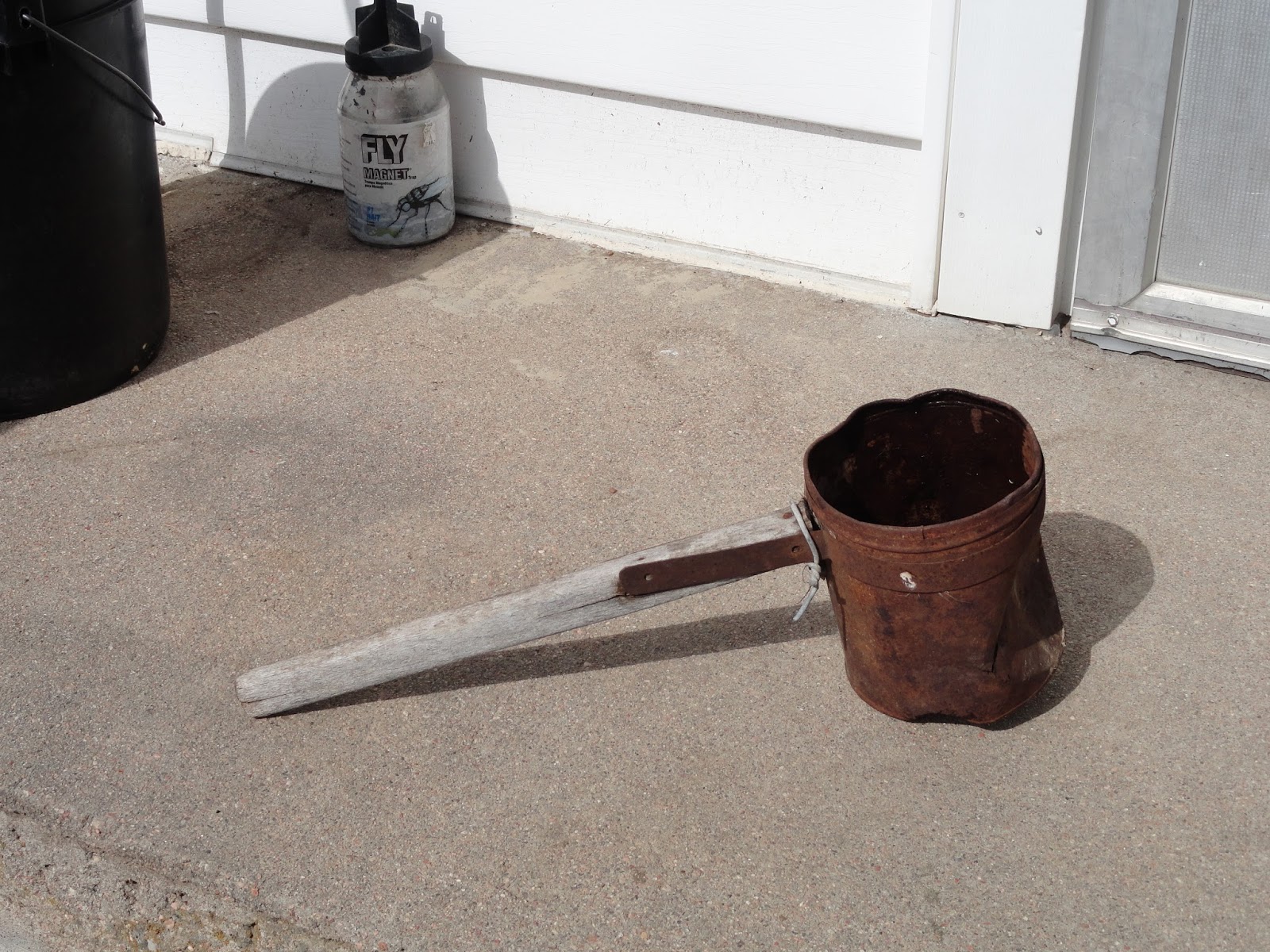
     A special dipper, a handle on a lard can, was used to dip the water from the rinse tubs into the washing machine until the tubs were light enough to lift and empty into the washing machine, and the rinse water followed the wash water out the door.


      The washing machine and rinse tubs were then rolled back onto the porch where the clothesbaskets would join them after the ironing, folding, and stowing of clean clothes were all done.  In those days, folks ironed the sheets and pillowcases.  Mom got a “mangle” that was 110 volts. (I’m thinking the Maytag washer must have been 32 volt and converted to 110 after the arrival of the REA.)  The first few times she used the mangle, it was up at our neighbors to the north, the Pratts, who got electricity some time before we did.  The mangle was used mainly on the sheets.

      The mangle rests in its corner in the basement waiting for someone from Antiques Roadshow to discover it.
    I remember two incidents involving washday.  One day I was standing on a chair by the washing machine playing with the hose that was spouting hot water into the washing machine.  Somehow, the hose got lose and the stream of hot water hit my bare belly.  The water was so hot it blistered my skin.  It was the first time I remember using Burn Allay.  I can still smell the greasy stuff.
     My second memory, the one that brings up floor number one, was once when a neighbor girl was hired to help with the housework and the children.  It must have been Monday.  Sue was in charge of the washing and I was helping her.  
     Somehow, something went amiss, the drain hose got knocked off its perch, something.  Water ran all over the floor before Sue saw it.  Pandemonium. The leak was corrected, and then the mopping and containment began.  I remember the water running towards the refrigerator and the door.  Sue allowed, after it was all over, that the floor wasn’t level.  That “first” floor was the one that got flooded.

     Over the years, the other three floors came and went.  Apparently, they weren’t dangerous to remove, dangerous meaning full of asbestos fiber.  Conventional wisdom says the black stuff contains asbestos and should be avoided, particularly the dust produced during the removal. 
     Standard practice calls for covering up the asbestos-laden surface with a thin underlayment, which is what the previous installers did.  The only sign left of floor number two is in the threshold between porch and kitchen.  The remnants of floor number three exist only as counter top of the cabinet and a shelf in another cabinet.
     Like many jobs, the actual work isn’t so bad once the preparation work is done.  In this case, the refrigerator and the wood-burning stove got moved to the dining room sometime in February or March.   The big gorilla, the kitchen range, oven, dishwasher succumbed without too much trouble.    


     Floor number four is now gone.  New underlayment and floor number five are in the works.  I’m not exactly in on the ground floor with this project, but these things do happen eventually, when it is too wet to farm. 


Sunday, May 15, 2016

The Eyes Have It

      Myasthenia gravis.
      Ocular myasthenia gravis, to be more precise.  It’s what the doctor said.
     It all began a little over two years ago when I could no longer focus on close up work, like reading the fine print, over the top of my glasses.  I had to resort to the bifocals for close up work and use more light.  Well, I am getting older, I thought.
      I called on a series of doctors, starting with an optometrist.  When, after new lenses and new frames, the conditioned worsened, I called on an ophthalmologist who made monthly visits to the local hospital.  He said I was suffering a condition that many people went through in their forties.  I didn’t much believe that.  He told me to come back next year.
       I got along for a year, but by that time, I was having trouble focusing both eyes in the upper portions of my glasses.  The inability to coordinate both eyes was working its way slowly down.  I could still see very well through the bifocals.  My right eyelid was beginning to droop by this time.
     The first ophthalmologist was no longer on the staff at the local hospital, so I made an appointment with a Loveland ophthalmologist.  Except I couldn’t see him until I had seen his optometrist first.  If there was a problem, I would be referred to the big guy, the receptionist assured me.
     No problem, the optometrist said.  They could correct my double vision with pyramids in my right lens.  My ability to read, which was still good, might be screwed up by the pyramids, but I could get reading glasses. 
     I am not so concerned with correcting my vision as I am concerned about what is causing it to deteriorate, I explained.  No answer, except the hint that I was getting older.  Was I having other problems?  Yes, thyroid issues.  So he wrote a report to be sent to the endocrinologist who was dealing with the thyroid problem.  Let him know if I wanted to try the pyramid lenses.  Come back in a year. 
      One more time the endocrinologist opined that the thyroid problem was not the cause of the eye problem.  For sure, I did not have Graves’ disease, a thyroid disease which does affect the eyes.  She referred me to another ophthalmologist.
     The one she referred me to was booked for three months.  Would I accept one of his associates, also an ophthalmologist?  Yes I would.  A few hours later, the office called back advising me that they would like to change my appointment to another doctor who was more familiar with the drooping eyelid problem.
      At that visit, a pair of young folks ran me through the standard visual checks, blinded me with piercing light beams, questioned me about my condition.  They departed saying the doctor would be in soon, except they returned in about ten minutes and said they would like to change whom I was going to see.  Another doctor was available who could address the whole eye issue, not just the droopy lid problem.  Yes of course, I concurred.
      This fellow got to the root of the problem and gave the best answers to my quest for a cause of my eyesight deterioration.  He said it could be a blood vessel problem.  If so, the body would eventually restore circulation and the problem cure itself.  
       He was diplomatic with his second possible solution:  I might have celebrated too many birthdays, he said.  The third possible cause was a disruption in communication between nerve and muscle.  He wanted to wait a few weeks to see if the condition changed.   
    I made an appointment for January 11.  In the meantime, I found a date to swallow a radioactive pill to destroy the growth on my thyroid, a date where I could be outcast and unclean for five days.  I had to stay away from others for five days while the radioactive stuff left me. 
      The date was January 6.  I was cleared to be around adults, but not pregnant ladies or young kids.   I called the ophthalmologist’s office to be sure none of the caregivers was pregnant.   “Oh,” the receptionist said, “Dr. Arnold is a pediatrician.  His waiting room will be full of kids.”  We cancelled my appointment.  She didn’t offer to reschedule and I didn’t insist.
      In the meantime, I did call on our “family” doctor for my first visit.  He heard my story, examined my eye, and ordered an immediate MRI, fearing there would be a tumor somewhere in my head.  An hour later I was in the imaging chamber being entertained by a chorus of jackhammers.  Loud jackhammers.
      Two days later, in a follow up visit with the doctor, he gave me the news my dad could have told him a half-century ago:  the examination had found nothing in my head.   (Whenever we did something stupid as kids, Dad always said, “You ought to have your head examined.”  I finally did, and sure enough, they found nothing in there.)
      Dr. Prows decided we needed a neuro-ophthalmologist to get to the root of my problem.  He found only two and sent me to one in Aurora in the University of Colorado system.  I thought I had an appointment with a Doctor Bennet, but when I checked in, the receptionist told me I would be seeing Dr. Pelak.
     This time, a young man came through the double doors, called my name, escorted me to an examining room where he checked my vision, asked me questions, and recorded my answers and his impressions by tickety-tacketeying a hundred words a minute on the computer keyboard.
     Dr. Pelak turned out to be a comely young lady who said she had 17 years’ experience as an ophthalmologist.  It is hard to believe she has been out of high school 17 years.  More to the point, she knows her business. 
     She looked at the MRI images and pointed out the muscles in my right eye, the lower muscle about twice the size of the upper one or either of the left eye muscles.  She thought the swollen muscle prevented the eyeball from rolling up, thus he focus problem in the upper part of my vision.  Later, she would ascertain that the eyeball was free to move by numbing the eye, then using a big Q-tip to force the eyeball up.  After she was done, she said many ophthalmologists would use a forceps to grip the eyeball and move it.  I thanked her for using a Q-tip.    
     Dr. Pelak suspected I had myasthenia gravis.  It was Dr. Arnold’s option three, interference between nerve and muscle.  Here is how I understood her explanation.  When the brain sends a message to a muscle, the nerve uses a juice to reach the muscle.  The muscle absorbs the juice and contracts.  The brain says “open eyelid” and the nerve sends the juice.  When the brain says “relax eyelid”, the nerve stops serving the juice.  Along comes the janitorial staff which mops up the juice and sends it down the body’s waste system.
      In myasthenia gravis, the body produces antibodies probably in response to another problem elsewhere, like my thyroid hyperactivity perhaps.  The antibodies ally with or stimulate the janitorial staff.  The nerve juice gets cleaned up and shooed away before the job is done.  So the eyelid doesn’t go up.
      The condition can affect other muscles, arms, legs, diaphragm (breathing problems) and swallowing muscles.  Statistically, I have about an 85% chance of having other muscles affected.  If other muscles haven’t been affected after two years from onset, the chances of other muscles being involved drops significantly.   If left untreated, the “gravis” part can come true.  A victim can end up in the grave.  Modern medicine to the rescue.  The antibodies have to be suppressed.     
     Dr. Pelak had me try pyridostigmine taken four to six hours as needed.  It helped get my eyelid open, but didn’t do much for my focus problems.  I still have double vision.  I also had to return to the MRI for better pictures of my “orbits” and because myasthenia gravis can be caused by a growth on the thymus gland. The thymus got a clean bill of health, but the image revealed a “nodule” on my adrenal gland.  I am referred back to Dr. Prows for that problem, if it is a problem.
      Irreparable muscle damage can occur if the antibodies aren’t suppressed.  Dr. Pelak demonstrated by using her fingers to represent the muscle surface where muscle and nerve interface.  The rough muscle surface allows a lot of area where the nerve juice can contact the muscle.  Left untreated, the antibodies can result in the muscle surface smoothing over like the surface of cold gravy.  There is much less surface for the nerve to contact the muscle.  The muscle function is greatly reduced.          
     She gave me two options to try in addition to pyridostigmine.  One is Imuran.  I will probably end up taking that or something similar for life.  It is rather slow acting.  I reluctantly elected to try prednisone for a time for a faster “cure” for the double vision.  The idea is that once the double vision is fixed, I will quit prednisone and go to another drug less harmful to the rest of the body, probably Imuran.
     I can only think that now if I want to try out for the Rockies, I won’t get past the drug test.  I am on steroids!  Plus, I have seen folks who are taking prednisone.  They don’t look healthy.
     For one glorious year, I went through the day without taking any pills.  Then I took a blood test.  My calcium was low.  Start taking calcium again. 
      I am in the early stages of getting the right dosage of Synthroid.  The radioactive iodine got rid of the thyroid nodule, and the gland’s ability to produce.  Add to the Synthroid the two pills for my eye, and the Zantac for stomach upset and the selenium to counteract the steroid, and I am a walking pharmacy.
      For now, it seems I have succeeded in my quest to find the cause of my eye problem.  In the process, I nearly lost my respect for the medical profession.  With the help of a couple of good doctors, my faith is partially restored.
     Now, if you have read this far, reward yourself with a gold star for listening to yet another old goat discuss his medical problems.  A bourbon and Seven might be in order, but I think you don’t need to dig out the Tylenol PM.  You are probably half-asleep already.


Sunday, May 8, 2016

Springtime on the Prairie


     It’s May.


       The yard decorates itself for a visit from Royalty, if purple is the color of Royalty.


      With some yellow thrown in.
  
      The rain gauge recorded .75”.  It didn’t capture much of the ten to sixteen inches of heavy wet snow.  Roads were nearly impassible, not with snow, but with mud.  It’s a rare year.  I can remember only one or two springs this wet.
     Now of my three score and ten, 68 will not come again, So about the yard I will go, tying to learn to enjoy yellow and purple "flowers." (With apologies to A. E. Housman)

Sunday, May 1, 2016

Culvert

     This is a story of two boys.  The names have not been changed to protect the innocent.  There are no innocent.

     Jake and I were born about four days apart.  The first birthday party I can remember was probably his fourth or fifth birthday.  We visited school together pre-first grade.  We went twelve years to school together.  We rode the school bus together.
    Our first bus was a 1940’s Chevrolet panel wagon with windows.  Oliver, our bus driver, kept us separated because together we squirmed and wrestled and made life miserable for the other passengers.  One of us sat beside him in the front seat, the other in one of the back seats.
     It was our custom to “stay overnight” with a friend.  I spent a few nights with other schoolmates, but I stayed with him, or he stayed with me more than with any others.
      Jake’s dad Ed was sort of a gruff old guy.  He used a lot of forbidden cuss words in ordinary conversation.  When I was a kid, I was a little afraid of him, but as I grew, I learned his bark was worse than his bite.  He smoked Camel cigarettes.  He bought them by the carton.
      One day when a carton of Camels was about half empty, Jake lifted a pack, figuring Ed wouldn’t notice.  Jake confided in me.  We planned.  On a Friday evening, I spent the night with him.  On Saturday morning, after our fill of watching cartoons on their new television (all televisions were new in those days), we threw on overcoats and overboots and headed for the culvert.
      Jake’s place was about a hundred yards south of what is now Road 3P.  3P crossed the Lickdab just west of their driveway.  There once was a rickety bridge there.  The road made a curve there so the bridge could cross the creek at right angles.  The curve and the bridge were both road hazards.  The county replaced the bridge with a six-foot tube and straightened out the road when we were in second or third grade.
    Going to the culvert was not unusual for us.  It was a neat place that could be anything we wanted it to be, a bomber, a submarine, a cave.  This morning our game wasn’t imaginary.  Jake had stowed the Camels and a packet of matches in the culvert, ready for us.  Safely out of sight in the culvert, we opened the pack of Camels, took a cigarette apiece, and lit up.
     No, neither of us got sick.  I’m sure it was not the first encounter with tobacco for either of us.  One was enough, though.  We left the cigarettes and matches in the culvert, thinking there would be another day.  There wasn’t.  I left for home that afternoon.
     Sometime later, when I suggested we could go get another hit, Jake sadly reported that he had visited the site and the cigarette pack had slipped to the culvert floor and the cigarettes got soaked up with water and were no longer any good.  Shucks!   
     So that was that, at least so I thought.  Fast forward fifty years.  At an alumni gathering, I am visiting with Jake’s older brother Rod.  Jake always idolized Rod.  Rod was probably ten years older than we were.  He joined the navy out of high school and served on an aircraft carrier.  He went a lot of places, particularly, Japan.
      In those days, Japan was known to us as the manufacturer of cheap toys that usually broke before you could get them out of the box.  Rod changed our mind about that.  He brought from Japan a neat pair of binoculars and the first transistor radio any of us had ever seen, from Japan!  When leave was over and Rod returned to duty, the radio became Jake’s radio.
      It had an earphone.  Here was another opportunity to listen to the World Series in class without the teacher knowing. It had an FM band.  There weren’t any FM stations then.  It also had a short wave setting.  Once in awhile we could hear somebody talking over the short wave band.
        Rod and I are visiting at the alumni banquet, probably in 2011 or 2013.  He tells me he has a sort of funny story to tell me.  It’s something his dad shared with him.  That had to be an old story.  Ed died in ‘66 or ‘67.
     Ed told Rod he saw Jake and I headed for the culvert.  Nothing unusual about that.  A little later he glance that way and saw something quite unusual—smoke coming out of the end of the culvert!  Ed laughed.  Those dang kids!  In the culvert smoking cigarettes, thinking they were pulling the wool over anybody’s eyes!
     Rod laughed.  I laughed.  But I was thinking:
     Busted!  And I didn’t even know it, for fifty years.
     Here’s another Japanese import, less well-known than the high quality electronics that became Japan’s trademark in the 1960’s and beyond.

     Atama kakushite,
    Shiri kakusanu.

     Literally translated, it says, “Head covered, butt uncovered”.  There is no witticism, no Poor Richard wise saying in English for that Japanese quip.  It refers to a toddler who “hides” by covering his head with a blanket while leaving his bum exposed.
      We were beyond toddler stage, Jake and I, but we left our bums exposed in that culvert on that Saturday morning long ago.  I’d like to say it never happened to me again in my life.  Such a statement would only be one more unsuccessful attempt to pull the wool over somebody’s eyes.
       I’ll give Sir Walter Scott the last word:

      Oh what a tangled web we weave
     When first we practise to deceive.


Sunday, April 24, 2016

Ernie and the Pilot

      Missing.
     It made the radio headlines for a day or two, probably some television news stories, maybe a newspaper or two.  A private pilot in the Colorado Springs area took off from a small airport popular with small plane owners, Meadow Lake Airport or something similar. His destination was somewhere in Nebraska.  He was flying a small experimental plane, probably one he built himself.  He failed to arrive at his destination.
     The story had a brief follow up three or four weeks later.  A rancher found plane and pilot in his pasture some forty or fifty miles east of his departure airport.  The rancher had been on a routine cattle check when he came upon the wreckage.  The FAA or NTSB was investigating.
      The story would have crawled under the rocks and yucca plants of my memory and composted into the landscape, but for a turn of events.
      The Lutheran churches in our small communities are served usually by “supply” pastors (euphemism for guys who aren’t too good at their job, maybe down on their luck, maybe looking for a short-term job to get them to the point they can retire) or young folks fresh out of seminary.  The small churches can count on a different pastor every two or three years. 
      The old guys go on to retire or find another interim job somewhere.  The enthusiastic young guys and gals who are good at their job get gobbled up by the big churches somewhere who can afford to pay a decent salary.  The not-so-good ones may stay around for up to three years before the congregational bell-cow (or surly bull so as not to be sexist) and followers raise enough hell with synod authorities to get them sent on their way.
      Thus, Ernie came to town, fresh out of college, young, energetic, friendly, engaging, popular, with a young wife to match.  She taught music in a neighboring school district.  They had no children at that time.
      They both were from somewhere north and east.  We said they had a Wisconsin accent.  They said words like “soary” (“sorry” that rhymed with “soar”) instead of “sarey” (to rhyme with “are), the correct way to say it (in our Eastern Colorado opinion).  They almost said “aboot”, meaning “about”, but not bad enough for us to accuse them of being Canadian.  It didn’t really matter.  We loved them anyway.
       They could have been from North Dakota, too, but they were probably from Minnesota.  That was fine.  After all, we have roots in Minnesota, too, “ya know.”
      Mom or probably the Goodwife decided it would be a good idea to invite Ernie and Wife out to the farm on a weekday evening for a barbecue.  I think the menu was Japanese, including teriyaki. 
      This time, chicken accompanied thin-sliced beef on the charcoal grill.  I was young in deed and not experienced in grilling chicken.  I knew it had to be done well to insure no one suffered from salmonella.  Not a chance.  These bite-sized pieces could have been substituted for the ball on the rubber string on a paddleball toy.  It would have bounced as well or better.
     Pastor Ernie was of good Scandinavian extract and didn’t allow his occupation to interfere with sipping a beer or two before and during supper, so it was a pleasant evening, vulcanized chicken notwithstanding.  The beef, fried rice, and cucumber salad were palatable.          
      A good storyteller, Ernie got started on telling us of a very recent experience he had had.  Among his flock was an undertaker. His father was a competent ambitious man who bought a small funeral home in a neighboring town.  He purchased the Limon facility and relocated.  He also bought a few other homes down I-70, as far as Burlington.  He closed them all except the ones in Limon and Burlington.  He was the only funeral facility in much of Eastern Colorado, Brush being the closest one to the north and Lajunta or somewhere to the south.
     The funeral director was a stalwart member of our Lutheran church, as was his son, who took over for his father. The son became a good friend and supporter of Pastor Ernie.  The day came when the son had two or three funerals on the same afternoon, all out somewhere in the big outback.  His staff was stretched thin.  He needed someone to answer the phone at the main headquarters in Limon.  He prevailed upon friend Ernie.
     Ernie could sit in the funeral home office and work on his sermon or do whatever pastors do when not visiting or counseling parishioners, while maintaining church office hours.  The telephone would probably not even ring.  Sometimes, three or four days go by without a call, the mortician assured Ernie.  Somebody would be back in the office in three or four hours.  Shouldn’t be any problem.
     Ernie acquiesced.  He hadn’t sat in the funeral home office chair long enough to warm the seat cushion when the phone really did ring.  The El Paso Sheriff’s Office was on the line.  They needed the coroner or his representative at an airplane crash site as soon as possible.  (In rural areas, the mortician often doubles as the coroner.)  Ernie tried to explain the situation.  He had no experience, was only the answering service, couldn’t do any investigation.  The Sheriff insisted.  There wasn’t much investigating involved, but there was a body to be removed.  You are the representative.  Get out here, now.
      What to do?  Ernie turned to another parishioner and friend, Tom.  Tom came to town as the manager of the local Co-op Grain Elevator.  When it folded, he opened his own grain brokerage.  Later, he would run a used car business and oversee a successful mechanic shop associated with the car business.
     A young lady came to town to teach grade school.  She was a lifelong Lutheran.  She joined the local congregation soon after moving to town.  When she and Tom met and hit it off, he joined the church, too.  They became pillars of the institution.
     Tom, like Ernie, tried to find a way out, but friendship and duty overrode his protestations.  Together they dug out a spare hearse.  They equipped themselves as well as they could in their inexperience, taking gowns, gloves, masks, body bag, anything they could think of they might need.  This was the days before cell phones.  No way to call the mortician and ask for advice.
     It was also the time before GPS.  Following the Sheriff’s instructions, they headed west on 24 until they came to the deputy’s car.  He directed them down a county road to another deputy, who opened a gate and pointed the general direction to follow.  Ernie and Tom bounced the hearse across the prairie into endless grass and sky.  Dodging creeks and soapweed, eventually they saw yet a third police car, sitting on a hill upwind of the crash site. Lights flashing, the deputy and his car kept bovine and avian gawkers from the wreckage.
     As they approached, the deputy got out of the running air-conditioned car.  Tom and Ernie approached the deputy to find out what the deal was.  He pointed and said the body was in the mangled airplane downwind below.
     “What do we do?”
     “Get the body out of there.”
      “Can you help us out here?  Neither of us has any experience in this sort of thing, being a pastor and a businessman.”
     “Your problem.”  Just like the hard-boiled New York cop on television.  The doughnut eating one.
     As they approached the wreckage, they understood the deputy’s upwind distance from the site.  Donning robes, gloves, masks, preparing the body bag, they procrastinated as long as they could.  Nobody came to their rescue.  The deputy braved the hot day, standing outside of his air-conditioned car as he watched from a scent-free distance.
       The face masks may have protected them from infestation, but did nothing to reduce the stench.  Eventually they set about maneuvering the decomposed remains out of openings in the mangled metal.  They knew nothing of odor reducing sprays.  They brought no tools.  With whatever pieces they could find in the wreckage they managed to get the remains out of the wreckage and into the body bag and the bag loaded into the hearse.  The body bag contained the odor fairly well.
      Ernie spared us the details.  We were after all enjoying a meal and its aftermath.  One of the things that made him a good preacher was his ability to tell a story.  Our horrified imaginations supplied the missing details.
      The boys retraced their route across pasture, down county road, along Highway 24 and back to the funeral home.  Sure enough, a staff member was there to hear their story and take over from there.  Our boys returned home to strip, throw their clothes in the laundry, jump into the shower to try to wash away the day’s events from their memories as well as their bodies.  Supper didn’t really beckon to either man.
      All this Ernie told with a glint of humor and amusement, but it was apparent that both qualities came after the event, certainly not during it.  We had listened attentively, our imaginations titillated by those missing details.   The story wasn’t quite done.
      About a week or two later, the mortician called Ernie with an invitation:   “Care to ride along to Brush with me?  Your pilot friend has an appointment with the crematorium.”
     Ernie had decided during the gruesome part of the adventure that if the funeral director ever called again, he was busy, couldn’t possibly get away. He stuck to his guns and declined the invitation.  The coroner / funeral director supplied a bit more information.  An autopsy revealed that the deceased pilot had suffered a heart attack, was probably dead at the time the plane impacted the ground.  At most, the crash administered the coup de grace, but was not the main cause of death.  Case closed.  No need for the FAA to investigate further.
    The story over, we went on to other subjects. Our pleasant evening came to an end.  Ernie stuck around another year.  The school where his wife taught closed its doors for good.  Ernie got an offer for a much better job.  Time marched on.  We got a Christmas card or two.
    Now, we remember Ernie not as that young Lutheran preacher, but as the man whom fortune crowned Coroner-for-a-Day.”


Sunday, April 17, 2016

Weather

      Everybody talks about the weather but nobody does anything about it.  
      Perhaps we don’t do anything about it.  But we do lots because of it. 
     I put in 30 Colorado Blue Spruce trees this past week, all replacements for last year’s failures.  It seemed a good time to do it in light of the predicted weekend blizzard. 
       I scattered some grass seed on a couple of bare spots in the yard.  I covered the seed with a light covering of composted soil to keep the seed in place until it could get covered up with snow.
      I put out a couple of rows of radish / carrot seed mix in hopes that the forecasted snow would sprout them and have me crunching a radish or two come June.  In other years, I would have buried some pea seeds, too, but other projects demanded my time and my diminished supply of energy. 
     The asparagus patch beckoned.  It had a good mowing a couple of weeks ago.  The last of the snow bank had only just melted off the first of the week. A few clod eruptions here and there signaled its intent to burst forth.  Just in time to get nailed by the incoming weather.
    Wait!  Here and there was a spear sticking out of the ground.  My inability to tell green from brown made it a difficult task, distinguishing a fresh new spear from the stub of a stalk from last year’s crop, but I grabbed a pan and knife and gathered enough for a small batch.  I cut anything I could see sticking above the surface, even the smallest heads, knowing the cold temperatures would turn the crisp green spears to black jelly and set the crop back to day one.  My lunch was a reward for my labor.  
     If the weather reports were right, I had to choose whether to leave Friday afternoon, or wait until Monday to return to my home near the front range.  Saturday and Sunday travel would be difficult to impossible.
      Parts for my broken down tractor have yet to arrive.  I couldn’t hole up in the shop and work on the tractor during the blizzard.   I had an appointment or two scheduled for Monday.  I left Friday afternoon.
     The Goodwife was expected in Denver Saturday morning to help make corsages or some other creative flower thing.  I told her she should call her friend and tell her she wasn’t coming.  Heeding my advice as usual, she set off about 8:30.  It was raining, not snowing.
     About 45 minutes later, she called saying she was turning around.  The further south she went, the worse the weather got, some snow accumulating and slush on the roads. 
     A few hours later, we still had no accumulation, but apparently Denver had quite a little, causing airport cancellations and delays.
      My good farm neighbor called in the afternoon to report an overnight rain of maybe as much as an inch followed by about ten inches of heavy wet snow through the day, with little wind.  The moisture didn’t turn to snow till after daybreak, he said.  The trees were threatening to break under the weight of the snow that no wind blew off.  
     
      There’s probably a reason no one tries to do anything about the weather.  I remember a dry spell in the mid-sixties.  There was a guy called himself Doctor Crick, or something similar.  He was trying to drum up support from the farmers, promising he could make it rain.  He shot cannons of something, silver iodide maybe, into the clouds.
     He put on a few demonstrations, I think, though I never attended one.  Then came May or June of 1965.  Heavy rains fell.  Floods wreaked havoc.  Highways and roads washed away on mountain and plain.  Cabin Creek all but disappeared.  Deer Trail silted in.  Concrete pillars set up to support I-70 across creeks and other roads and railroad tracks east of Denver washed away.  Rumors of motorists and their cars vanishing in the deluge persisted.
     Doctor Crick must have washed away, too.  I never heard of him again.  I always suspected he vamoosed in fear of being held liable for the flood damage.  Maybe he realized nobody needed his services and left the country.
    More recently, maybe ten or fifteen years ago, some government body or other was conducting “weather modification" experiments.  They were flying specially equipped aircraft  around thunderstorms that threatened to become severe.  They had, or thought they had, evidence that silver iodide reduced the severity of a storm and maybe prevented tornadoes and hail from forming all the while inducing kinder, gentler rain.
      It also was a dry time on the plains.  Far from seeing cloud seeding as a beneficial rainmaker, some of the local farmers (Western Kansas farmers that is) were sure the cloud seeding was having the opposite effect.  The proof was watching a thunderhead approach from the west and either blow over in a dry dusty blast of wind or skip around to the north or south while dropping nary a drop of moisture.
     That never happened before silver iodide treatments began, they implied.  They got mad, held meetings, made demands.  Farm Bureau got involved.  Other insurers were quite interested in the experiment, hoping the treatments would reduce hail losses.  Farm Bureau sided with its members.
     Initially, the scientists tried to explain what they were trying to do, but ultimately the airplanes quietly withdrew, going west and south to friendlier territory.  Mother Nature returned to unrestrained flinging of wind gusts and lightning bolts.  If there were results of the weather modification, I never heard what they were.  Interest waned with the airplanes’ departure.
    There was one interesting tangent from the furor.  In the wake of the cloud seeding brouhaha, many of the locals signed on to the “chemtrail” conspiracy theory.  The theory claimed that high altitude aircraft were spraying the country with dangerous chemicals.  The proof was the contrails left by the high-flying jets.  They are not passenger or military aircraft but tankers spraying deadly chemicals over the populace. 
     Who is behind the poison sprayers?  Some theorists insist it is our very own government, while one local family insists China is behind it all in an attempt to do irreparable harm to our country.  Local gossip says the family stays indoors as much as possible on days when contrails are abundant.            
     The movement reached its peak (maybe) when a small group rented a film and hired the local theater to show it.  Ads and letters to the editor in the local paper urged us all to attend.  I didn’t attend.
      Living in a small community, I have learned, or tried to learn, to keep a closed mouth when such controversial subjects arise.  (Never discuss religion or politics with your friends, or they won’t be your friends for very long.)  Many of my rural friends did attend the movie and subsequent meetings. One of them was a Certified Flight Instructor who gave me a couple of flight lessons when I was learning to fly.
      Mark Twain or Charles Dudley Warner or whoever came up with the observation that folks complain but never do anything about the weather, correctly characterized human nature.  Sometimes, there is a good reason for such human behavior.
      It’s probably not a good idea to try to do something about the weather, unless you like being the cause of controversy.