Sunday, May 12, 2013

Mother May I

    Hey, it’s May.  Mayday on the farm looked like this:


     I had a guest. But he really couldn’t stay.


     He came flopping through the snow right in front of the kitchen window about 6 p. m.

    May 2 brought a little sunlight, an end to the snow anyway.


     I had to head back to Kansas to get ready for the barbershop show on Saturday.  We returned to the farm on Cinco de Mayo.  The wheat seemed to enjoy the cold and wet.

 
     Back to the field with me and the plow.  That worked well until Wednesday, when the rains came.


     The birds enjoyed it.  I had to keep the wood stove going.  My feathers didn’t keep me warm.


     The dandelions and mustard enjoyed it, too.  It is kind of pretty if you can set aside your prejudice, knowing they are all weeds.


    May 11 brought everything from clear blue skies to weird clouds and more rain. 


     May has to be one of the best of months.  Start the day in hooded sweatshirt, strip to shirt sleeves, don a slicker in late afternoon.  Pick some fresh asparagus and have it for supper. Take a front row seat at Mother Nature's moving show.  All done without insect repellant.


Sunday, May 5, 2013

Tulips


     The tulip is the best of flowers, at least for our area.  Its plusses:  easy to grow, pretty blooms that last a fair amount of time, and perhaps best of all, when they are done, they retreat into the sod and you can run the lawn mover over them (well, over their “grave”, because after June you can’t find a trace of them) all summer long.  Then, in the spring, as early as February, up they come to remind you that life will continue when you most need that reminder.
     The “ancient pulse of germ and birth” will go on.  (Thomas Hardy “the Darkling Thrush”)
  
  One problem with tulip-keeping:  In the spring, you see that one group needs a few more, or a few less plants.  Can you remember which group needs help or where that group is located when fall rolls around and it’s time to dig up the bulbs, split them apart and replant in time for the bulbs to go through the winter freeze necessary to get them to grow again next spring?
    I guess you could dig them in June between their demise and the disappearance of any evidence of where they are planted, but I’ve never done that.  There are always too many other things to attend to at that time of the year.
      I do have a map of the big producers, just south of the garage.  They are 54 inches south of the garage wall, and 50 inches east of the east door jamb.  The ones separating the yard from the circle drive (all in buffalo grass) are planted in little bowls in the sod where shrubs of 30 years age failed to take root.  I can find them.
    But then there are the ones north and south of the cement driveway leading into the garage, and the ones under the faux pear tree, and the ones in the ditch by the old roadbed leading from the county road to our yard.  The grass does its job of sealing over the site of the dormant plants so remarkably well, I can never come within three feet of locating them. 
      Most of those exposed sites could use a few more bulbs.  They don’t have the easy life of the garage tulips which benefit from the garage’s protection from the spring’s harsh north winds while receiving ample moisture from the garage roof snow slides that apex 54 inches from the garage wall, plus the benefit of southern exposure to winter sunlight.
    So every two or three years, I dig up and thin out the garage tulips which have become overgrown and crowded.  Then I try to find a place to put all the extra bulbs.
     Well, this was not a good year for tulips.  We should be in full bloom this time of year, but . . . .


     Normally, the snow and cold doesn’t set them back, but April’s record lows and duration of the low temperature pretty much did them in this year.

 
      But a few hardy (not Thomas) souls persist.  I predict that yellow tulips will survive the ice age, while the red and blue (probably purple for you color-sighted folks) ones will go extinct.


     Actually, these fellows (gals?) probably were the ones that slept through the alarm and showed up to work late, thus catching the destructive cold weather at a less vulnerable time.

       Blessed be the tardy for they shall inherit the earth?

Sunday, April 28, 2013

April Snows

     Time to begin farming again.  Past time, actually.  But with the lack of moisture the past few years, you have to think about breaking out any more grass.  If it’s going to stay dry, it’s as easy to have no crop without tilling the earth as it is to put all the work into breaking out the sod and still having no crop.  It takes a lot less work to keep it in grass.

    But, we have had a few drops of moisture.  The wheat planted last fall doesn’t look too bad for all it has been through.  (Here, an acquaintance pointed out, goes my native pessimism.  “Doesn’t look too bad” is in the negative.  “Looks fair to good” would be the more positive way of stating the wheat condition.)


     The late cold weather had less of an effect on the wheat here in Eastern Colorado than it did in Kansas, where the development was farther along.  A Goodland, Kansas gardener who writes a column in the weekly newspaper compared this April with last April.  Last year, he had early spring crops, radishes, peas, growing full tilt.  This year, the soil is so cold that as of the middle of April, nothing had begun to grow.
     But some moisture tagged along with the cold weather.  So, time to finish breaking out the sod.  One of the biggest reasons I am two weeks overdue is in a way related to weather.  We had a barbershop program planned for March 23.  It snowed out, blizzarded so bad that I 70 was closed. 
     We rescheduled for May 4, which meant we had to continue practicing.  Then, we had another program to do in Sharon Springs on Sunday April 21.  I took off for Colorado on Monday April 22 in misty drizzle.  I experienced a great variety of weather on my trip to the farm, from spotty sunshine and balmy temperatures (the fifties) in Burlington, to the fog and drizzle I left.
     The sunshine gave way to overcast.  By the time I reached Genoa, the tops of the windmills were hidden in cloud.  As I reached the farm, the giants had disappeared entirely.


  By Monday evening:


     Tuesday looked like this in the morning:


         And like this in the evening:


     Note the nearly-full moon playing at being a mole on the roof’s cheek.

     Not the best farming weather, but very welcome moisture, of course.  It was nice enough that I could lay out the course for another row of bushes north of the yard.  The old Ponderosas are losing their lower branches and don’t provide the wind protection, they used to.  Overboots and coveralls separated me from the unmelted snow, mud, and chilly air.
    Wednesday evening brought another little shower and some weird skies, but the snow was pretty much gone.


  Even Pikes Peak donned a rarely-used coat for this late spring weather. 

 
       I might be tilling the soil by now, but there’s this barbershop thing in Denver, a district convention with lots of singing and fun stuff to do.  Oh well, I guess the farming will wait.

Sunday, April 21, 2013

Piddler on the Roof


     Never say “never”.  Some months ago, I said I’d never do another roof.  It’s time I start acting my age.


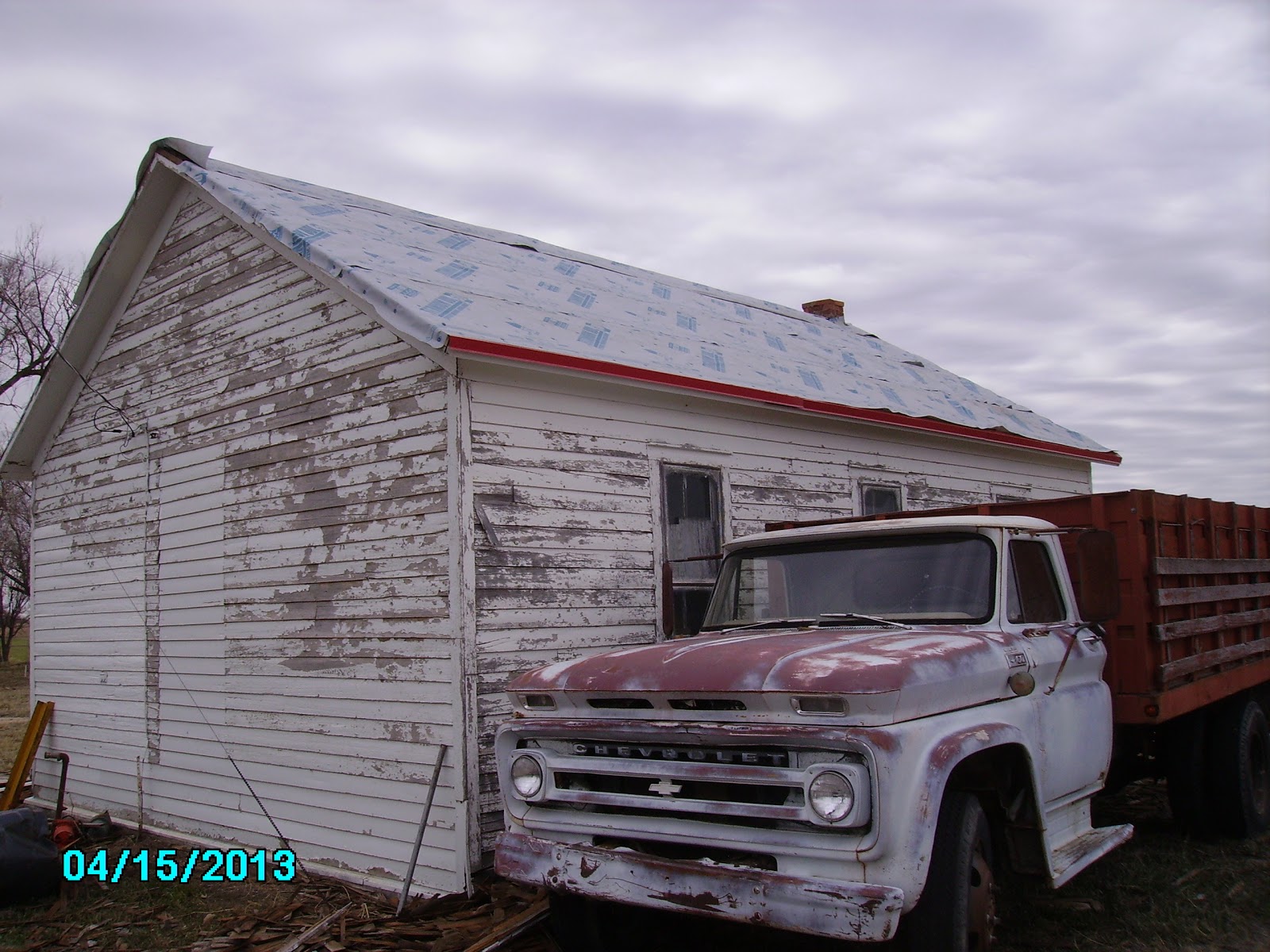
 Load up the scaffold, drive out into the country, and there I am up on a roof with two layers of old wooden shingles and several pounds of dust.  


      The millions of small-headed nails used to fasten the old shingles to the roof outweighed the shingles themselves.  When you get to this point, you still have to deal with the nails.


  You can hammer the nails in.  We pulled most of them.  They have to be out of the way before applying the fabric.


    Day one wasn’t too bad.  We got the shingles off and the “paper” on.  Day two was another story, with 30+ mph winds stirring the dirt up into our faces.  We had a truck to catch the falling leaves, but the wind sailed half of them to the horizon.

 
    The wind also made laying the fabric a challenge.  We persevered.  The wrinkles on the lower right of the roof are due to the wind making it difficult to stretch the stuff tight. 


    Day three was still windy and unsuitable for handling thirteen-by-three feet sheets of metal. 
    We spent half of day four gathering shingles that had been sowed to the winds (south on day 2 and north on day 3) and picking up the big pile we created when we did not have a truck available.  A front end loader on a tractor helped immensely.


    And then it was all clean.


     We had a pretty good truckload for no bigger than the roof was.


    Up went the metal.  It took a little over two hours to get the metal on this side.  The only cutting was for the chimney.
     The next day was back to wind again.  It took nearly five hours to do what we had done in two the day before.  Again we persevered and the roof blushed for us.


    Mother Nature added a little snow and ice to go with the wind for the next two days.  Just a few pieces of trim remain.  But, the chimney took a lot of time, with flashing and replacing mortar between bricks, etc.

 
     Sorry, the photographer was a brick short of a full row.


   Another hour and a half loading up tools and running the nail magnet brought the project to a close.  Or so I thought.

       Come Saturday morning, the old truck refused to hoist the bed, so the load of shingles had to be removed by hand, shovel, and pitchfork.  But the wind was light and gravity was on my side this time.  Maybe I am done now.


Sunday, April 14, 2013

Post Straightening

     Something there isn’t that doesn’t want to go straight.  Lightning.  Snakes.  Politicians (some).  And some posts.


    Here is the original “column” which was replaced by this one:


     The original one actually got straightened out via the chain and the bumper jack.  But over the course of three months, it reverted to its old ways.  So I replaced the original post with a new one.  Things went well for about a year.  Then the newbie turned crook.  I tried the bumper jack again.
     After a year or better, the bumper jack proved inadequate.  The crook in the old post involved the entire length of the post, whereas this bend is in the bottom four feet.  Call in the reinforcements.   Add the bottle jack for a little more pressure.


                Reconfigure the troops. 


      Then the chain wasn’t quite enough.  Actually, it was the bolt holding the chain that gave away while increasing the pressure with the bottle jack.  The chain links only accommodate a ¼” bolt. Pop!  Chain, jacks, dead bolt (part of it anyway) all lying at my feet, not on my feet, thankfully. So, bring in the enforcer, a log chain and another jack.


     This has all taken place over a year or more.  We just got serious this spring.  And the post actually got “over-straight” with the two bottle jacks.  Attempts to hold it in place with two angle irons failed.  So back to the drawing board.
 

    The drawing boar revealed the bumper jack and light chain again, this time using a half hitch in the chain to hold the pressure.  The bolt only has to keep the knot from slipping.  Add the bottle jack.  Now, come up with some way of holding the thing in place once it behaves.  Help stamp out redicidivsm.


    The struggle continues.
   If wood can be so intractable, it doesn’t give you much hope for snakes and politicians, does it?  Let us leave the lightning to Pecos Bill.


Sunday, April 7, 2013

Asparagus Patch


      April is the cruelest month, says T. S. Eliot.  Awakening from winter’s hibernation, there are a lot of things that have to be done.  One chore is rescuing the asparagus bed from dead fronds and tumbleweeds.  (I realize that in most of the world, asparagus is a weed that you gather from the fence rows and roadsides, but not here in the semi-desert.  You have to cultivate the weed if you want fresh asparagus in May.  The snow fence captures a great drift, if there is any snow, and that is all the “irrigation” it gets. )


    Usually, I break out the Ford tractor, hook up the rotary mower, and run it as low as I can which chops off the stocks and pretty much minces the dead branches into a light shallow mulch, and even stirs up a little dirt and kills a few early emerging weeds.


  Still a little snow lying around and a lot of mud, so too wet for that maneuver.  Out come the tools that must have been around since the iron age—the pitchfork and the scythe.


     The scythe really didn’t cut much.  The dead asparagus stems pulled out of the wet ground and the tumbleweeds stacked up.  A little pitchfork work, and voila!


     It’s not as flat and clean as the mower would leave it, but it’s done and there aren’t any tractor tracks.  It will be easy to spot the spears when they begin to emerge.

     The time was that my mother would spend an hour a day hoeing in the patch.  When I got out of school in May, I could spend a couple of hours with shovel and hoe to finish the job.  So we had an “all-natural” product—no herbicides.  Not enough time for that any more, so I have to resort to a pre-emergence herbicide, and later, spot spray with grass killers, like Roundup before the spears appear, or other marvelous things that can actually be sprayed on the asparagus (and irises, too) that kills the grass and not the desired plants.
     Sorry you organic folk, it has some chemical on it.  At my age, the chemical probably won’t kill me, I guess.  An early spring treat is a batch of steamed fresh asparagus, even if  you have to cheat and use chemicals.
 
     One drawback of not using the mower—the leftover residue.  It won’t stay piled like that for long.  The right wind will have it crammed up against the fence again. 

     It was a wet day, almost foggy.


     Time for another old tool, the kitchen match.  Actually, I had to use a propane torch to get anything to start.


 An accelerant became a necessity, too--$3.56 per gallon gasoline.


 It won’t blow away or stack up in the fence row now.


 If the tulips come, can the asparagus be far behind?