Monday, July 23, 2012

Wind Generators 2


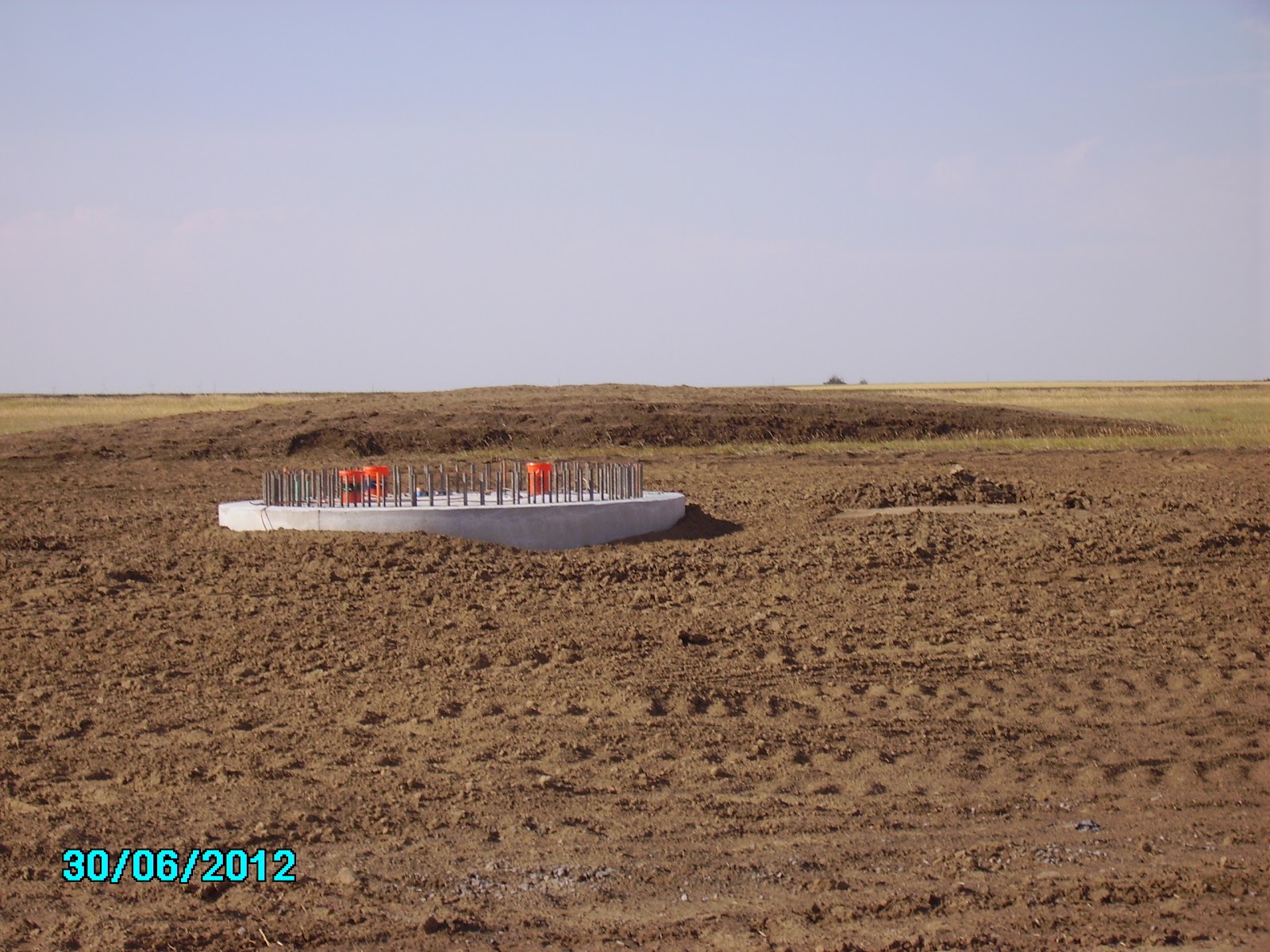
     In the last exciting adventure of the wind towers, the mass of rebar and concrete had been covered, leaving a pad with threaded bars protruding.  To that pad, a pillbox has been added and a series of deliveries ensued.


     What’s in the box?  That’s easy.


    Ready for blastoff?  Then the BIG trucks arrived.


      The difficulty is to demonstrate how big this thing is.  Count the axles, each with 4 wheels.


    Turning corners requires the back axles to castor.  A little help from its own hydraulic system.


    Then they laid cable between sites.


     And finally, some blades arrived.


      Meanwhile, cranes dominate the western horizon doing their thing.


    The windmill forrest, as the Goodwife calls it, grows rapidly.

Friday, July 20, 2012

Round 4 or Wind at My Back

      The inch and half of moisture the first week of July brought on a few weeds.  If we were doing chemical weeding, those big ones would be called escapes.


    We’ll just call them survivors, who didn’t die with the last operation.  Here’s a close up for the soil scientists.  These are new growth.  You have to look hard to see the new weeds just emerging.


  Miller bar to the rescue.


  I wonder how many acres this old machine has gone over.  It works by going under the soil surface.  Weeds, dirt, everything goes over the bar which knocks the weed’s roots loose.  It works pretty well if you don’t go too deep.  It leaves the soil relatively undisturbed on the surface, so it can be hard to tell where you have been and where you need to go.


     Whenever I start a tillage operation, I have control of the wind.  That is to say, however I lay out the land to farm it, the wind will arrange itself so I have a tail wind in one direction and a head wind in the other. This time I followed a path the wind guys created to lay underground cable to neighboring wind towers.  Its general direction was east-southeast. For two days, the wind blew out of the east-southeast.  The wind hardly ever blows out of the east.  I got covered in dust.
     But, after 30 hours of tractor-riding in 100 degree heat, with dirt plaguing me half the time, the weeds are gone.  For now.
    So off we go to Kansas to our local friendly auto dealer to have a 100K checkup on our car.  We just thought it was hot in Colorado.  And dry.  Here’s what Kansas looks like, even after some rain the first week of July.


     No, that’s not the African Veldt.  It’s Northwest Kansas.  It got up to 110 degrees both days we were there.  Before the early-July rain, the local fire department guys were called out at least once a day with multiple calls on many days.  They’re unpaid volunteers.  Support your local fire department.
     We had near-100 mile per hour winds on Saturday before Memorial Day.  It knocked all the fronds off the asparagus plants.  Heat and drought haven’t helped it recover.


     The horse radish is doing ok.  We’re happy to be back in Colorado.  Upper 90’s and low 100’s are better than 110.
      Mowing and yard time again.


Monday, July 16, 2012

Farm Maintenance

    It rained!   An inch and a half!  Time to do some maintenance, starting with the garage doors.  The old ones needed changing.  A dog chewed a hole in the lower left trying to get out of the garage.


      And the opener pulled a hole in the top.  The instructions for installing the new doors said it would take between nine and thirteen hours to complete (along with cautions that if the garage door is the only way in and out, you will be inside the garage for the duration--until the door is functional).   The 9-13 hours was right on target for the first one.  The second one took less time--the value of experience.


    The problem is, it isn’t done yet.  Now what to do with the leftovers?


    The new steel doors don’t let in light like the fiberglass ones did.  It is pretty dark inside now.  And the new ones are a bit heavier. 

   Most of the fence posts have been driven.  That was a lot easier after it rained.  And the wire-pulling job is done. The rain has refreshed the grass and the weeds.  Mowing will be in order soon.
    But some of those things will have to wait.  It is time to start Round 4 on the summer fallow.

Thursday, July 12, 2012

Windpower

      In the last exciting adventure of the Invasion of the Wind Towers, cement covered the dome-shaped mesh with a cylindrical batch of rebar still protruding.


     Then they formed up the cylinder.


   And poured it.


And the result:


     Then the cover up:


    It has been pretty dry, so a little water was necessary.


      And we are back to normal, sort of.  It is amazing that they filled the hole with miles of rebar and tons of cement and then ALL of the dirt they dug out originally.  The power of compaction.


    The boys took off July 4th and it rained 1.5"  That slowed them down a little.  But they have added a pillbox to the pads.

 
     And the tower bases and blades continue to roll in.


More to come.

Wednesday, July 11, 2012

Fencing


     “Something there is that doesn’t love a wall”, er, make that a fence.  I have a hard time thinking of anything that does love a fence.  Tumbleweeds?

    Anyway, harvest is over and it hasn’t rained, so time to catch up on some odd jobs.  Like fixing the mailbox after the combines knocked it over yet again.


         The sign had to be rewelded.
         Back to normal. 


      Note where some mental giant demonstrated his prowess with an automatic weapon, probably done from a vehicle in motion.  (Entry point just above the flag arm, exit just below the last "94".)  That knocked it over, too.  But the sign is back in good order.

      The farm yard has been "hayed", mowed and raked.  The hay is pretty dry.


     New garage doors are on order.  Which leaves the fence.  There isn’t much romantic about fencing.  Right now, I’m pulling 60 or 70 year old neglected fence, much of which has gone underground.


     See the fence?  No?  It’s there, underground.  Ford tractor to the rescue. 


    This device was invented to sever tree roots from big trees that hog the moisture and nutrients from little trees.

    
      Elms from the left send their roots over into the spruce at right.  When that happens, the spruce don't do very well.
    The machine didn’t work too well for severing roots because it doesn’t go deep enough.  But it works pretty well for disinterring ancient barb wire.


     Then the wire hs to be rolled up and hauled off.

    And then there is still some fence to be built for cattle who will be hungry later this summer.  Post driving is a lot of work for one person.  Here is the weaponry and what’s been done.


      And here is what is left to do.


      The new wire is there, used as a guideline to keep the posts in somewhat of a straight line. 
    And then there is still this half mile to remove wire, some of which is actually above ground.  The new wire is there, too.  I plan to fasten it to the old posts temporarily.


      I have some shop work to do too, if it ever rains enough to drive me indoors.


Tuesday, July 3, 2012

Harvest 2012


   I have been doing a little more than keeping an eye on the wind workers.  Fence building and fence removal are at the fore front.  But harvest got in the way.  I don’t have anything to harvest yet, but I have helped friends with their harvest for years and I went again this year.

     My job this year was to shepherd the trucks.


      My truck is the old one of the bunch, the Dodge, but the newest piece of equipment I own—a 1969 Dodge.


       Most of the time, I hauled to the bins on the farm.


      When the bins started to fill up, it was necessary to haul to town.  Several other farms were hauling to town, too.  So, truck drivers spend a lot of time waiting in line.


     Sometimes there is something interesting to watch.


     Here, a daring young man applies patches to the metal tube that channels grain from the top of the elevator to the storage building. 

      Or you can visit with others in line.  Many of the trucks belong to custom harvesters.  They have the air conditioner running and are content to sit inside the cab.  Not conducive to conversation.   

       Four years ago, I began reading “On the Origin of Species” by Charles Darwin to occupy the waiting time in the elevator line and in the field as I wait for combines to fill the truck.  I didn’t quite finish it this year.  Maybe next year.

    Meanwhile, back at the farm, the combines rolled on.


     That is, until they break down.  This time, the combine engine fan bearing failed, allowing the fan blades to whack a chunk out of the radiator.  Downtime was about a day and a half, with a 100+ mile trip to get the new bearing.  A local shop repaired the radiator.  It could have been much worse.


     Other things that interrupt the harvest are weather.  Not much of that this year.  What looked like a promising thunderstorm (it’s so dry most farmers would welcome an inch or two of rain during harvest) turned out to be smoke from the forest fire near Colorado Springs, about 100 miles away.

   
   But things worked out and harvest is just about done. It was the earliest harvest I can ever remember, almost done before we usually start (first or second week of July).  It has also been the hottest, with many days going over a hundred degrees, plus the usual wind.

     It is done for me.  Clean up the truck (get all the stray grain out so the mice won’t have anything to eat and maybe won’t nest in the truck cab) and put the truck back into the shed. 


      A favorite mouse-nesting place is under the lower door hinge.  On the step, removed for cleaning, maintenance supplies:  power steering fluid (blue bottle), two gallons of water, and brake fluid.

      Back to the fence.