Sunday, October 29, 2023

Summer’s Over


     October 28, 2023  It all came to an end.  A killing frost ended the growing season the first week of October at the farm. 


      Frost held off for another two weeks in Loveland.  The result of all the pumpkin vines over the backyard resulted in three good sized pumpkins.  Grandkids took them.  They had to have help carting them off.  I haven’t seen the jack-o-lanterns yet.  Hope they survived the cold weather!    

                                                     The trees put on a show this year.


                                                      It was a good tomato year as well.


     No time for canning tomatoes yet.  I have been freezing what I couldn’t use, which was the vast majority of them.  Now that winter has arrived, it won’t hurt to heat the place up with boiling water to skin the frozen tomatoes and the canner water.  It might actually feel good.

     It was a good squash year, too.  I must have given away 50 pounds of the yellow crook-neck squash, the product of two plants.  We ate a lot of them, too.  They make good filler for casseroles, even scrambled eggs.

    I put an old ice chest out on the corner with a sign, “Take Some”.  The plants were at the farm, so I brought the squash back and put them in the ice chest.  Most of them got taken by somebody.

     Nobody wanted the big ones, so they got put with the pumpkin excess lining the walk from the driveway to the front door.

       The zucchini produced for a short time, but then backed off.  A few zucchini found their way into the ice chest on the corner and were soon gone.  There was one that couldn’t be harvested.  It grew inside the wire cage and couldn’t be removed without slaughtering it.


     I also had six cantaloupe from two plants.  One was good, one was horrible, and four are trying to ripen.    

      The pretty colors are gone, too.  Just white now.  I won’t grieve too much when it disappears.


Sunday, September 17, 2023

Some Pumpkins


       Benign neglect?

      Or is it ”Give it an inch and it’ll take a mile?

     I planted a pumpkin seed last spring.  It was an effort to cut down on yard work.  It covers up a lot of ground and keeps weeds at bay.  Bottom line: less mowing.

     I must have planted a pumpkin somewhere in the past, but I don’t remember specifically.  I knew that a pumpkin vine would spread faster than bindweed and prevent weed growth.  Unlike bindweed, it will be gone when it freezes.

     Where did I get that idea if I hadn’t planted a pumpkin in the past?  Maybe from Nathaniel Hawthorne.

     From The Scarlet Letter:

            But the proprietor appeared already to have relinquished, as hopeless, the effort to perpetuate on this side of the Atlantic, in a hard soil and amid the close struggle for subsistence, the native English taste for ornamental gardening. Cabbages grew in plain sight; and a pumpkin vine, rooted at some distance, had run across the intervening space, and deposited one of its gigantic products directly beneath the hall-window; as if to warn the Governor that this great lump of vegetable gold was as rich an ornament as New England earth would offer him.


     My pumpkin vine has taken over much of the strawberry patch.


                                      It’s currently attempting a coup of the roses.


     If it defeats the roses, I won’t grieve.  Roses are pretty, but caring for them is like trying to help a wild animal.  Weeding or trimming results in lots of painful pricks and snags, the reward for caring. 

     I inherited the roses from a previous owner.  There were nearly twenty.  I’m down to a dozen or so.  An attempt to move three of the biggest bushes to the front of the house resulted in one fatality and two never-blooms.  Obviously, I’m not a rose person.

     The pumpkin has invaded the mint patch, but is doomed to lose that war.  I have prevented it from covering up the cantaloupe vine.   

    Pumpkin trivia:  The comic strips used to include one called “Some Punkins.”  A World War II bomber was named “Some Punkins”, maybe after the comic strip.

     At the junction of Colorado State Highways 71 and 94 lies a settlement called Punkin Center.  Farm broadcaster / pilot Evan Slack liked to point out that the place was listed as “Pumpkin Junction” on air charts (maps).

     As October approaches, the pumpkin will get its share of the limelight.  Soon I will be able to sing, “Hey there Country Bumpkin, How’s the frost out on the pumpkin?”

     Harvest will take a strong back (volunteers wanted).  Want a huge jack-o-lantern?  Roasted pumpkin seeds?  Maybe homemade pie filling?  Apply in person at the patch.

     Then there will be all those vines to dispose of, the tradeoff for not having to mow all summer.

     It will be okay if Mother Nature doesn’t send us a killing frost for a while.


Saturday, July 29, 2023

Auger Down!

     Sheets of water splashed against the north windows. Looking out the west windows, I could see water not just falling, but coming in waves that oscillated up and down as they fell to earth.

     I hadn’t seen anything like that since experiencing the tornado in Limon.  I began looking out the windows for a funnel cloud.  I hurried from window to window where the wind-driven waves attacked mainly the north and east sides of the house.

     No funnel cloud and the blast lasted less than five minutes.  I checked the north windows for leaks.  Water was running through the yard. 

      I could see the west combine shed doors sticking out at the bottom, waving in the receding east wind.  Uh oh.  We forgot to shut the east doors.  We forgot to pin the bottoms of the west door.  We were in for some door repairs.  Thankfully, the roof stayed on the shed.

      It took an hour or so for me to think of the auger.


     It was Thursday July 20.  Early morning showers dictated there would be no harvesting wheat this day.  We had started harvesting Wednesday, putting nearly a thousand bushels of wheat in the grain bin.  Typical harvest weather!

    We spent time working on the “off-site” bin, putting the finishing touches to alterations we had made to unloading access and attempts to plug water leaks around the base of the bin.  We would be ready to move to the ”off-site” bin when the farm bin got full.

     We had relaxed a little from the pre-harvest hurry, getting ready for ripe wheat.  We had let down too much.  Failure to shut the east shed doors, to pin the base of the west doors.

     Brother Dave asked as he left if we shouldn't chain the auger to the bin roof.  Nah, not necessary, we thought.


     Maybe we should have chained the auger to the bin roof.  However, Brother John found as he researched ideas for dealing with an overturned auger on the internet, that one man reported complete destruction of an auger chained to the bin, which got flopped and whipped around in the wind.

     When I finally thought about the auger, it was nearly dark.  From an upstairs window, I can see the bin top.  I trudged upstairs and looked out the window.  There was the bin top all right.

      No auger.  Ouch!

      We took a quick trip out to the bin.  We inspected and found no damage to under-carriage or auger tube.  The tube was straight, with no visible kinks in it.  We wouldn’t know for sure until we got the tube off the ground and could see what was the underside as it lay on the ground like a dead, bloated, 2-legged aardvark.

      Well, there would be more to do on Friday than merely wait for the wheat to dry out.  It took a couple of hours to get the door back to some semblance of normalcy, repairing the broken frame, and forcing the door back into it’s regular pathway.


        Then came the real chore of getting the auger up and checking for damage.  We decided it would be better to repair any damage with the auger on its side rather than up in the air after we uprighted it.

     The front-end loader on the 4010 easily raised the auger tube.  Three 50-gallon barrels supported the tube and the repair process began.


      The tube was undamaged.  Two frames that supported cables used to raise the auger to bin height were damaged, both bent and one broken.

      By Friday evening, the frames were straightened to a reasonable semblance of normalcy.  Welding the broken piece got stalled because the welder cables weren’t long enough to reach the vice where the broken piece was held firmly to the brace.  Friday ended with the construction of a 220-volt extension cord.

       Saturday was upright-the-auger day.  The engineers on the project decided we need two pulling points, one on the north to pull the auger up onto its two wheels, and one on the south to prevent the auger from crashing down once gravity took over the process.    


    The Ford tractor was nominated to do the north pull.  It was connected with a length of chain and a nylon rope to be sure there was plenty of distance between the auger and the Ford tractor operator in the event the auger decided to flop over on its other side to the north.

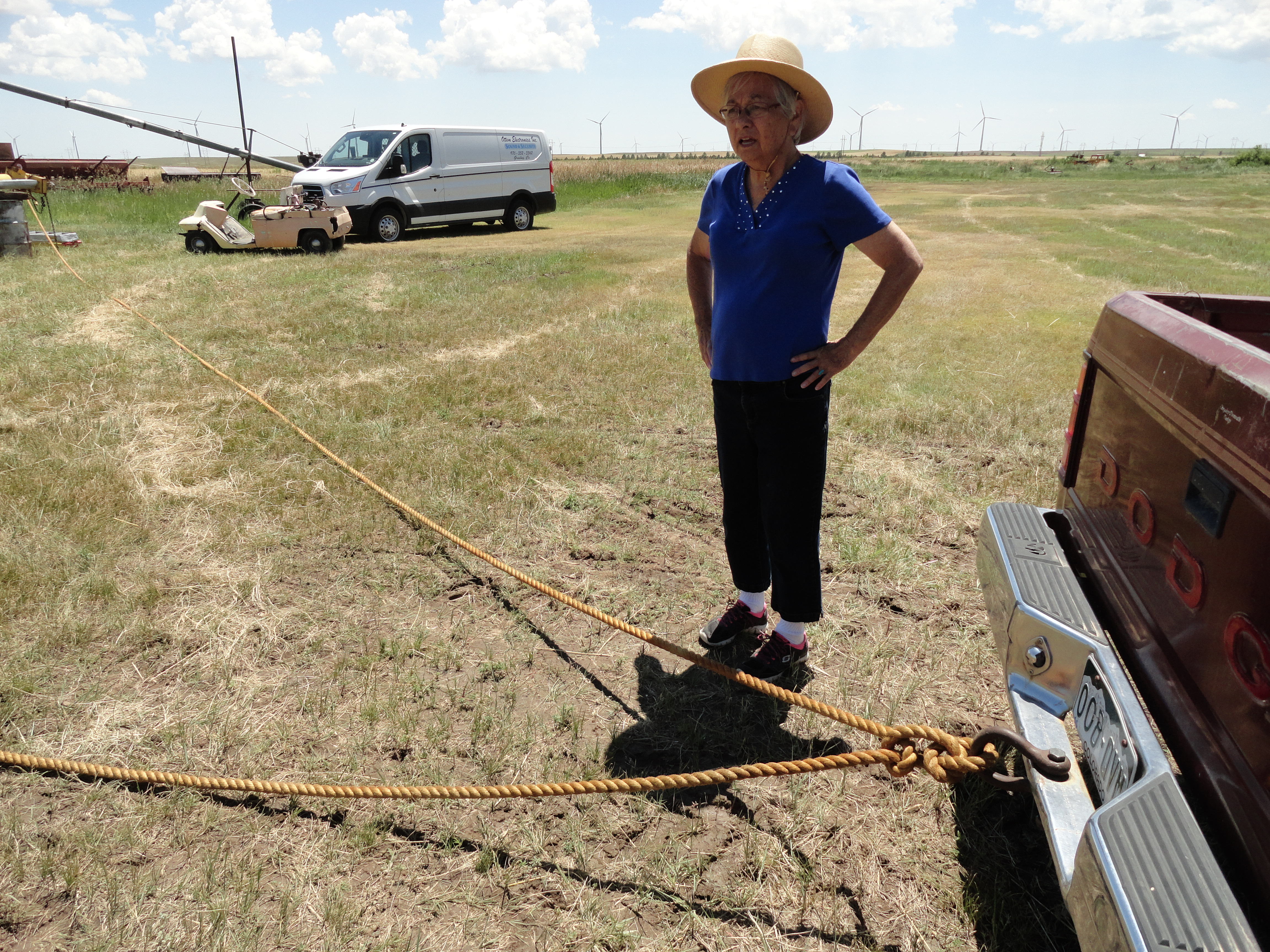
     The old Dodge pickup got the nod for holding the auger back as it descended for a landing on its north wheel.  Pickup and auger were connected with the “well rope”, the rope used to lower a man, usually Dad, down into the 90-foot domestic well when there had to be work done on the well bottom.

      We hooked both rope and chain to the same wheel so accelerator and brake were at the same point.  The engineers decided a third “hold-back” point should be used to insure that the upper end of the auger didn’t swing wildly and slam into the grain bin as it went over center on its way back to its wheels.  There was enough well rope to tie both auger points to the Dodge.

      The actual uprighting was rather anti-climactic.  The Ford tractor had no trouble pulling the auger up, and when it started down, the Dodge brakes made the touchdown a soft landing.  There was a moment of panic when I thought the Ford was going to let the auger crash back to the earth on the south, but everything went according to plan. 


     The auger was restored to its place and we were ready to try cutting wheat.  A 5:30 sample tested 14% moisture, a little too wet to bin. 

      Sunday would find us back to harvesting wheat.  The auger worked just fine, thank you.

     I have never played the "Farm Game" and have played the Money Game only once.  I think I know of a setback or penalty suited for those lifelike games at the  hands of Mother Nature.  And maybe some neglect on the part of a player?  


Sunday, July 2, 2023

Boyd Lake: Ebb & Flow

      Ebb and Flow sounds like a comic strip.  At least it does to old guys who remember Eb & Flo.  If you don’t remember, never mind.  It’s a footnote you don’t have to read.

    It’s really the wet spring that is featured here on the shores of Boyd Lake.  The early pictures were taken April 2, 2023, the later ones on June 5.


     All the lakes are filled to overflowing.


     Connection between Heinricy Lake and Boyd Lake.  In April, you could easily walk across the neck where the swimmer is.  The water is probably 8 or 10 feet deep now.  July 2.


     Connection between Heinricy Lake and Horseshoe Lake.  The water hasn’t quite reached the high-water mark.


       The south end of Horseshoe Lake near the outlet to Heinricy Lake.


              The outlet of Heinricy Lake to Westerdoll Lake.


      The dock floats.  In April, it was downhill to get to it.  It’s almost level with the sidewalk now.


The pelicans and herons liked the high water.  The pelicans have flown, probably getting too warm for the big-billed buggers.

        There’s still plenty of snow in them thar hills, too.


         The beginning of July, a good time to pause and smell the roses.


     And the sunflowers.


    And whatever they are.


Tuesday, June 20, 2023

Sea of Grass


      Spring 2023.  Different than springs we have known for many years.


      In April, you could have walked out and seen the grader blade and a two-bottom plow.  Do you see it in June?


     The reason why?  Many days in late May and early June looked like this:


     Over eleven inches of rain from late May through mid-June.  Probably more than we got in the last two summers combined.

     Resulting in:


     Not too mention this:


 High water mark in the southwest basement window, 2.5” in the rain gauge.

Still drying out a week later.  Another 1.5” didn’t add to the basement problem.  But it did aid in eroding the gravel path into the back yard.


   No one is complaining.  It does call for some different action.  The old rotary mower can’t handle the three-feet of grass. 


               Coming soon, a sickle mower.  As soon as I find it and dig it out of the grass