Saturday, January 26, 2019

Games People Play

     “Oh, the games people play now, every night and every day now. . . .”
    
     There are all kinds of card games, Pinochle, Canasta, many types of poker (some folks play five or six nights a week), and Hand-and-Foot.  That’s a new one on me.
     It’s a bit like Canasta, which I have forgotten how to play, and somewhat like Rummy.  It takes multiple decks of cards.  You have to have “books” of matched cards, no runs.  The game I watched, they played partners, boys versus girls, four people per table.  For most people, that is one night per week.
     There’s the real biggie, BINGO!  That’s Thursday nights (mostly ladies, I think).  Then there are day games, like Bocce ball.  I’m not sure how to play it.  It looks like shuffleboard in the sand.  (Nope, no shuffleboard, this isn’t a cruise ship.)


     And there is Blongo balls.  Golf balls with holes drilled through them and tied two to a cord are tossed at a frame with three horizontal cross members.  You toss the corded balls at the frame, trying to wrap the cords around the cross members   I’m not sure how it’s scored, but you get more points for wrapping around the lower sticks.


      There is beanbag baseball.  It’s like traditional beanbag toss, throwing the bags at a slanted board with holes drilled in it.  The holes are labelled “HR” (homerun), “S" (single), “D” (double), “T” (triple) and “O” (out).  The square at the bottom is for foul ball—you get another throw.  You have two teams, each player gets three bags to throw.  If none of the beanbags go into a hole, it is an out, just like baseball.
      The game is set up like a miniature baseball diamond infield with a home plate and three bases.  The board sits about where the pitcher’s mound would be.  The thrower stands at home plate.  It’s played like baseball, with each “batter” getting to advance to the appropriate base if she lands a beanbag in one of the openings.


     There are other activities, not necessarily games, like Yoga, or line dancing (ooh) and water aerobics when the weather allows (it was 26 degrees Friday morning!).
      A gym accommodates those who prefer a little more strenuous activity.


      There are less-organized games, too.  A pool room (with somewhat undersized tables) and a ping pong table get plenty of use.  We are probably the only ones to use one of two horshoe pits.


     No excuse for being bored or inactive here in the desert.  I haven’t mentioned all the hobbies folks indulge in, such as quilting, sewing, wood carving, gourd decorating, and anything else you want to start. 
     The many activities attract people to the RV Park rather than owning or renting house or condo.  You miss all the fun and games if you trade the comforts of a home for the confinements of an RV (although some of the RV’s are huge).

     Roswell addendum:  I took time out from game-playing to sort through photos.


Modern-Day Aliens 


The Videos 


The gist of it 


Roswell Streetlight Christmas Decorations


Roswell Guitar—Eat your heart out, Les Paul         


Sunday, January 13, 2019

UFO or IFO?


     March of 1995.  We were on a road trip.  It began strangely enough in Ransom, Kansas where we attended a scholars’ bowl meeting.  Scholars’ bowl, being the new kid on the block, took back seat to athletics, music, speech, and drama.  The state meet was on the first Saturday of spring break.  We packed up, headed east, and took in the scholars’ bowl meet, in which our eldest daughter was a participant.
      Then we headed west. We over-nighted in Amarillo, Texas and got on Route 66 headed for Tucson where we planned a few days' stay with friends formerly from Limon.  We drove through Roswell, NM.
      “UFO Museum” the sign said.  UFO museum?  You’re kidding.  Probably ranked right up there with the “See Six States” Genoa tower.  On we went.
     Over time, something about that sign stuck.  I didn’t forget it.  Maybe it had something to do with our own little UFO experience (http://50farm.blogspot.com/2016/12/ufo.html).
     This time, we were headed to Tucson to pay a revisit to the RV Park where the sister-in-law winters.  We left a couple of days early.  Originally, I had thought we might visit the Grand Canyon en route.  Politics interfered as our elected representatives quarreled over priorities.  The Grand Canyon remained open, but with limited service under the government shutdown.
     Carlsbad Cavern closed.  State and private museums remained open.  We left the cold clime of Santa Fe and motored to Roswell.  We went to the UFO Museum.
      Old geezers pay $3 to get in.  Two hours wasn’t enough to take in everything.  “Everything” includes definitions: (My explanations may not be entirely accurate)  UFO (Unidentified Flying Object), objects that have been experienced but never explained by natural phenomena:
       IFO (Identified Flying Objects), hoaxes or things explained by natural phenomena (a collection of fake photographs such as the saucer supposedly flying through air, but advanced techniques reveal a monofilament line suspending the disk, or crop circles in England where hidden cameras recorded folks with ropes and boards tromping through the fields).
      Encounters of the first kind, reported sightings with little or no supporting evidence.
      Encounters of the second kind, where there is some physical evidence left behind such as marks or strange elements left in the soil.  A reported sighting in Kansas not too far from where we used to live is documented through newspaper stories (lots of newspaper clippings in this museum).
       Encounters of the third kind (yes, the movie), contact with alien beings, such as abductions, with evidence. One such piece of evidence shows X-rays of a person’s hand with chips like those implanted in pets.  There is no scar or no explanation of how the imbedded devices got there.  Nobody professes to know what the little nodules are.
      The main thrust of the museum documents an encounter of the third kind that took place in 1947 in the desert some miles from Roswell.  The story goes that a rancher found these strange-looking objects scattered across the ground on a piece of his grassland where he was working one day. 
     He had never seen anything like it, so he picked up a few pieces and took him to a friend who ran a kind of country store (I think—not sure).  The friend advised him to take them to the county sheriff, which he did.  The friend declined the invitation to return to the site with the rancher, a decision he regretted for the rest of his life. 
     The sheriff, seeing how strange, alien, the things looked, called a friend of his, a military officer on a nearby base.  When the military got involved, the action accelerated.  A veil of secrecy soon covered all, but too late for some.
     The rancher had been interviewed by the local paper and radio station.  The story was out.  But hold on.  In a few days, the rancher was back in the paper, a picture of him holding fragments of a weather balloon.  He swore the pieces of a weather balloon was what he saw and took to the sheriff’s office.
      Except the rancher’s first friend, the one he went to initially with the artifacts, saw the picture in the paper and declared the stuff the rancher showed him were most definitely not pieces of a weather balloon.  All these people had to be silenced, which the military did by using threats of force, including death to the individual and his family.
      There are copies of affidavits by family members, children and grandchildren, but no eyewitnesses, attesting to the threats.  Those threatened include the sheriff and his family.
      After the initial visit to the site, the military sealed off the area and allowed no one in.   A local funeral director reported that he had a call for several child-size coffins, an order he was unable to fill.  (If there were dead bodies there, why didn't the rancher see them and report that to the sheriff?)  
     A nurse working at the military base supposedly sketched what she saw as doctors performed autopsies on bodies, which were moved from the site to the military base.  She drew the sketch for the funeral director who received the coffin orders.  The nurse immediately burned the sketch before anyone else could see it.  From her sketch comes our image of the little spacemen associated with the story. 
      The radio station that reported the original story tried to pursue it.   They encountered a threat of a different kind.  The banker called the station owner and threatened to foreclose if the station didn’t drop the story.  They dropped the story.
    Others reported there was a foul odor associated with the bodies, an odor of decaying flesh.  One alien supposedly survived the crash that spread debris over the pasture.  No one was able to communicate with the creature before it succumbed to its injuries and/or its foreign environment.
     The event and the cover-up all took place in July of 1947.  The sleuths and conspiracy nuts have been trying ever since to uncover the real story.  Part of the display was a nonstop series of videos including the movie Roswell with Martin Sheen.  We watched the last 30 minutes of that.  There are three or four other flicks, one showing interviews with those still living who were associated with the story.
     We didn’t take the time to watch any more videos.  We wanted to head down the road.  Our visit to the museum did stir some memories.  When I was still in college, a certain Dr. Edward Condon came up to Greeley from Boulder where he was a professor of physics.  He had been appointed by some government agency to investigate UFO’s.
     Brother John and I attended the lecture.  It was held in one of the science lecture halls.  The seats were stacked in rows like an amphitheater.  We sat on the steps toward the top row.  I remember not being too impressed with Dr. Condon’s presentation.  That must have been in 1966 or ’67.
      A couple of years later, Condon’s committee issued the official report on UFO’s.  No such thing as a UFO.  That was pretty much the last word by Uncle Sam.  Now, you put your sanity up for inspection if you report seeing a UFO. 
      I’m not sure when the military abandoned the Roswell site.  Sometime around 2006, a group led by archaeologists went in and did a dig as if it were an ancient civilization.  They found stuff, but I’m not sure what.  It wasn’t pieces of a weather balloon, I’m pretty sure.
      After visiting the UFO Museum, I’m not sure what I fear more, aliens, or our government.  Don’t tell anybody I said that.

Sunday, December 30, 2018

A Christmas Story


      What am I doing here?  At 8 a.m., I’ve been up since 5:30, the temperature outside is in the low teens, the west wind buffeting the Jeep.  In the seat next to me, the four-year-old grandson chatters.
      Ski lessons?  Really?  At my age?  But we were headed north.  A stop at a McDonald’s drive-through in Laramie got us hot coffee.  By the time we reached Snowy Range, I needed the boys’ room.  Nothing in the parking lot, we’re told.  Have to get to the main building.
     The original question sang out silent but clear again when we stepped out of the car onto the packed snow and the sharp wind attempted to knife through jacket, shirt, and t-shirt.  I don’t like snow and cold.
      I had refused the sticker the grandson wanted to paste onto my shirt the night before as we checked out of the ski-rental place with equipment in hand:  Boots, helmets, skis, poles.  “I Love Snow!” the stickers said.  “It would be a lie,” I told him.
      On went the vest.  Next came the Carhart insulated coveralls.  I don’t care what kind of fashion statement I make.  They are warm.  If I can just get them on without falling on the packed snow I’m standing on.
     I have a ski suit.  But the Goodwife couldn’t find her winter bibs she used to wear on winter playground duty many years ago, so she took my one-piece suit and I opted for the coveralls.  I did wash and dry them the night before.  When you are 71, the fashion police grant you a pass.
     My Carharts held the knifing wind at bay.  The wool socks were no match for the icy blast, however.  I slipped off my loafers and exposed my foot.  Getting the ski boots on last night in the sporting goods store, with the helpful clerk assisting, hadn’t been too bad.  My fingers were still nice and warm. 
     But now, my fingers numbed as I fumbled at the five latches and grabbed the tongue loop to try to pull the heavy boot onto my quickly cooling foot and shin. I succeeded in getting the boots on, but I had to have help getting the five latches in place.
     Now for the walk over the packed snow to headquarters.  Walking in ski boots is a challenge.  Walking in ski boots on a slippery surface is a fall waiting to happen.  But we made it safe and sound, with the younger folk carrying skis and poles.
      The first stop, the restroom.  A deceased friend once told me as we stood in line for the urinals at a state championship football game in Wichita, “Never get in the line with the bald guy, or the one with the white hair.”  He was, of course, referring to the amount of time an old man takes to void his bladder.  
      I didn’t put a stopwatch on it, but it might have been a Guinness World Record, by the time I fumbled with the coverall zippers somewhat bound up by last night’s laundering.  Then there were the jeans, the long underwear, and the briefs to navigate. I suffered a thoroughly modern problem, finding myself before it was too late.  The gloves and the sunglasses fell to the floor, but I didn’t care.  Priorities.
      The restroom experience behind me, I navigated the steady flow of skiers coming and going.  No turning back now.  Eventually, number two daughter found me amongst the crowd and wired a four-inch square tag to my Carhart zipper.  Number one daughter helped me latch my skis to the uncompromising boots.
      I only fell twice.  The first time was trying to make my way to the other side of the chair lift loading station on my skis where the lessons for beginners was already in session.  That was a mistake.  The very patient instructor had us start with one ski.   I should have carried my skis to that point.
      The instructor, who was himself in his sixties, had us do 360’s with both skis on as he demonstrated.  Then we walked sideways uphill.  A gentle slope.  My major concern was how to slow and stop without crashing.  Two hours later, I would still be trying to perfect that ability. 
     We graduated to a bigger bump.  At first, it wasn’t too slick, but as the temperature rose and as the snow got packed by many skiers gliding over it, it was slippery.  I only endangered others a couple of times.  One involved my second fall, where I took to the ditch to avoid crashing into a couple of girls conversing on the sidelines near the fence separating us from the chairlift mounting station.
     I could make left turns, but not right ones.  I could slow myself pretty well but not well enough to take on the “magic carpet”, the conveyor belt lift that creeps uphill slowly beside the gentle slope for tyros.   
     I abandoned the Goodwife.  She was on her own.  I could barely maintain myself on skis.  No way could I help anyone else.  She took one bad spill, backwards on her first attempt down the big bump.  The rented helmet proved its value.  It saved her from a cracked skull.  She was much better at “snowplowing” as she calls it, or the “pizza slice” as the instructor called the knock-kneed position used to put on the brakes.
     The lessons stopped at noon.  We attempted another run or two before we decided we had had enough.  We were tired.  I might have made a few more stabs at it.  Progress does encourage one to continue.  But the ski boots chafed the inside of my anklebones.  I knew I would regret it if I punished them anymore.
     So we rested in the lunchroom after our meager repast (I ate chicken strips rather than wait for hamburger or pizza) while the younger folk returned to the slopes.  After a catnap, we strolled (if trundling along in ski boots can be anything like a stroll) around the huge upstairs room (thank goodness for a sturdy handrail we used to negotiate going up and down the stair steps) where we could watch skiers and snowboarders coming down the slopes, or folks mounting the chairlift or riding uphill on the magic carpet.
      A couple of hours before sundown, number one daughter brought the Jeep up to the loading zone so we thankfully didn’t have to negotiate the hundred yards or so of packed snow across the parking lot.  Priority number one after seating myself in the Jeep:  get the snow boots off.  What a relief.
     I reflected as I slipped on my loafers to protect my feet from the still-blowing wind that I had not been cold at all during my two-plus hours amongst the winter elements.  Not even my feet or my fingers, the usual cold spots.
     Our adventure was done.  We headed home.  A brief stop at a gas station to put in a gallon or two to get jus back to Laramie ($4 per gallon at the one-pump convenience store), and we were on the road.
      The trip was our Christmas present from the girls.  It certainly was an adventure.  We both reserved judgment until tomorrow to see if skiing was something we might wish to take up.  Would we be stiff and sore?  (Answer:  not really)  Still, it’s cold and snowy.
       Additional Christmas tidbit:  The two-year-old granddaughter can’t pronounce words very well yet.  She says “yeah” and “no” very well and manages to get her wants known with signs, shakes and nods of her head.  She’s coming along on pronunciation.  But she understands nearly everything we say.
     “Your nose is runny.  Go get a tissue and blow your nose,” someone instructed her.  She pushed a stool over to the counter, a skill she has pretty well perfected.  She crawled up the stool, also a well-developed skill, grabbed a Kleenex and crawled back down.  She stood where we all could see her and blew her nose.
      We all congratulated her.  She looked at the tissue and its contents.  Then she licked it and discarded the tissue. (“Ughs” and “ishes” from the audience only brought a smile.)
     The Grandson got an “Elf on the Shelf”, a doll who sits on the shelf and helps Santa keep an eye on the recipient to see if he’s being naughty or nice.  The literature accompanying the elf instructs the recipient to name the elf.
         “What shall we name him?” asked his mom.
      The briefest of pauses followed the question.  “Walker Stapleton,” was his reply.


Sunday, December 16, 2018

Wild Goose Chase

     Snipe hunting.  Cow-tipping.  Catching the Northern Lights.
     Clack, clack, clack went the tires on the street.  Starting October 1, Iceland drivers can equip their cars with studded tires.  Many had done so.  It was hard to be surprised by an approaching car.
      We made our way once again towards Bust Stop 1, where we were scheduled to catch a bus for a Northern Lights Tour.  It was nearing 8 p.m.  The girl at the tourist information desk assured us the bus would have printed across it something like “Sky Tours” or Tip-Top Tours” or something similar.
      A plane old bus, shaped like a high top shoe, pulled up.  A group of about a dozen stood there conversing.  It soon became apparent that we were all waiting to take the Northern Lights tour.  One of our number stepped out of the shelter of City Hall into the breeze to inquire of the driver.  He turned and motioned to us.  This was our bus.
      The driver made friendly conversation as he checked our paperwork in the dim light.  We all took our turn and we were soon aboard.  Checking his list, the driver said we needed to make just one stop at another hotel and pick up one more light-chaser.  Someone said we would just go along.
      All aboard, the driver, also the tour guide started his spiel.  He introduced himself, his name, his occupation (semi-retired teacher) and our goal for the night, finding a hole in the clouds where we had a chance of viewing the Northern Lights. 
      When you buy the tickets, they are careful to endorse a disclaimer that says there is no guarantee that you will actually see such a sight.  Also, you need to check the website displayed on the paperwork to see for sure that the tour is a go for that night.  If the weather is hopelessly cloudy, the tour will be rescheduled for the next night, or the next, depending on the weather.
      It had been cloudy and drizzly all day, but the sun had come out later in the afternoon, and the website said our tour was a go for this night.  So, having had our supper and a brief rest, we made our way to the bus stop.
      The driver consulted his cell phone for the weather and reported that we stood the best chance of finding a clear sky by going south.  All the while as he talked, he was hauling us out of town into the black night.
      He had us each tell our name, where we came from, what we did in life, following his example.  He said the trip would be a lot more fun if we were a group interacting together, rather than a bunch of silent individuals.
      He proceeded to sing an Icelandic folk song.  When he finished his song, he translated for us.  This was an English-speaking tour, even though two or three were from Germany.  An extended family from Alabama made up about half of our group. 
      He then asked us to sing him a song.  He said pick an American song since most of us were from America.  There were several suggestions, such as “Yellow Submarine” and a few other tunes.  I started singing “Dixie” thinking surely the Alabamians knew that song, but the song ended up being a duet.
     The driver said he had found from his experience of guiding tours that Americans didn’t have any songs, that everyone knows.  He said that in Iceland, there are a few songs that everybody knows, such as the one he had sung.  That ended the song-singing.
      He enlisted our help in searching for clear sky.  Look for stars.  Seeing the Northern Lights requires a clear sky.  After an hour or so of riding, we saw a few stars.  We pulled into a grassy space by the side the highway and got out.  We looked up.  The stars disappeared and a few drops of moisture lit on our upturned faces.
       Back to the warm bus.  The driver consulted his cell phone for a few moments.  Further south, closer to the coast, he said, the weather folks were showing clear skies.  We hit the highway again.  We passed the airport.
      Around eleven o’clock, we found the combination of a clear sky and a place to pull off the highway without any interfering lights.  In Iceland, the Northern Lights may appear from any direction of the compass, not just the north.  Sure enough, some strange colorful “clouds” were churning around in the southern sky.  (I know it was south, because the North Star was behind us.)
      Folks oohed and awed as the display waxed and waned.  The Goodwife was a bit disappointed because the color was largely green, not pink as in all the pictures of the phenomenon.
      Several people took out cell phones and cameras to try to capture the event.  I gave it a shot, but I got nothing but black.  Earlier, the driver suggested camera settings, but all that was beyond my savvy.  Automatic exposure with automatic settings is the best mode I know. 
      After about twenty or thirty minutes of that, the promised treat of hot chocolate and cookies came out of the bus’s cargo hold.  I had long before that retreated to my comfortable seat in the bus.  My toes had curled, searching for a roost, two or three hours ago. 
      The Goodwife reported that the hot chocolate was really lukewarm chocolate.  The cookies weren’t too sweet.  A few more minutes viewing the strange clouds that mostly moved horizontally (sometimes they leap vertically, but not this night) and everyone joined the two or three of us who had spent much of the time dozing in the bus, and we headed back to Reykjavik.
      It was after one o’clock when I crawled into bed.  We had one more experience on our list of things to do in Iceland, take a plunge into the hot waters that arise from the bowels of the earth.  It didn’t happen.  We had tried to get tickets to the Blue Lagoon, but we were never able to. 
      The folks at the tourist office showed us some pools in the city that they said were superior to the Blue Lagoon and not nearly as expensive, but they were a bit out of walking distance, as the weather was still overcast, windy, and spitting rain.  The temperature ranged from six to ten degrees Celsius (40 to 50 F) the entire time we were there.  The wind and light precipitation made it feel a lot colder.
      Anyway, we spent our last day at two museums that were in walking distance from our digs.  The whale museum had huge models of whales.  I’m sure they were scaled down, but even so they were huge.  Once again, the Goodwife rented a recording to accompany the displays.  I was reminded of part of Moby Dick where Melville describes the different types of whales.  A blue light that illuminated the collection made for poor photography. 


       We also took in the Saga Museum, which was probably the best museum in a way.  It had lifelike figures in realistic settings.  One figure even breathed, his diaphragm moving in and out.  As the name suggests, each setting had a story featuring a heroic man or woman.  At the end of the tour, there was a room with costumes from the earliest days.  Visitors get to try on the costumes and handle the weaponry.


      On our first day in Iceland, I relied on a ship in dry dock (I think) to keep my bearings as we walked around unfamiliar territory.  We passed near it a few more times on our way to the museums and various eateries.  It was interesting to follow the progress the crews made.


      Our last day there ended at noon at, you guessed it, Bus Stop 1 where we boarded a small shuttle (packed to the gills with departing tourists) that took us just outside of town to the main bus depot where we boarded a big bus for the airport.
      We found Icelanders to be friendly folk.  But they have an international airport, like apparently all international airports.  We struggled through the bureaucracy.  It was the only place we had to carry on our luggage.  We were allowed to check our baggage at the other airports.  We were allowed to carry on without additional fee only after the ticket agent lady marched us over to the little cage that defined what was allowable in overhead bins.
      We were plenty early for our flight.  We took turns standing in line at the lunch counter to buy a drink and a snack.  When it was my turn to sit at a table guarding the luggage, I witnessed a strange event.
      We were seated at a small table for two next to a low wall.  A young man with backpack stood just on the other side of the wall.  He stood there a long time, observing, what?  It became obvious he wasn’t looking for another person.  I grew suspicious.  I kept an eye on him and our luggage.
      After about ten minutes, he came around the wall and asked if that sandwich, on a plate on a nearby table, was mine.  No.  Same question to people next to me.  No.  He grabbed the sandwich and walked off eating it.  A few minutes later, a waitress removed the dishes and wiped off the table.  Nobody ever came to complain they  had lost their sandwich.
      Our flight departed about 3:30 p.m. Iceland time.  After eight hours of flying, we caught sight of the Rockies.  We approached from the northeast, coming over Nebraska.  We landed just after 6 p.m. at DIA.  One of the longest 2½ hours of my life.  Once more we waded through the Disneyland back and forth cattle fences.  The agent checked our passports, asked where we were going, handed back our passports, and we stepped out of the secure zone.  Our trip was over.    


Sunday, December 9, 2018

Iceland 2


     Sunday morning.  11 a.m. appointment.  Breakfast.
     When I booked Alfholl, our bed and breakfast, breakfast came with an extra fee, how much I don’t remember.  But we decided as long as we were having to pay for it, we might as well seek our morning meal elsewhere.
      It was our first morning, also the day we were scheduled to take the “Golden Tour”, and it was Sunday.  Reykjavik honors the Christian custom of taking Sunday off, at least the part of Reykjavik where we stayed, and during the off-season.  All the little shops that usually served food were closed as we walked around at 9 a.m.
      We found a hotel with a breakfast bar open.  It was a lot like the breakfast served at bed and breakfasts in the olden days, scrambled eggs, bacon, sausage, various types of bread, fruit, juices, coffee, tea, etc.  Having dined, we walked the three or four blocks to bus stop 1 where we would join the Golden Circle tour.
     Like all things, the decision to take our breakfast elsewhere had advantages and disadvantages:  we had a variety of breakfasts, but we did not get to know anyone, seeing only the tourist servers.  We saw our host when we checked in.  He helped us make bus reservations to return to the airport on the appointed day, tried (and failed) to get coveted reservations to the fabled Blue Lagoon, helped haul our luggage upstairs to our room.  But then, we never saw him again.
      Our bus was on time and we were early.  We watched the birds in the pools that surround City Hall.


      A shuttle bus took us to the main bus depot, the same one we went to on arrival from the airport.  The attendants helped us board, and after most of us were on, then they came to take our tickets, vouchers, or smart phone pictures.  Thoughtful, really, rather than having everybody standing outside the bus door in the wind and drizzle. 
      The first stop was Þingvellir National Park (don’t ask me what that first letter is—English translations usually substitute “th”, thingvellir).  The park centers around some ancient ruins from a thousand years ago where the Icelandic parliament met.  We only saw that site in passing.  The real attraction was a huge rift in the lava where two tectonic plates separate.
      The fault line runs for many of miles with various degrees of separation.  Where the bus stops, the fault is yards (woops—meters) wide and deep.


      A walkway allows tourists to walk down between the canyon walls to a flatter plane below.  All three stops we made on the tour included similar tourist centers with restrooms, some form of eatery, gift shop, and convenience store.
      On the bus trip, we went through miles of open space with an occasional settlement or farm type dwelling.  But when we reached the designated site, things changed.  While we experienced some traffic enroute, at each site, a parking lot was crowded with cars and a bunch of busses, enough that we had to take a close look at our bus before departing to take in the scene so that we could get on the right bus at our assigned departure time.  Don’t be late!  It’s an expensive taxi ride back to Reykjavik.  Needless to say, the centers were crawling with people, many natives taking advantage of a Sunday afternoon to see some of the sights.


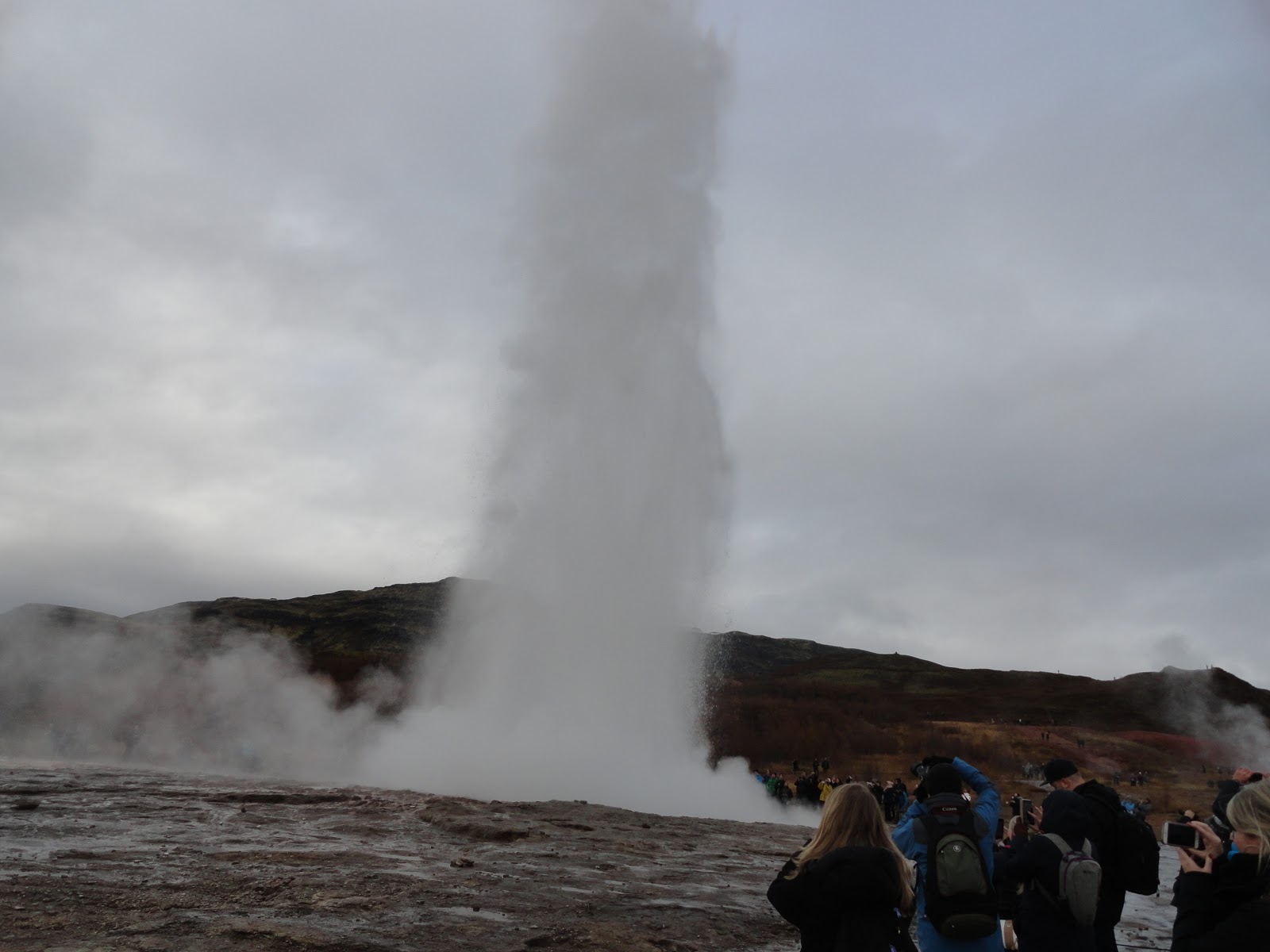
      Our second stop was Geysir.  Apparently, it’s where we get the word “geyser”, Geysir being the first named hot water eruption from Mother Earth.  Geysir is not as predictable as Old Faithful, and perhaps not as spectacular, but it erupts much more frequently. 
     From the parking lot and tourist center, we walked the hundred meters or so to the site.  Several pools of hot water and other steam spouts line the pathway.  We were probably 15 minutes making our way around the spout, and we saw two pretty sizable eruptions. 


      Our final stop was Gullfoss, a huge waterfall.  It sits in an exposed area, pretty rugged, obviously, to have the waterfall.  The sharp wind and occasional spit of rain made for a pretty quick visit. 


      From Gullfoss, we took about a two-hour bus trip back to Reykjavik.  Coming and going, we saw a lot of scenery, including mountaintops, glaciers, a snowstorm progressing down a mountain pass, an industrial site or two, and some sheep and horse ranches.  Not much in the way of grain fields.  Iceland imports nearly all of its grain needs.


       For the rest of our Iceland stay, we would visit museums in Reykjavik and take a wild midnight ride.    

Sunday, December 2, 2018

Iceland


      The sun was not cooperating.  It was early afternoon.  We were heading north. 
      The sun should have been shining through the left windows of the bus.  It was coming through the right rear window.
      We are heading south, I concluded.  I had looked at the map enough to know that Reykjavik was about 45 minutes north of Keflavik, the major airport.  Why were we going south?  Was the map wrong?   
     Except we weren’t.  Headed south.  Hmmmm.  It was a problem I wouldn’t have to work on much, because it was practically the only sunny day we had while we were in Iceland.
     We had landed, cleared the passport office, and headed to bus kiosks.  I had again relied on Trip Advisor, which sent us to Fly-Bus.  They had service from airport to your doorstep.  Not quite, but okay.  Reykjavik ordinances limited busses to certain streets in the city.
      The big bus we took from the airport stopped at a depot just outside the city, where the passengers dispersed to smaller busses that took us into the city.  We were given a bus stop number where we were to disembark. 
      The driver of the small bus asked each of us which hotel or lodging we were staying at as he helped us unload our luggage.  He wasn’t familiar with our place, Alfholl Guest House.  He recognized the street, Ranargata.   Two blocks up, two, or maybe three blocks right, you’ll come to it.  Except we didn’t.
      I accosted two young ladies and asked them for help.  Out came the cell phones.  In a minute or two, they produced a map.  We had gone up one block too far.  Go down one block, turn left and go two blocks, then left again on Ranargata.  We were home.  Fairly simple, especially compared to finding our way in Dublin.


      Our first view of Iceland came from the airplane.  It was a clear day, apparently a rarity as winter approaches.  The land looked like rough rocks, lava, covered with the skin of a kiwi, soft green fuzz. 
      There is a small community around the airport, but the ride to the city reminds me of Eastern Colorado in one way:  there are few buildings, farms, or small towns.  The vista includes distant mountains and an occasional glimpse of the sea, but very little in the way of agriculture, fields or animals grazing.


     Iceland has a lot in common with Hawaii, volcanic islands with lava mountains punctuating the flats that have eroded, providing soil for plant life.  Iceland has only one native tree and limited agriculture due to the short growing season of the northern clime.  Still, it is green with the moss, or whatever it is, that covers much of the landscape.
      Having arrived, met our host, and stowed our luggage, we set out for the tourist office which was conveniently located in the city hall beside bus stop 1 where we got off the bus and started our pedestrian journey.  We made arrangements for a couple of trips, both by bus.  The lady who sold us the tickets directed us north to the old harbor where we would find abundant seafood places.  Which street should we take?  Oh, any of them.
     The street we chose took a left turn and so did we.  We walked a mile and never came to the harbor, which later we would learn was only three blocks from our lodging, if you took the right street. 
      A couple of young ladies tried to give us directions to a great seafood place not far from  where we stood.  We went to the supermarket and turned right, walked another three blocks where we could see the harbor, but no restaurant. 
     An older lady caning her way along the street sent us back the other way to a local establishment.  The place the younger ladies directed us to, was indeed another few blocks down the way we were going, but it was a chain restaurant like Red Lobster or something.  Go back to the supermarket, cross the street and go right for two blocks and we would come to a local place that served great food, she said.
     So we did.  The store was a bakery that specialized in pastries of various kinds.  In the evening they served a limited menu of seafood.  The problem was, only one girl at the counter spoke English.
      We asked for a menu.  They had none.  The waitpersons almost ignored us.  We teetered on the brink of walking out.  The girl came to our table and informed us that she was about to post the menu—which was chalked on a blackboard right above our table.
      We stepped aside to allow her room to get to the blackboard.  As she wrote, she informed us what she was posting, as she wrote in Icelandic.  We must place our order at the counter.  We made our choice and I went to the counter.
      I stood in line beside a local who ordered a bottle of beer.  I asked about the beer.  Fortunately, he spoke English.  The beer was from a local brewery, he said.  Things were certainly taking a turn for the better. 
      He said the beer was good and there was a large selection.  He pointed to a row of bottles on a shelf behind the counter.  The bottles wore the same label, except for a big number in the middle of it.  I saw that the number 15 was a porter, so I ordered it.  It was good.
     We sat in our own private little island of English while those all around us spoke Icelandic.  We indeed had strayed off the tourist pathway.  With a belly full of good food (it was some kind of flat fish) and good beer, life was good.
      The sun had set as we began our journey home.  Finding our way wasn’t much of a problem, since we had mainly taken one street all the way.  With the sun gone, the temperature dropped some and the humidity increased.  Still, it was quite pleasant as we walked home on a Saturday night.
     Reaching home, we took our turn at the shower.  We shared the bathroom with three other rooms on our floor.  We didn’t see anybody else, so sharing wasn’t much of a problem.  It reminded me that when I was booking the place in September, I was urged to hurry to close the deal, as there was only one room left!  Liars.
     Sunday morning, we needed to be at Bus Stop 1 before 11 a.m. to catch our bus to make the Golden Circle trip.  We congratulated ourselves on a successful day one in Iceland and hit the hay.