Sunday, October 16, 2022

Another Tree—er—Elm Bites the Dust

     “That’s not a tree.  That’s a weed.”       Minnesota native Marvin Ekgren circa 1963


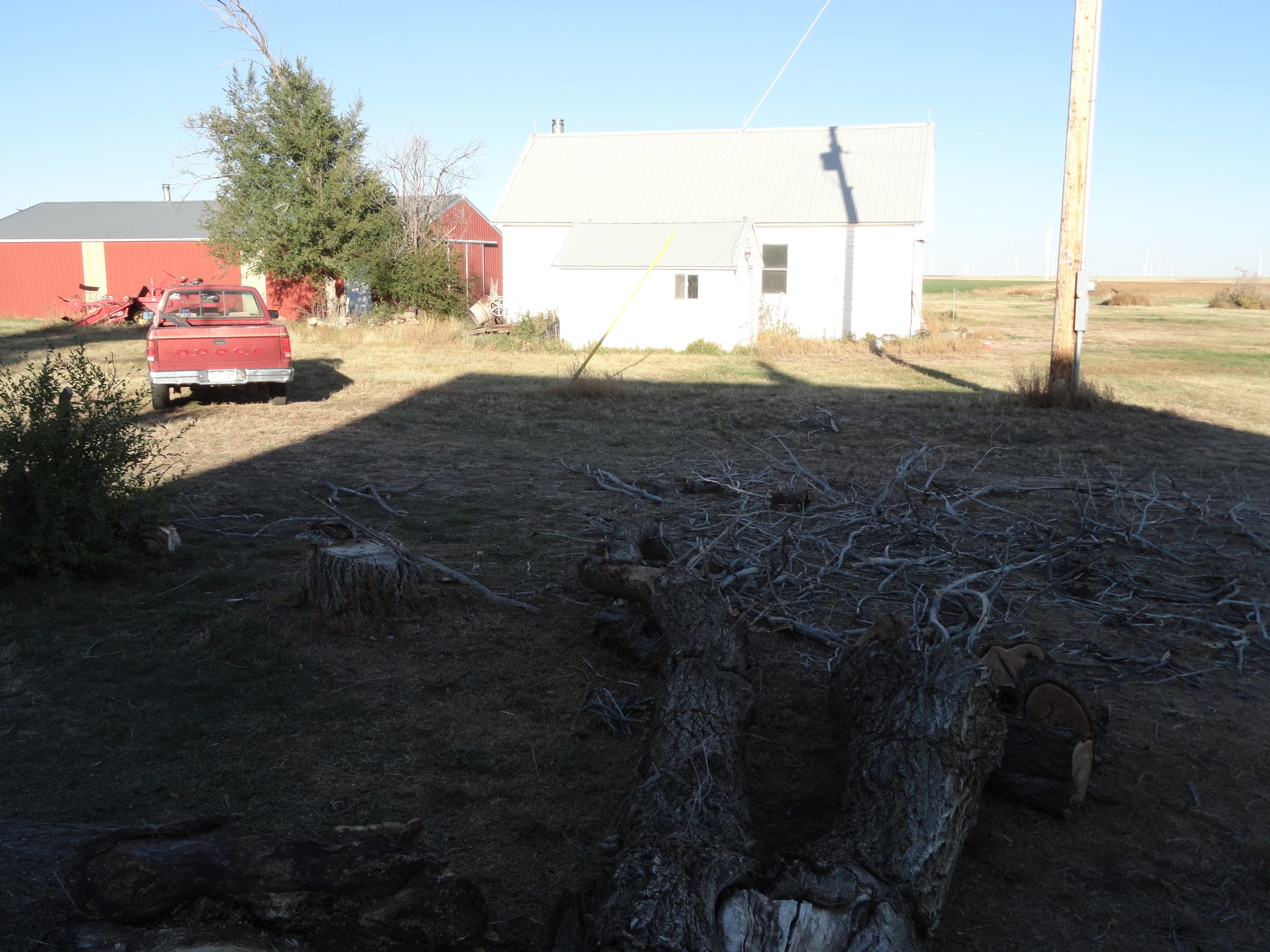
     The tree would be some 60 years old.  I don’t think it was planted.  It was a result of one of the characteristics that earns the Chinese elm the designation as a weed—the blizzard of button-sized disks that sweep the landscape with every March or April breeze.

     I have seen the seeds growing in rain gutters with too much trash in them.  Mr. Ekgren complained about them taking over the fence rows.  I can see that happening in a wetter climate.

      A bramble of raspberry bushes used to support the east side of the picket fence near where Rommel’s house now stands.  All of the tree’s brothers and sisters would have been uprooted as a matter of course in the spring when the raspberry thicket got its spring tending.

      Somehow, this one survived.  In time, it shaded and sheltered that corner of the yard.  In its time, it provided relief from the hot  summer sun, and even served as some protection for unhoused vehicles during a hail storm or two.  It was a nice place to wash a car or pickup, particularly when we were still shaving ice and needed a clean pickup to haul the equipment.

      In 2021, its shade capability diminished.  By the end of summer, its bare branches were not the result of the regular Fall leaf-drop.  It was dead.

      A sister elm fifteen or twenty feet to the east had been planned and planted.  It died in 2020 and was removed a year ago.  It wasn’t as big as this one.  After taking that one out, I wasn’t up for another one.  It wouldn’t hurt to let this one age and dry for a year.

      All of the summer chores done, the wheat planted, the machinery housed, it was time to take on the tree.  I had studied the proper procedure quite a few times before actually mounting my attack.

      I would need a rope to safely direct the tree’s descent in case my lumberjack skills weren’t quite up to felling the thing in the right direction.  In danger were Rommel’s house, the hedge less that two feet away, and even the northeast corner of the house.

     Step one was to take out a west-leaning branch that could lead the tree to fall the wrong way.


      That done, it was time to harness the Dodge Dakota to the tree as high as I dare go with a step ladder in the pickup bed.


     The old eighty-foot well rope secured to the Dakota, it was time for the coup d’ grace.  I was working on  the finishing touches of the fish mouth when I heard the tell-tale cracking that indicated the tree was coming down. 

    But wait!  I hadn’t even nicked the back side of the tree above the fish mouth.  No time to contemplate what went wrong.  The shadow of branches crossed me and I ran.  I ran like hell. 

     I wasn’t sure which way that thing would fall, but in the instant, I chose to run south.  Good choice.  I stood there, thirty feet south of the tree, the idling chainsaw in my hand and looked at the north half of the tree that fell north and managed to miss the burn barrel.


     The best laid schemes of mice and men. . . .

       The rope was affixed to the south branch, the main trunk.  It had no effect on where the north half of the tree fell.  I had cut through the good wood and left only the rot in the center of the tree supporting the north branch.

     Oh well.  When you get bucked off, get back in the saddle before you have much time to think about it.  When my heartbeat returned to something like normal, I went to work on the back side of the fish mouth. 

     This time, before I heard the ominous cracking sound, I installed the Goodwife in the pickup and told her to put it in gear, but don’t step on the accelerator.  Let the idle pull out the remaining slack in the rope.

     As the rope tightened, I got ready to go back and make a final cut, but before I could move away from the Dakota’s open right window, the ominous cracking sound came again. 

      I stood in my tracks and watched as the pickup inched forward and the tree began to tilt in our direction.  In an instant, gravity exceeded the pickup speed.  The rope slackened, but the tree fell almost where I  had planned for it to fall.

     The excitement was over.  Now, the grunt work.  Cut the tree down.   Cut the tree up.

     I had filled the chainsaw gas tank and oil reservoir twice.  By the time it ran out of gas the second time, I was also out of gas.


     Long October shadows bring cool temperatures.  The fire in the trash barrel warmed us as we fed it the smaller branches from the tree’s destruction.

     I coiled up and stowed the heavy old rope.  The chainsaw in its case in the shop, time to enjoy some fruit of the day’s labor. 

     A fire in the small kitchen wood-burner cheered us as we prepared our supper and watched the long shadows turn to night.

Sunday, September 4, 2022

Galena

      Paul was Romanian, I think.  He came to America as some kind of petroleum engineer.  He became a citizen and retired. 

     Paul complained about the company he worked for, how they cheated him.  I forget the details.  He wasn’t well-off, which explains why he settled in a small town in Western Kansas.  Housing is pretty cheap.

     Paul spoke Russian, which is probably how he came to know Galena.  What random chance occurrence led the Goodwife to strike up a conversation with Paul I don’t remember.  It’s been a while ago. 

     Paul and Galena showed up for supper one night, and we had an interesting, if somewhat laborious conversation.  Galena spoke very little English.  Paul got a workout translating our comments to Russian and Galena’s to English.

      Galena was a journalist.  She wrote stories from America and sent them to a paper in Russia.  She did a story on the Goodwife.  She showed the Goodwife an English translation for her approval before she sent it off for publication.  I’m not sure how it got translated.  Paul?  A computer program?

     I don’t think Galena got paid very much for her efforts.  When we met her, she was working as kitchen help in a hospital.  Later she worked in the kitchen at the Good Sam.  She finally landed a job as head cook at the hospital in a town west of us.  She must have had a green card.

     I don’t remember much about our conversations, which we held on two or three occasions, except one time when we tried telling jokes, in English which Paul translated to Russian, and then Galena would tell one in Russian which Paul converted to English.

     We were trying to see what jokes translated well.  Ones with a moral, or an understandable punch line, worked.  Ones that relied on an idiom for their humor fell flat.

     We got together a few times, especially as Galena, with Paul’s help, interviewed the Goodwife and wrote her story.  The Goodwife invited Galena to come to the farm and they would go on to Denver and go shopping and look at quilt shops and the like.

     Paul didn’t understand that he was to bring Galena to the farm in Colorado.  He called us from our Kansas “farm” and said nobody was home.  About three hours later, they showed up to “The” farm.

     I was in the process of flushing drip irrigation lines for my tree project.  Paul made the trip down to the trees with me.  I unplugged a line and caught water in a five-gallon bucket until it ran clear.  To start irrigating without flushing would mean removing every nozzle and cleaning crud out them.   

     It sometimes took ten gallons to get the water to run clear.  When it was clear, Paul stuck his hand in the stream and tasted the water.  Tasted good, he said, but too much sand!  As far as I know, he never suffered any ill effects from that exercise.

     After two or three hours, Paul took off for home.  No talking him into staying the night.  He might have had pets at home.  I don’t remember.

      The girls left for Denver the next morning and stayed for a couple of days.  I don’t remember how Galena got home.  Maybe Paul made the trip again.

     What I do remember was another time (the last time) Paul and Galena came to our house.  We were getting along with our conversation, and Galena was confident enough to speak some English on her own, relying on Paul when she ran into difficulties.

      I don’t know how the subject came up, but the Goodwife mentioned how great a guy Gorbachev was.

     KABOOM!

     Galena exploded.  He was not a good guy!  He was a traitor to Russia.  He presided over the fall of the Soviet Union!  He should be in jail, executed, etc., etc.

      But Galena, the Goodwife asked, don’t the Russian people appreciate the freedom Gorbachev gave them? 

     Assuredly they do not!  Personal freedom is nothing.  Having a strong country is most important.

     You don’t want Russia to be a democracy?

     No!  I want a Czar again!  We need to be a strong country in the world!

     Galena calmed down a bit (she had risen almost to standing and flailed her arms over her head during some of this).  The Goodwife asked the obvious question:

     If you feel that way, why do you stay in America?  Why don’t you return to Russia?

     No answer.  Before long, Paul and Galena decided it was time to leave.

     We never saw them again.

     Two or three years later, we learned that Paul had died from some sort of cancer, and that Galena had given up whatever job she held at the time to nurse him through his final weeks of life.

     What became of his meager belongings, an old car, a mobile home and its contents?  What became of Galena?

      The recent death of Mr. Gorbachev brought this episode back to the old frontal lobes (maybe).   I reflected when this happened and I reflect again.

       Are there really people in the world who would prefer to live under a dictator rather than a democracy?  Apparently so.

     Democracy will never work in such a world.  Have we been deluding ourselves to expend so much time, effort, and capital in trying to grow something where it can never grow?


Sunday, August 14, 2022

The Harvest That Wasn’t

     “Don’t sweat the small stuff.”

     Or is it, “I can handle the big things.  It’s the little ones that get me”?

      This saga actually began over a year ago when I bought Neighborly’s 1995 New Holland combine at the auction where the family disposed of many of his possessions, including an impressive gun collection.  The combine hadn’t been used for a few years, but it had been inside all that time.

     I thought it should have a few good seasons left in it.  My $10,000 bid won the prize.  A week or so later, a June hailstorm destroyed the growing wheat’s ability to produce seed.  It produced heads, but no seed.  My 2021 harvest was over before it started.

     Neighborly’s heirs kindly shedded the combine for a year.  When I finally finished planting millet during the first week of July this year, I retrieved the big yellow machine.  Jim had the header in the yard minutes after I parked the combine proper. 

      I turned to getting trucks ready.  One of the tires on the big Dodge truck hissed at me when I tried to pressure it up to match its peers.  The truck still has split rim tires, and Hugo is one of the few places that will still work on split rims.  Of course it was Friday afternoon, and I couldn’t pick up the tire until the next Wednesday.

      Eventually, I did get the header and the threshing machine reunited.  I had (still have) quite a few things to learn.  When I put the separator in gear, the reel wouldn’t run.  By the time I figured out that I had failed to connect a hydraulic hose properly, I had burned a belt in two.

     Hydraulics are not my strong suit.  Whenever I deal with hydraulic connections, I end up feeling like the greased pig at the county fair.  The thought frequently crosses my mind during the process:  couldn’t this be done with compressed air instead of oil?

      I had to “crack” a line (loosen a threaded connection a little) to release enough pressure to make the connection properly.  I would have to wait until the next day to try running it again since the burned out belt lay on the ground mutely accusing me of incompetence.  A trip to the parts store would bail me out, but of course it was past 5 in the afternoon.

       The reel problem successfully solved, I had to deal with another real problem.  Somewhat reminiscent of the small globule of rubber in the fuel pump inlet the shut down the Allis tractor, this small item was a sheer bolt, smaller than ¼ inch in diameter and about two inches long.

      Everything was running except the auger bringing clean grain into the grain tank.  I couldn’t find a replacement sheer bolt on a Saturday morning, so I bought a  6-millimeter bolt, slightly smaller than a ¼ inch bolt, but still too big to fit.  I ground it down enough to go into the holes that connect sprocket and cog that turned the shaft that turn the gears that propel the auger shaft.  

      The auger ran for maybe a minute before with a crunch, a hammering,  and a thump,  it quit.  The jury-rigged sheer bolt had sheered.  Something had to be in the auger tube obstructing things.  If there was, I couldn’t find it.

      Another try or two had the same result.  In the meantime, I had contacted three folks to see if they might be interested in cutting the wheat, since I wasn’t getting anywhere.  Two were neighbors and the third a custom cutter. 

     They all three were smarter than I am.  They didn’t want to have anything to do with cutting the thin crop with lots of weeds.  The custom cutter said I had to get the combine running.  He found a cotter pin the right size and used it for a sheer bolt.  That didn’t end with us living happily ever after.

      The cotter pin went a few revolutions and then a clunk and the cotter pin’s role as a sheer bolt came to an abrupt end.  I had to find what was jamming that auger.

      Along came John.  I had called to see if he might want to do a little custom-cutting.  He didn’t.  But he was curious.  He went right to the gear box that transfers power from sprocket, sheer bolt, and cog through a system of five gears, to the auger. 

      It became apparent that we were going to have to remove a lot of stuff, including the “tailings” elevator, to work on the stuff inside the gear box.  John dove right in.  In about three hours, we had yellow metal lying all about, and a pile of grease.

     We also had a few bearing rollers spread around in the gob of grease that was in the gear box.  It didn’t take Sherlock Holmes to tell us the rollers from a failed bearing were getting into the gears and causing all the trouble. 

     John set about pulling gears off, after he removed a pound or two of grease.  That’s when I began to get nervous.  I have known friends to tear something apart and find it convenient to be gone when it came time to put it back together.

     With gears out of the way, we could see on the end of the auger shaft where there should have been a bearing, only an inner bearing race remained.  We had to get up into the grain bin to pull the auger out.    

     About this time, the custom cutter returned.  He wanted to take some pictures of some of the old junk in the farmyard.  He had to see what we were doing.  He asked if we were having fun and suggested we might want to replace the other four bearings in the box to avoid having to do it all again.

    We concurred and John set about removing snap rings and shafts.  Our day ended when the gear box was empty and all the gears and shafts and bearings were soaking in greasy solvent or perched on rags.  I was reminded of James Herriot’s description of replacing a cow’s prolapsed uterus:  would we ever get all that stuff crammed back in there?

      The next day I spent cleaning bearings so I could get numbers off of them and cleaning and checking gears.  I called the parts store and they had three of the five bearings.  The other two would be available in the morning.

      The next day, I ended  up making two trips to town to get all the right parts.  About halfway home on the second trip, the old Chrysler got hot and I had to stop.  Fortunately for me, the other neighbor I had visited with about cutting wheat called me just as I shut down, unfortunately for him.  He ended up towing me home.

     Where would I be without neighbors?

     Also fortunately for me, John came back.  He couldn’t be there until 5 and we worked until 8 when I was out of gas.  We had the gear box mostly back together.

     So John made a third trip the next morning and in a couple of hours, we had everything back together and running correctly.  John also made a ”chain run” and tightened up all the roller chains he could find on the machine.

      I tried to pay John something, but he would have nothing to do with that.  He was in his truck and out of the yard before I could do much more than say thank you.

      I headed for the field for my maiden voyage with my “new” combine.  I went a hundred yards or so and stopped to check on things.  The new bearings hadn’t really been tested because when I crawled up and looked, there was no wheat in the bin. 

      I began looking around and under the combine to find the gigantic hole that was letting all the wheat out.  Nothing.

       I scratched around in the stubble behind the combine to see if I was throwing grain out the back.  Nothing.

      I knew I was cutting stuff because there was a few straws and some weeds that obviously had been ground up.  I could see a few stalks of stubble.  Mighty few.  And there were quite a few wheat stalks lying flat on the ground, impossible to pick up with any sort of machine.  Sawfly, the experts say.  Apparently, they attack the wheat straw at near the ground level.

     Nothing to do but try to find “greener pastures”, or in this case, a heavier stand of wheat.  I spent an hour going around the field.  A few checks proved I didn’t have any leaks in the machine, and only a small amount, mostly shriveled, lightweight kernels, were going out the back end.  There were a few bushels of weedy grain in the grain bin.

      I left Field 6, southeast of the yard, and headed for Field 11, northwest of the yard.  I pecked around on the north for an hour, cutting where it was mostly wheat and not so many weeds.  The best wheat was just north of the farmyard in the lee of the trees north of the farmyard.

       After another hour cutting here and there, getting what looked like the best wheat, I unloaded onto the old GMC, maybe 50 bushels, I thought.  I was done for that day.

     The next afternoon, I set out again to cherry pick in Field 6.  After another hour, I was done there, too.  The A-C wasn’t working very well and it was hot in the cab.

       I dumped the dab of wheat onto the GMC and headed for town.  Where I weighed in with 38 bushels of wheat.

      Here endeth the saga of the 2022 harvest, the harvest that really wasn’t.


Sunday, July 10, 2022

How the Mighty are Fallen

      It was about the size of a BB.  It was more cylindrical than orblike, like a short piece of a nail or a spaghetti noodle, less than 3/8 of an inch long.

     “It” was responsible for three days of agony, hair-tearing, and more than normal number of oaths I’ve vowed to stop using.

      All during the dry winter and spring, I held off stirring any dirt for fear that the terrible winds we had during May would start things blowing, like the 30’s or the 50’s.  Late in May, we got a nice heavy wet snow.  And before that all dried out, in early June we got a little over an inch of rain.

     Suddenly, it was time, past time, to get the ground ready if I was going to plant millet.  All the dry spring, the dry ground remained sterile.  After the snow, the weeds began to come.  Before the June rain had dried enough to farm, the weeds got to be 4—6 inches tall.

      So on a nice June day, I set out with the old Allis and the Calkins rod weeder and tried killing a few weeds.  It was still too wet, and the weeds were going over the rod alright.  But so was enough wet soil that some of the weeds were surviving.

       But there was another problem.  The tractor engine was dragging down, losing rpm’s as if it were overloaded.  Which of course it wasn’t.  Or was it?

       I decided the tandem disk offered a better opportunity to kill more weeds, so I returned to the farmyard and made the exchange.  All this took hours, of course.

       When I returned with the disk, the tractor still acted like it was overloaded.  No way.  Not with that disk.

     I found that if I stopped for a few seconds, the tractor would run top speed for about 30 seconds, and then start dragging down again.  I played that game for 30 minutes.  Stop and wait ten or fifteen seconds.  Go for thirty or forty-five seconds.  Do it again.

       I decided that was no good, so I headed back to the farm thinking, “What am I gonna do?”  It almost certainly had to be a fuel starvation problem, there being no ignition issue for a diesel. 

      The first thing I tried was changing the fuel filters.  Back in the field, it was stop and go, still.  This time, I pulled the fuel line off at the tank.  Plenty of flow there.  Next, I pulled the line off in front of the fuel pump.  Good flow there.  I pulled the line in front of the filters.  Fuel flow there seemed okay, though not as robust as in front of the electrical pump.

      Back to the field.  Same old problem.  Again, I managed to get over some acres when it decided it could run up-to-speed.  The key was once it got to running correctly, don’t stop.  Mother Nature determines that strategy has some problems, bladderly speaking.

      I got to thinking maybe the electrical fuel pump I added last years was too small, was restricting fuel flow.  The next morning, I went to town to try to buy a bigger fuel pump.  No luck.  All they had was what was already installed.

      With some vague hope that the problem had cured itself overnight, I went to the field with the disk.  But after about five minutes of the tractor dragging down, I knew that I would have to fix the problem some way somehow.

     Like most problems in life, determining that I could and would find and fix the problem set me on the right path.  That and centering on the fuel pump. 

      Back in the yard, it was quick work to remove fuel lines.  I had been down that road a few times very recently.  This time, I removed the line right in front of the filters and in front of the fuel pump.

      I put a piece of an old sheet over the fuel pump inlet.  I put some compressed air in the fuel line that connects to the filter, forcing air back through the fuel pump. 

     When I removed the piece of old sheet from the fuel pump inlet, there was my “rubber bb”.  Hard to imagine that a piece of rubber about the size of a whole peppercorn could shut down a giant tractor.

      Even the stone David used to take Goliath out of the picture was a boulder compared to what I held in my hand.  But the lesson was the same:  How the Mighty are Fallen.

      Back in the field I had every confidence that things would run correctly now.  And it did, too.  I finished disking the millet field and moved into the summer fallow that will be wheat in the fall (if moisture conditions allow).

     That afternoon as I retired from my day’s work and inspected things while the tractor filled with fuel.  I discovered two more problems.  One was quite apparent.  The air conditioner had stopped working.

     Two gangs on the disk had bearings that had failed.  My spirits sagged.  Would I never get this job done?

     I had to return to the city to keep an appointment with the eye surgeon.  (We scheduled surgery in October to correct double vision.)

      I used the trip to buy refrigerant but I couldn’t find disk bearings.  NAPA could get them in overnight.  It took one day to remove and disassemble the disk gangs.

      An eight-foot cheater (a section of 1-1/2 inch pipe in this case) and two big pipe wrenches were required to remove the nuts holding the disks on their shaft. Even had I the bearings in hand, which I didn’t, I was pretty much done for the day after that chore.  I’m not as young as I used to be!

       Another day of reassembly wore me out again.  On the third day, I began by recharging the air conditioner.  Success!  I headed for the field with a-c and disk working great.  Maybel

      I pressed the lever and dropped the disk in the ground.  I got ten feet into my chore when the tractor died dead. 

      What now?  When I tried to restart the tractor,  I found everything dead.  Pushing the starter button produced nothing.

      That has to be electrical, I thought.  I brought the portable generator and the battery charger to the field.  Still nothing.  An hour of checking battery connections and other electrical things led me to a solenoid that didn’t appear to be working.

      Back to town.  They had the solenoid.  When I tried the starter button after replacing the solenoid, I got the old “click-click-click” that means only one thing.  Dead battery, plural in this case—two of them.

       I put in a quick call to NAPA before closing time, in case they had to order the batteries in overnight.  They had the batteries.  For only $579, the two new batteries would be mine!

      The batteries are huge weighing about 80 pounds apiece.  Gravity assisted in getting them down from their perch above the tractor tires.  I wasn’t looking forward to getting the new ones in place.  Gravity switched sides in this battle.      

      Day four of this nightmare began with a trip to town.  The young lady who waited on me at NAPA had to have assistance to get the dolly with the batteries on it tilted back enough to roll them to my pickup.  Between the two of us, we got them loaded and the old ones on her dolly.  She didn’t volunteer to help me get them to their proper place in the tractor.

      The 4010 with frontend loader came to my rescue.  The scoop just below the tailgate of the old Dodge pickup made it possible to slide the batteries into the scoop.  With the scoop perched above the battery box, gravity was once again on my side and I managed to drop both batteries into the battery box.  

      Some minutes later, with baited breath, I tried the starter.  The tractor whirred to life almost before I could worry about what to do next if this didn’t work.

      Two days later, the summer fallow was done.  Now, to plant the millet.  But wait!  There’s more!

      Weeds were coming up in the millet field.  The disk didn’t kill everything.  The field would have to be worked again before planting.

      This job took only two days with the Calkins machine and everything running correctly.  Another two days of getting the drills calibrated and loaded with seed and I was planting.

     I finally finished planting July 7, about a month behind schedule.

     Is somebody trying to tell me something? I wonder.

     On the other hand, Mother Nature blessed me with .75” of rain the evening of July 8.  That should be the perfect amount to get the millet off to a good start.

     Another old saying:  "Hope springs eternal in the human breast."


Sunday, June 5, 2022

The Golf Cart

      It rolled off the assembly line in 1965.  It’s been rolling along ever since.

     It probably rolled across golf courses for some years, but for the last thirty-plus years, it hasn’t been too close to a golf course.

      “Uncle” bought the old Cushman many years ago to serve as a yard cart for the motel-RV Park.  The work for the cart wasn’t abusive.  But there wasn’t anyplace to keep the cart inside.  Local juveniles found they could easily hijack the old girl and take her on a joy ride.

       Uncle would have to go out and find the cart, where the batteries had run down, or in at least one case, pull it out of a ravine where the miscreants left it for dead. 

      Removing the keys was no help.  The thieves knew to hotwire across the switch.  Chaining and locking the thing to a light pole slowed things down.

        When “Auntie” and Uncle retired from the hospitality industry, Uncle sold the cart to Mom.  She wanted it serve as a carrier between the garden and the house.  Mom and I rented a small U-Haul trailer from La Junta and took her S-15 GMC to get the cart.

     The trailer opening wasn’t quite wide enough for the back tires on the old golf cart, but Uncle took care of that by taking a full-speed run up the trailer ramp.  The cart went in.

      The days of being garaged outdoors were over when Mom got it.  The old cart  had a permanent place in the garage.  One car had to be parked at a slight angle to make room for everything, but it worked.  It’s still working.

      The poor old thing has suffered some abuse in its present situation.  This time, from grandkids and even great grandkids, who also found thrills in joy-riding around the farm.  It has lost both bumpers,  lost a few screws and bolts, and suffered cracks to its aging fiberglass body.  But it still runs.

       Maintenance was highly necessary this spring.  I knew it would have to have  new batteries.  When I folded back the body to reveal batteries, I discovered a broken tube that serves as the frame for the machine.

       I can fix that.  I took one piece of angle iron that would fit inside the square tube, and another piece that would fit over the tube.  It took some doing, but eventually I got everything lined up and clamped in place. 

      I “rivet” welded the two angle irons.  That means I did what I usually do when welding—burned a hole through outside angle iron, the tube and even the inside angle iron.  Once the hole is through everything, I backed the rod out and attempted to patch the hole—also standard practice for my welding.

      So far, it is working.  The angle irons can’t move and they keep the tube in place.  That job done, I turned to replacing the speed switch plates.  There are four copper plates about an inch by two inches.  They are stationary.  A “movable switch plate” rotates with the foot pedal to vary the speed of the cart by contacting the stationary plates. 

     The old plates were burned and rough and the moveable plate couldn’t return to its resting place, so the thing was always in gear.  I had either to shut off the switch or grab the foot-feed and pull up to disengage the contact plates and stop the cart.

      A thorough cleaning and new batteries and I was ready to go.  Except:  after an initial lurch, the thing wouldn’t go.  It was dead. New batteries, cleaned cables and contacts and nothing.  When I hooked it up to the charger, it wouldn’t charge.

      To make a long story short, I spent a lot of hours when I wasn’t working on something else, while waiting for it to maybe rain, trying to figure out why that thing wouldn’t run.  I used an electric meter to test this lead and that lead.  I changed the solenoid.  Nothing.

      Finally, I traced the problem to one particular cable.  It would carry current when I tested it with the meter, but when it was under any kind of load, including charging, it finked out.  I had cleaned the terminal when I replaced the batteries, but the problem was corrosion where cable and terminal meet, the clamp that hold the cable wires and the terminal together.

       I used the most sophisticated of tools to figure it out—a pair of pliers.  Thinking maybe one of the new batteries was no good, I made brief contact across the negative and positive battery posts.  It would spark if I went directly from battery post to battery post.  But when I shorted from cable to cable, nothing.   

       It was a week or two of either walking or driving a pickup when I had to carry stuff around the yard, from shop to machine.  Redoing the cable connection took no time at all in comparison to the amount of time I spent scratching my head.

      You will have trouble imagining the thrill I felt when I first pressed the foot pedal and the old gal jumped to life. 

      So, the old Cushman golf cart rolls on.  It lives to serve another day.


Sunday, May 15, 2022

Down on the Farm 2022

     Dry.  Windy.

     Not so dry as it had been.  We actually go .6” of rain and snow early in May.

     Wheat planted last fall is coming up.  A few patches that came up last fall now stands six inches or more.  The result is a field that looks like a coyote with mange.


     The newly-hatched wheat will have plenty of competition from weeds.  If the crop comes to fruition, it will be a miserable harvest.  Retaining organic status forbids spraying to kill the weeds.  Green weeds and ripe wheat don’t mix well from the combine’s point of view.

     The dry weather and the wind have put tillage operations on hold.  Time to do some maintenance. 

     I started on the “new” (1974 Allis) tractor last fall.  The two sizable cylinders that provide the steering both leaked hydraulic oil.  Greasing three or four zerks and checking fluid levels have to be done underneath the tractor.  Add some ubiquitous dirt from any farm operation and servicing the tractor makes for a filthy uniform for the service person.

      I removed the cylinders and took them to a shop.  Sometime this spring, I got around to installing the cylinders.  I removed the fuel gauge float assembly and assured myself that the problem with the inaccurate fuel indication is in the dash board.


                                                     Cylinders in place  


                            Cylinders being cleaned up to take to the repair shop


    Fuel gauge sending unit with the steering cylinders removed.  It's the little round thing, center back.

      A second problem on the Allis was the foot brake.  It ran out of fluid.  To get to the master cylinder, I had to remove the hood. 


      I thought I might need to change the hydraulic hoses that run from the steering wheel to the cylinders.  That would also require hood removal.  Hindsight:  I should have cut an access hole in the hood for adding brake fluid.

         Next on the repair list was the chisel.  When the bolts holding the right hitch beam sheared, the left beam took the brunt of the damage.


          The end of the hitch needs to move two feet to the left to get things back to normal.


   The red cylinder and chain weren’t enough to straighten things out.  I chained the 4010 to the hitch and blocked the wheels of the chisel so it couldn’t move.  By pulling at a right angle to the normal direction of travel, I got everything to move.  It took more tinkering to get bolt holes lined up, but it happened.


 Next on the docket was the old golf cart.  It remains a work in progress.  Electrical problems yet to be solved.

     The latest thing was the disk.  I had it pretty well-done last fall.  I had one disk to replace, but I couldn’t budge a nut on the end of the shaft.  An 8-foot cheater on a pipe wrench resulted in a broken pipe wrench.

     I pulled the disk around to the shop a couple of weeks ago.  When I finally got a windless day when I didn’t have to worry so much about setting the world on fire, I fired up the acetylene torch and applied some serious heat to the recalcitrant nut.  This time, with a bigger pipe wrench, the 8-foot cheater did its job.  The disk was soon replaced.

     Now for some moisture.  I lack a tool in the shed to do anything about that.


Sunday, April 10, 2022

Collector Bill

       Bill was a collector.  All you had to do was open one of his garage doors to see that.  It was a three-car-plus garage, but you could only count on one bay containing a car.  Jeanie insisted that the  bay closest to the house proper was reserved for her car. 

     There could be another car or two in there, but it would take a goodly while to free it from all the stuff piled on and around it in order to get it out of the garage.

      Two or three times over the years, many of us pitched in and helped Bill clean up his garage so that we, the high school faculty, could hold our annual end-of-school party there.  One year we even took up a collection and hired the DJ who did the high school prom to set up and have a dance for our party in Beamgard's garage.

      For a while the garage would stay neat and organized, but the “rot” always came back and navigating inside the garage would be an arduous task.  One of our number once volunteered to clean up and organize Bill’s garage for him, if. . .if he could keep one of every tool that Bill had duplicates of.

     Bill’s habit was to look for a brief while for a tool or gadget in his garage, but when he couldn’t find it, he simply went downtown and bought another.  He had duplicates and triplicates of quite a few tools.

     The garage clutter attested to the many hobbies that Bill indulged in.  Cars and working on cars were lifelong hobbies.  Flying took a close second.  But he tried many others.  His Brother Rod once said to him, "Bill, if you started right now today working on all the projects you have started, you wouldn't live long enough to finish them." 

     One of the other things he tried was photography.  Back in the day, that meant buying film in cannisters designed to fit your particular camera.  The film came in a yellow box from Kodak, or later from Fujifilm in a green box.

     You put the film in your camera, clicked the shutter and wound the film two or three times to get the exposed film out of the way.  Then you took pictures till the film ran out, usually 8, 16, or 32 frames in my experience. 

      Then you rolled the film back into the cannister and removed it from the camera.  You filled out the form, enclosed a check and the film cannister, and sent it off in the mail.  In a week or two, you would get a fat envelope in the mail containing your prints.  Alternatively, you could take the film to the local drugstore and they would send it off. 

      Many times, it took weeks or even moths to use up a roll of film.  By the time you got it developed, you forgot what shots you had taken.

      Bill thought he could improve upon that.  He read up on film developing, ordered the chemicals for developing colored film, along with proper trays.  One of our acquaintances had an enlarger which Bill borrowed.

       One night, Keith Ross who in his prime stood over six feet and weighed upwards of 250 pounds, Bill, and I found ourselves packed into Bill’s bathroom.  It was the only room any of us could muster that had running water, apparently a necessity for developing film, and no windows to let in light and spoil the developed film.

       We stumbled over each other in the dark trying to develop three rolls of film, one provided by each of us.  Not a pretty picture for sure. 

      About the only other thing I remember from that night was that one step in developing colored film required the processor to select a gray square from a sizable grid of colored squares.  Keith and Bill laughed heartily when I selected a pink square (looked gray to me).  When everything was done, they agreed that I had the most colorful print, three floaty toys, red, yellow and blue, floating in the toilet bowl where number one daughter had put them.

      I was convinced that whatever the cost and delay in getting film professionally developed was worth it.  I never tried developing film again.

      I’m pretty sure that the chemicals and trays found a resting place in Bill’s garage where they remained until they were no longer useful.  Bill would have been among the first to try digital photography.  He had the first mobile phone in the country and must have been among the first to use a cell phone to take a picture.

       Bill collected a lot of things.  Perhaps his best collection was a collection of friends that loved him dearly and would do lots of things for him.  Thus it was when he took on the challenge of building a four-place hangar at the airport, he had lots of volunteer help. 

      Lions Club was also dear to Bill’s heart.  He went through several offices, including district governor and sight chairman.  When he was sight chairman, his garage was a collection point for all the used eye glasses gathered by Lions in our region.  There must  have been thousands of them by time Bill finally took them to Garden City to be cataloged and sent off to distant lands.

      As a Lion, Bill decided the state of Kansas needed a “Sight Bus” (now called a "Mobile Screening Unit," which also does other health screens such as for diabetes), a mobile unit with the equipment to do all sorts of tests on folks’ eyes, all at no cost to the “patient.”  That project took years, but again, Bill had a collection of friends who helped him get it done, and get it done he did.

      I was fortunate to be one in his collection.