Tuesday, September 18, 2018

Fire!


     “Fire fighters work to control a grassfire that gave Atwood a smoke-scented Sunday afternoon Oct. 5, [2003].” 
     So reads the item from “Looking Back 15 years ago” in the local paper.  I remember it as if it were yesterday. 
      The house was permanently under construction in those days.  There were quite a few small scraps of wood, especially OSB board.  Some of the bigger pieces I had used to pave the way to the trash-burning barrel and the compost pile.  (We had no garbage disposal and sometimes it could be muddy getting to compost pile or trash cans .)
    So I spent a couple of hours Sunday morning burning trash.  The wind was just a breeze out of the southwest, a pretty good day for burning. 
     I had elected to do that rather than trek down to the neighbor’s pasture to cut a load of firewood in the Dodge pickup.  There was lots of good firewood down in the bottoms, but some rather rough ground to get there.  It had been a dry Fall.  I feared I might set the pasture on fire with the pickup’s exhaust system.
      So I burned trash instead.  I had exercised due diligence, covering the burn barrel with a screen to supress the flying sparks.  All went well and the big flames were done, only the coals to simmer and go out.  Or at least so I thought.
      I took a bike ride down the county road, it was such a beautiful day.  When I came back, I rode past the burn barrel.  It was still smoldering and smoking, but nothing unusual.
     I went inside to fix a lunch and maybe catch part of the football game.  Sometime later, not more than 20 or 30 minutes later, I looked out the east windows to see flames encroaching on my woodpile some 30 or 40 feet east of the trash burner.
      My woodpile going up in flames?  That pile represented a lot of work.  I grabbed the fire extinguisher and rushed outside to save the woodpile.  Then I saw the real disaster.  The smoke and flames were headed northeast over a sizable area.
     I yelled at the Goodwife to call the fire department.  The fire had already burned through the north yard where I had several ponderosa pines.  They all were singed.  Two would die and have to be replaced.
      Worse yet, the fire was into the cedars north of the house that provided wind and snow protection during the winters.  It was burning into the neighbor’s pasture, the very pasture I was afraid I would set on fire by venturing into it with my pickup truck.
       There wasn’t much time to think.  My neighbor across the draw, some two miles as the crow flies, but five or six miles by road, was already pulling into the yard.  He saw the smoke and flames long before I did.  What to do? 
      I don’t know.  Get the gates open so the fire trucks can get in.  The two of us were no match for the task at hand.
      The fire extinguisher quickly ran out of water and I had not succeeded in getting the woodpile extinguished.  I abandoned both, extinguisher and woodpile.  I was reduced to the garden sprayer, all three gallons of its capacity.  The fire extinguisher required an air compressor, which I did not have.
      I tried to control the southwest edge of the flames to keep them from getting around to the southwest where the housed would be endangered.  The Goodwife took the garden hose to the woodpile and succeeded in getting it extinguished.  I helped her string the hose out toward the windbreak, but we lacked quite a few feet of reaching it. 
      More neighbors arrived.  One lady came from church.  She was in black skirt, hose, and black dress shoes.  The skirt may have survived the afternoon, but the shoes didn’t.  She and the Goodwife spent the afternoon in the cedars keeping the blaze from destroying the trees.
      Another neighbor saw the lack of garden hose.  I told her to go buy hose, but no stores were open Sunday afternoon, so she recruited a few hundred feet from her neighbors in town.  Even with water, it took the ladies all afternoon to control the smoldering flames that worked under the compilation of dead grass and needles that covered the ground beneath the cedars.
     The fire fighters and several volunteers, including local Future Farmers of America boys who showed up, fought the grass fire in the pasture.  The battle was complicate by rough terrain unsuitable for motorized vehicles.  The boys relied on shovels to stop the flames advance.
     I was still worried about the south edge of the fire front.  I left the girls in the tree row and headed out into the pasture with my weed sprayer.  I managed to extinguish everything up to the highway running north into Atwood.  The flames on the south had to back up into the wind, so they were much more docile than the flames consuming fuel to the north.
       My three gallons were just about gone as I approached the highway.  A man in a pickup driving down the highway saw me, stopped, and hauled two jugs of water over the fence and helped me replenish my sprayer.
      The south edge safely suppressed, I started north.  The fire departments had stopped that and were working on the north and east edges.  I made my way back to the house where the girls were winning the battle in the cedars, finally.  I started checking hot spots that were smoking.  I feared it might reignite, but there was nothing left to burn, really.
       The hot spots were cow droppings.  I remember Dad talking about picking up cow chips for cooking fuel when he was a kid growing up on the prairie.  I now had a good idea of just how good a fuel cow chips are:  they burned hot, and they burned for a long time.
       There wasn’t much left for me to do.  Begin surveying the damage:  the worst was the trees we lost.  There is now a permanent hole in the northwest corner of the yard where the cedars died from the fire.  I tried for as long as we lived there to get other trees to fill in, but I was not very successful.  The roots from the neighboring survivors spread over to the blank space where I was trying to get new saplings to grow.  The bigger trees hog all the water and nutrients, leaving the little fellers to languish and eventually die.
     There were some fence posts that had burned.  Two or three power poles had to be replaced.  I thought I would get a bill for that, but I never did, perhaps because other fires in that pasture were started by electric lines arcing.  (There is a substation in the pasture, too.)
     The immediate job was to thank the many who helped fight the fire.  How do you do that?  Then there was all the garden hose to return.  I don’t remember exactly how that was done, but some folks didn’t get the right hose back.  I offered to buy new for them, but they all declined.
      How had the fire started?  Obviously, it was the trash-burning barrel.  The charred area looked like an old-fashioned megaphone like the one the cheerleaders used in days of yore.  The mouthpiece was the trash barrel, the huge bell spread out in a V-shape to the northeast, the direction of the breeze.
      How did the fire get out of the barrel?  It didn’t come over the top.  The particleboard walk I had constructed to get to the compost pile in muddy weather was to blame.  The fire worked its way out underneath the barrel, igniting the OSB stuff.
      Complicating the matter was the compost pile.  I had tried to use hog wire to keep the animals out of the compost.  I thought I was dealing with coons or other vermin, until one morning I found the dog’s collar stuck in a hole in the hog wire.  Iko was the vermin.
     I had wood pallets lying around doing nothing, so I constructed a fence out of four of them, using screws and some 1 X 2’s to connect the pallets and hold them together in place so the dog couldn’t get to the scraps.
      The fire worked its way via the “boardwalk” to the pallets.  When one of the 1 x 2’s burned in two, one of the flaming pallets flopped over into the dry grass, and away it went.
     For the next few days, I had to suffer the good-natured ribbing about being a pyromaniac.  A small price to pay for all the help we got from the community.
      For the next few months, the “burn scar” served as a reminder of the incident.  However, come April and some moisture, the burned area turned a beautiful green.  A few of the yucca plants had perished in the blaze. 
     A local preacher stopped me one day that spring.  “Congratulations,” he said.  “You have the greenest pasture in the country!”  Some small comfort for the trouble I had caused.
     Unfortunately, it wasn’t the last time the trash barrel ignited the neighbor’s pasture.  The next time, it wasn’t my fault.  Honestly!

Sunday, September 2, 2018

The Trellis


     Two of them you could never see.  The third one is somewhat visible since I trimmed the juniper on the corner.
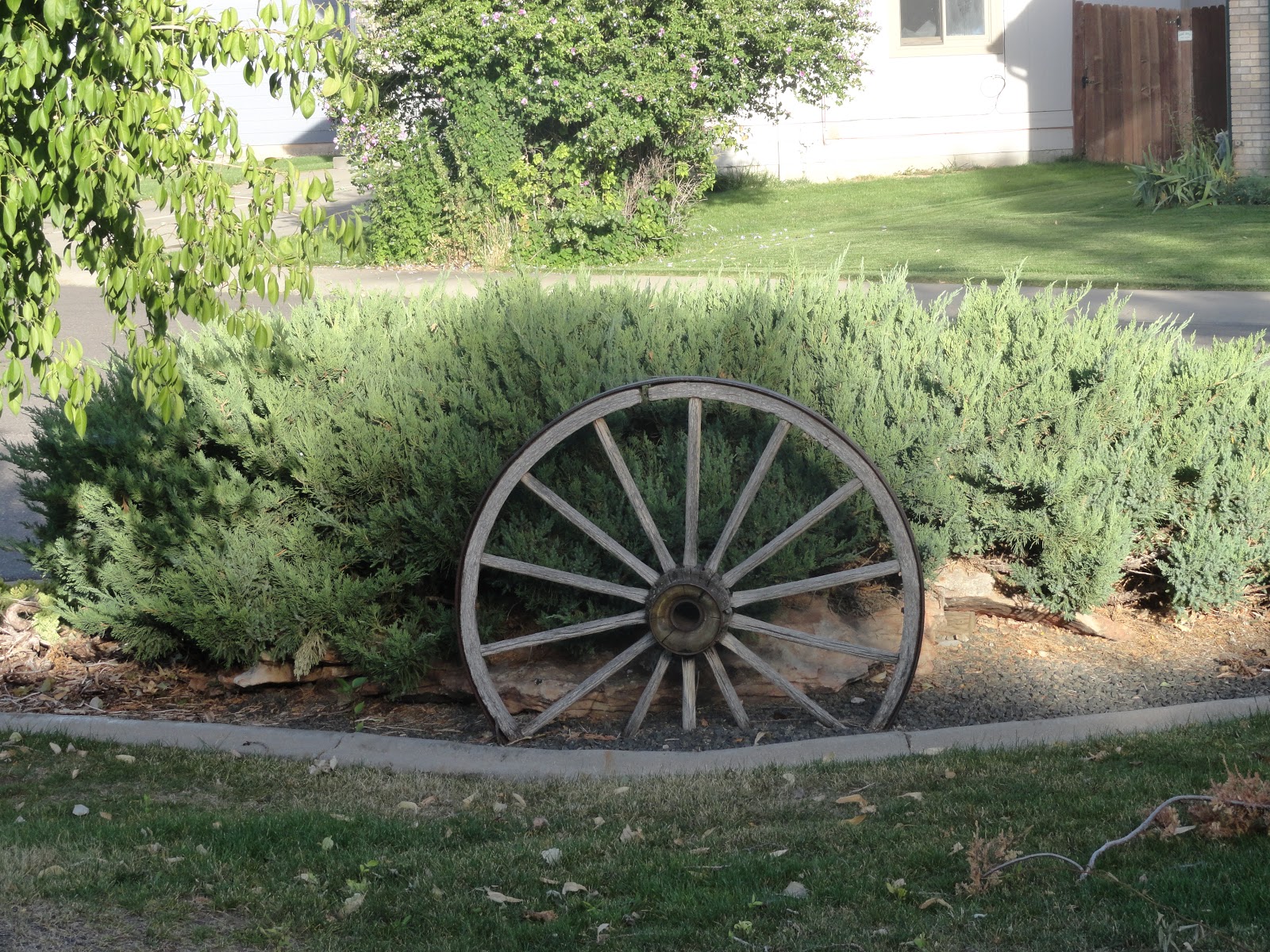
      Wagon wheels spruce up our yard.  One stood by the air conditioning unit just outside the front door.  It was nearly invisible, hiding under the spruces that guard the walkway and entrance to our front door.


     The third one sits in seclusion near the southwest corner of the house where the fence separates backyard from front yard.  It truly is hidden by evergreens that line the walk.


     When we first moved in, a little strip of soil bordering the garage wall had some kind of perennial branch that grew nearly to the eaves of the garage roof.  There was never a bloom of any kind. In the backyard, huge roses grew to over six feet high and blossomed profusely.  They wasted their sweetness on the desert air to paraphrase an elegy-writing poet.
      Why shouldn’t those roses be in the front where somebody might see them?  So I dug out the old plants by the garage and transplanted the three biggest rose bushes from the backyard.
      The roses seemed intent on proving the oldest rule in real estate:  location, location, location.  They emulated the former dwellers and grew up to the garage eaves.  They didn’t blossom.  What is in that soil?
     The roses did spill their canes out onto the driveway and the sidewalk, however.  They need a trellis, I thought.  I looked at various and sundry arbors to support plants.  Anything that fit the bill came with a healthy price tag.
       Why not use a wagon wheel?  It seemed a good idea.  I grabbed a shovel and began moving rocks piled around the wheel near the air conditioning unit.  I made an amazing discovery.  The wheel stood so straight and true without ever leaning because, it was embedded, about six inches of it, in concrete.
      One reason not to use a wagon wheel to support the roses, freeing the wheel from its resting place was going to be a challenge.  A shovel and a hammer didn’t cut it.  Neither did a chisel.
      A trip to the farm produced a crow bar.  Now I was well equipped to chunk away at the concrete, doing my best not to injure the wheel.  It still took a bit of work, but the wheel finally rolled out of its castings.
       How to stabilize the wheel in its new location amongst the roses?   Concrete worked before.  I guess it would work again.  I did not like the concrete around the wooden parts of the wheel.  The wood tended to rot. 
     Therefore, I made a small form, mixed up some Quickcrete, poured it into the form and let it set for an hour or two.  Carefully, I rolled the wheel up onto the stiffening mixture.  It made a dandy impression.  I rolled it off and let the concrete set overnight. 
     I should have let it set for two or three nights.  The small pad stood still for the removal of the forms.  But when I rolled the wheel into place in its track, the concrete went to pieces somewhat.   Still, it made a nice perch for the wheel.  But it wasn’t going to stand there by itself, concrete notwithstanding.
      I bought some four-foot sections of rebar and drove them down on either side of the wheel.  Another trip to the farm yielded some old rusty pump rod.  Those I bent into the shape of an arc as best I could.  I drove the ends of the pump rod into the earth and connected them to the wheel with, what else?  Bailing wire.  Duct tape wouldn’t work for this job.


      There was the trellis in all its rustic glory, glory that would soon be hidden by rose bushes, I hoped. 


                                             Rose bushes a-plenty, actual roses rather rare.

      You too, could have a trellis.  All it takes is a spare wagon wheel, a crow bar, some rebar, a hammer, some old rusty pump rod, a sack of premixed concrete, some 2 X 4’s for forms, a screw gun and screws to hold the forms together, a little water for the cement, and you are good to go.


Sunday, August 19, 2018

Peach Festival


      “Be there at 7:30,” the message said.
     But the race doesn’t start until 8 a.m.  Then we recalled last year.  The 5K run started at 8 a.m. last year, too.  Our quartet was supposed to kick the race off by singing “The Star Spangled Banner.”
     We had met at “our” church before 7:30 to warm up.  We took off before 7:45 in three cars, because two of the guys are Rotarians who had to work after we sang.  (The Rotarians of Fort Collins run the Peach Festival as a fund-raiser.)  Normally, we would have taken one car.  And got lost together.
     The first Peach Festival we participated in was held at the now-defunct Hughes Stadium.  It was a perfect place with plenty of parking.  Last year, and this year, the festival was held in downtown Fort Collins.  With difficulty parking.  Plenty of difficulty.
     We had given ourselves enough time to get to the general area where were to sing, but not enough time to deal with parking problems.  Rex found his way into a parking garage where the lady wearing a Rotary vest let us park free when we told her our mission.  We took off at a brisk walk for the race starting line.
     When we got there, Ted and Dick were there, too—on the other side of a six-foot chain link fence that enclosed about four city blocks.  It was 7:55.  The race manager said he would not delay the race for any reason.
     We tried valiantly to find a way over around or through the fence.  By the time we all four were standing near the microphones,  on the same side of the fence, the Master of Ceremonies was getting ready to do his ten-second countdown that started the race.
      “Five, four, three, two, one, go!”  A hundred or so runners passed through the archway that doubled as the finish line.  There we stood, dressed in our white pants, white shirts, red suspenders, white shoes, red bow ties, red-and-white striped vests, and our tin-pan-alley straw hats.  All dressed up and nowhere to sing.  At least two people rolled out of bed to get there at 8 a.m. to hear us sing.  We even had a fair-sized audience of runner-relatives besides the runners themselves.  How embarrassing! 
     The race manager apologized, saying he had promised not to delay the race for any reason, but we told him we should be the ones apologizing.  We were the ones who couldn’t tell time.
     All this came flooding back as we ruminated over the “7:30” message.  I guess we earned that early notice.  The race managers figured if they told us 7:30, we would be there by 7:45.
     This year had a little excitement, too.  I was just a little tardy for my 6:45 pickup of Rex.  We pulled into Fort Collins before seven.  There just happened to be a convenient parking spot right next to the chain link fence on the southern border of the festival area.
     I pulled in and parked.  We got out in time to hear the security man by the fence explaining to a couple of ladies wanting to enter the race that they would have to follow the fence around until they could find the opening to get inside.  Déjà vu all over again.
      We set off walking.  The security guard took three or four quick steps towards us and said, “Sir, if you park there, you’ll get towed.  They are towing everything in this block.”  Not until then had we seen the No-Parking sign.
      We thanked the guard profusely.  I could just imagine coming back after walking around and singing all morning to find my pickup gone.  Rex took off to find the other two and I turned the pickup around and began searching for another place to park.  This time, I checked out the signs carefully. 
    Three of us were there before 7:25, the fourth arrived right at 7:30.  We gave the Anthem a quiet run-through while standing behind the speakers that belted out some recorded rock of some kind.  Then we waited.
     The race manager, the same guy from last year, asked what we were singing, and how long would it last.  Ted estimated 2 minutes.  The manager said we would be on at 7:56.
      With about fifteen minutes to go, the MC started lining up runners, fastest (most serious runners) to the front, with the slower folks farther back, on back to the parents with children in strollers and the wheelchair pushers last.  
     We stepped up to the table with the microphone at five ‘till.  At 7:56, the MC introduced us and handed Rex the mic.  We belted out “The Star Spangled Banner” at decibels matching the rock music that had preceded us.
       Rex surrendered the mic.   The MC asked the front tier of runners to move up a few steps to the starting line.  “One minute to race start!”  A pregnant pause.  The countdown.  Go!
       A whole herd of runners passed through the start-finish archway.  We were in the clear.  Progress is important.  We had done ourselves one better than last year, anyway.
     As in the past two Peach Festivals, we wandered around the area, stopping here and there to sing a song or two, sometimes to a person we knew, or one who had requested a song.  We avoided the stage in the park area where there were musicians performing.  They were amplified and we were no match for that.
      This year was different in one respect:  It was partly cloudy and cool.  No need to hunt a shady place to sing.       
     We stood right in the middle of an intersection and sang two songs. We sang to some people running various booths.  We nearly always attracted a few onlookers.
       Everything was near-perfect until about 12:30 when it began to rain, catching many a festival-goer standing in line in front of one of the many food vendors.  The rain passed on, the sun came out, and altogether, it was a pleasant day.


Saturday, August 4, 2018

Mouse Invasion


     I stood there on the basement floor, in my sandals and shorts.  The animal headed straight for me.  I sidestepped.  It corrected course to come right at me.  I stepped over it.
      The mouse stopped, confused.  Its jaunt across the basement floor was more of a meander than a scamper or scurry you associate with a mouse in full out speed.  I surmised that it had too much of the wrong stuff to eat.
      It was a little after six a.m., but it was the second close encounter of the mouse kind that morning.  About half an hour earlier, the Goodwife and I were awakened by a rustling we agreed was probably a mouse in our bedroom.
      I couldn’t get back to sleep, worrying about how I would find the breech in our seawall holding back the rodent flood.  So I got up.  I tried to be quiet, hoping not to spook the mouse, knowing there was a trap in the vicinity where he was scratching.
      Instead, I went to the basement to check some traps I had set there the night before.  I hadn’t been down there long before the mouse came across the floor towards me.  I looked for a bucket or something to cover him until I could figure out what to do with him.
      An old-fashioned plunger stood nearby.  I grabbed it and plopped it down over him.  I shoved a dustpan under the plunger and proceeded up the steps, holding plunger and dustpan together securely.  Safely outdoors, I pulled the plunger and gave the dustpan a good flip, sending the mouse on probably his last journey.
      This wasn’t the first time mice have invaded.  Probably the worst invasion happened the winter of 1985-86.
     Dad had been in the nursing home for a while.  He hated it.  He referred to it as “the house of neglect.”  Mom told him if he could get well enough to walk from bed to bath to kitchen, he could leave the nursing home and come home, but she couldn’t get him out of bed and move him in a wheel chair. 
      He worked at it, and finally the day came when he was ready to come home.  It took an act of congress to get the nursing home to release him.  Documents and waivers and releases had to be signed.  All in the name of health and safety, they said.  Probably more to do with losing a paying customer.
        Uncle Ricky and I were both unemployed that winter.  As part of the deal, we would take turns staying with the folks and helping out with Dad’s care.  That didn’t last but a couple of weeks before Mom decided it was easier to take care of Dad than having to feed us boys.  But it was during that time that the great invasion occurred.
     Every morning, part of the routine was emptying the many traps set about the house.  Ricky referred to it as “checking the trap line.”  One of the places the mice frequented was the attic of the west wing that had been added in the 1970’s.
      Mom could smell the beasts.  Even after that invasion was stifled, she would occasionally tell me I had better check the attic traps.  Her bedroom shared the attic with the entryway and the piano room.  Usually, when she told me to check, there were mice caught in the traps.
       The attic traps were the most unpleasant to service.  You had to step up two or three steps on a ladder, push up the attic access door, set it to one side, step up another step on the ladder and peer into the dark attic.  Your face was about a foot away from the traps and their content.
      At first, there were individual traps set out.  But a few of those disappeared when a wounded mouse would crawl off, taking the trap with him.  Mom took a small sheet of 3/8” plywood, about 10” X 16”, and ran a wire across three traps .  She secured the wire at both ends of the plywood with staples.  The wire kept the traps from going anywhere after they had been sprung.  With your head (and your nose) about a foot away from the trap-laden plywood, you reached into the attic and removed it.  Then you could take it all outdoors and clean out the traps.
     Mom also got tired of having to bait the traps.  She took thread and secured a small chunk of cheese to the bait arm of each trap.  The thread went over the cheese chunk and around the bait platform.  Somehow, she tied a knot in that thread.  When the cheese dried, it was pretty secure.
       Set the traps and return them to their place went the routine.  It wasn’t much fun.  Eventually, I discovered where the mice were entering.  It was across the house on the east side where the back porch joined the main house.  Fixing that gap was complicated by a basement window-well abutting both foundations, the house and the porch.  And, there were two upright propane bottles by the window-well and the porch north wall. 
      I tried many ways to plug the hole:  masonry cement--hard to get it to defy gravity long enough to cure and cling in place.  The mice enjoyed chewing through various types of caulk.  They could push aside the steel wool enough to slip by.  Finally, what worked was a combination of steel wool and caulk.  That stopped the inflow into the attic.
     How did they get across the house from ground level to the attic?  I figure they must be going up house or porch wall, going between second story floor and main floor ceiling, perhaps following an electric wire route, using the holes through walls, to make their journey.  Ever after, whenever the mice got into the west wing attic, I would check out the triple witching joint of house and porch foundation and the basement window well.  Fixing it required my hanging down into the window well, turning to my left to look up to see where the portal was.
      The other grand entrance for the rodents was the cellar door.  The cellar door is the old-fashioned exterior set of steps, the one with the low sloping door that swings open to reveal a set of concrete steps leading to another door in the basement wall.  Mice that came in through gaps in that doorway would find traps on the shelf that runs the perimeter of the basement.  They would also find their way to the upstairs.
     The Goodwife always scolds me when she sees a trap in a bedroom or office. “ How do you want to discover that mice are in the house, by finding a dead one in a trap, or find live ones in your pantry or closet?” I ask.
    In the most recent invasion, I caught two in upstairs bedrooms.  I patched two places in the cellar door assembly.  For a week or two, there were no more incidents.  Then the week the Goodwife went with me to the farm, a wave hit.  It peaked Sunday morning.
     After disposing with the loco dustpan mouse in the basement, I checked upstairs.  Sure enough, there was a mouse in the trap in our bedroom.  What we interpreted as the mouse scuffling around was probably the mouse in the trap in  his death throes.  Time to return to the cellar door.
       A corner had pretty well rotted out.  The wood no longer held the screws that secured aluminum wrapping designed to keep the buggers out.  Steel wool and screen filled the gap.  I was fairly certain I had found the breech.
     I did crawl around the perimeter of the house craning my neck to see if any other gaps suitable for admitting mice had developed over the years.  I found two or three other likely places and plugged them as well. 
      We were packed and ready to leave Sunday afternoon.  I was about to lock up when I heard another scuffling, this time in the kitchen cabinet where we keep the pots and pans.  I threw open the cupboard door.  Nothing.
     I pulled out the “cracker” drawer.  There was a bugger staring right at me.  I jerked the drawer out of the cabinet.  He tried to get out of the drawer.  I grabbed a box of crackers and slapped at him to keep him in the drawer.
       Somehow, I opened two doors,  all the while carrying the drawer and whacking at the mouse to keep him in the drawer.  Once outside, I ceased the cracker box artillery and allowed the invader to jump out of the drawer and run for dear life, away from the house.
      Maybe that was the last one, I thought.  Vainly.  When I returned on Wednesday, I had four mice in traps, and one more deceased from an unsavory diet.  All the mice were in the basement, except for one in a trap upstairs, again.
       Time to revisit conventional wisdom.  Rechecking the cellar door, I saw no way a mouse could enter there.  I reset the traps and turned to other pursuits.
      The next morning, I had one mouse in the basement.  He was caught near the water heater.  But the bait was missing in three other traps.  Once again, I was crawling around the house, trying to check the joint  between concrete foundation and wood sill plate.  I put screen on some places they might be able to penetrate.
      The following morning, I had one mouse in a trap near the electrical breaker box on the east wall of the basement.  Two other traps had missing bait.  How can they get the bait out of those traps without triggering the thing?  I can barely set them down without springing them.
      One more search.  This time, I found a very likely leak hole where the cement steps  have pulled away from the house foundation.  Screen and steel wool to the rescue, maybe. 
      But no.  I found one more dead mouse in a trap this morning, again near the electrical box in the basement.  They must be getting in through the east wall.  Back to my hands and knees, shoving steel wool and window screen into gaps.  I shoved caulk into the screen and steel wool plugs to help hold them in place. 
      For tomorrow (and all my morrows) may all my traps be empty traps.  Having finished that job, I turned to the garden.  Two rabbits inside the fenced garden headed for the southeast corner as I entered the gate.  Through the fence they went, encouraged by my shouted epithets.
     “Fence-crawling stinkers,” Dad would have called them.  I used old window screen and lath to try to close that breech.
     I guess I have been called to plug gaps in the fortress walls.  I’ve always imagined something nobler.


Sunday, July 29, 2018

Old Folks Weekend


      It was our time to be a dollar short and a day late.
      A show of old farm machinery was scheduled for Saturday and Sunday.  The Goodwife saw the ad Sunday morning.  It was still Sunday, so we headed for Greeley. 
     The show was to run until four.  We got there at noon.  Some machines were gone.  Others were loaded on trailers getting ready to leave.  A trailer holding a half-dozen “hit-and-miss” one-cylinder engines sat silent.
       An old New Holland bailer held an unbound compaction of corn shucks in its chute.  Several two-cylinder John Deere tractors sat silent, flanked by a collection of Allis Chalmers, a couple of IH tractors, two Cockshutts, and one 2N Ford.


       One of the Allis tractors twisted a dull circular saw.  A man fed some slabs of wood through it.  “Don’t go near there without your ear plugs,” warned the Goodwife.  For some reason, she seems to think my hearing is failing.
      The only other thing moving was an antique orange state highway truck.  Cab and engine compartment were as big as the bed.  It had a flat head straight six-cylinder engine with twelve spark plugs.
      We spoke to the owner of the Allis collection and some of the Deeres.  On Saturday, he said, they used a binder to cut a strip of wheat he had growing on the lot.  They ran the bundles through a thrash machine sitting under a canopy.  They plowed up the stubble with some of the old equipment.  They had a lawn mower pulling contest. 
     That all happened on Saturday. I drove right by it on my way to Loveland. 
     Meanwhile, the Goodwife saw in the paper that Longmont was having a jazz festival Saturday.  It was outdoors.  It was free.  We took off to take a look at that.
     We got there about six.  An eight-piece band from New Orleans was in action.  They played some good old ones in Dixieland style.  A middle-aged lady in high heels and red dress sang without relying on music.  It was outside and still rather warm.  No matter.  We danced on the pavement to two or three.
     No too many couples were dancing.  Most folks found a place in the shade and watched.  Two or three uninhibited individuals dance solo.  One was a guy in shorts capped with a panama.
     About seven, the Dixieland crew packed up and a new bunch moved in.  The lead singer started speaking Spanish, and sang in Spanish, too.  He pronounced it “coo-bah”, not “Que-bah” like we do.
     The bandleader played the bongos.  He was accompanied by a drummer on a trap set.  A trumpet, trombone, a soprano sax player (all white guys!), plus bass fiddle and rhythm guitar rounded out the combo. 
     Latin beat, Calypso rhythm.  My dancing was over for the night. 
     The guy in the shorts and Panama was having a blast.  “I’m going to ask that old guy to dance,” said the Goodwife.  She did, too.
     They danced two numbers.  They were both good.  They did cha-cha or something.  She came back tired and happy.  She and the old guy, who was from Argentina originally, retired military, exchanged cards and agreed to get together again someday.
     It was pretty much the end of the old guy’s solo dancing.  After the Goodwife was done, two or three other ladies asked him to dance.  He left before the band quit at 8:30.  Worn out?
     The whole thing was over at 8:30.  It began at eleven.  Each band played about an hour.
     Maybe it was a good thing we were late.  Nine hours of jazz through a hot day might have been too much.    


Sunday, July 15, 2018

Harvest 2018


      It didn’t amount to much.
     I did a lot of worrying unnecessarily.  Not too much unusual about that.  Worrying about what to do for a grain bin. Should have been the least of my worries.
     Will I need help getting bin ready, setting up auger, etc.?   Needn’t have worried about that.  Wil I be ready when the wheat is ready?  (No, but it didn’t matter.)  What’ll I do if it rains and the weeds starting to grow between the wheat rows get big and gross?  Rain?  What rain?
      But there was a flip side.  Everything went right for a change.  All the old engines fired up without too much difficulty. 
     When I put water in the combine radiator, it began to leak somewhere.  I thought , “Oh, no.”  I decided to start it up and move it out into the sun light where I could see what was going on. 
     Miraculously, when I started the engine (I had to prime the electric fuel pump to get the engine going), the leak stopped.  It was the water pump.  Oh yes, I remember.  The last time I used it, two years ago, it leaked all the antifreeze out and I had to use water for coolant.
   Maybe the water pump seal healed itself with a little liquid and some heat.  But no, as soon as I shut off the engine, the water came dribbling out a leak hole in the bottom of the water pump housing. 
     Thereafter, a ritual ensued.  Start the engine, run  around, climb the ladder, and dump two gallons of water into the radiator.  As long as the engine was running, nothing leaked.  Shut the engine off, and two gallons of water would leak out.  I could live with that, feeling I would have the devil’s own time trying to find a water pump or seal for a 50-year-old combine.
      To get everything ready, I had to use the Ford tractor to extricate the header from the red barn.  The Ford had been running a bit rough lately.  Anticipating that I would need it to run the grain auger, I took the carburetor off and cleaned it out by blowing compressed air through all the apertures I could find.
      It ran after I remounted the carburetor.  It didn’t want to start when I was ready to get the header out a few days later.  After a few head scratches, I figured I must have flooded it with too much choke.  It took off and the header on its trailer was soon in position to go onto the combine.  (“Position” meaning the left trailer wheel has to be in a low spot to allow the combine to raise the header high enough to clear the trailer tire.)
      I was able, with a minimum of backing and readjusting, to get the header and the combine together. Both trucks fired right up.  The swather took some patience, but it too started and crawled out of the way. (I didn’t take my two-year-old grandson’s advice to put the swather in the building before the combine so I wouldn’t have to start the swather every year.)
      The combine had a few issues which could have been serious.  The double pulley that controls the ground speed started squealing and clacking, suggesting a bearing failing.  I tried applying a little oil and it quieted down. 
      Going through light wheat at top speed over rough ground was hazardous to the sickle and the reel.  I had to take a link out of reel-drive chain to keep it from jumping off.  When the reel drive belt jumped off, I spent a few minutes with a Chinese puzzle, trying to figure out how it went around the four pulleys.
     I made two trips to town with the Dodge truck.  The brakes worked!  (Thanks to $300+ of brake booster repair)  No waiting, no problems.  The Genoa terminal has added a row of big steel bins north of the office, including a new outdoor pit to dump into.  A new scale is in the works but not yet functional.  When the new scale is functional, a truck driver will weigh the emptied truck, grab the scale ticket from the machine and be on her way.
     I didn’t have to wait in line.  They actually dumped a semi in the old elevator as I dumped my second load.  Too bad they didn’t have all that storage two years ago when we had some real wheat.
       I began harvesting the afternoon of the fourth, Wednesday, and finished Saturday afternoon, the seventh. It went pretty fast once I got everything ready and got to the field. 
     While it wasn’t a yield to brag about, it was another victory for the ancient ones, including equipment and operator.


Sunday, July 1, 2018

Organic Certification Time


      June comes to an end, the longest day of the year has come and gone, the days get uncomfortably hot, the wheat starts to turn from green to gold, bringing with it harvest anxiety.  It also brings the organic inspector.
      Two years ago, the inspector came as I was emptying the grain bin in preparation for the 2016 harvest. I had to take three or four hours out of my day to visit with him.  As we sat going page by page through the voluminous application I had filled out in February, I couldn’t help but think of the things I should be doing, namely, hauling wheat.
     It wasn’t a problem last year, because there was no wheat harvest.  I did have a bin full of wheat, but I had until September to dispose of the wheat and prepare for millet harvest.
      I was getting a little worried as of last week when I hadn’t heard from the CDA (Colorado Department of Agriculture).  I had their letter saying my application, filled out in January this year, had been found acceptable and an inspector would be getting in touch with me.  It wouldn’t be the first time I had somehow disappeared from their oversight.
      In 2015, I called finally in August to ask about my organic certificate, which had not arrived.  I seemed to catch them by surprise.  Three weeks later, I got my certificate in duplicate, first via email, then by US Mail. 
      When I was doing my taxes for 2015, I couldn’t find a fee for the inspector’s services.  I emailed the inspector, and a week later, I got the bill.  Somehow, I dropped out of sight that year.
      My worries about the inspection came to an end on Monday when an inspector telephoned me to ask if she could come for a visit on Friday.  That’s right.  She.     
     I asked what happened to Mark.  She said they like to have different people look at different operations, so a new inspector.
     On Friday morning, she called about 8:15 and said she was leaving the pavement for the gravel roads.  Our appointment was for 9:00, but I told her she could come earlier if she wished.
     When she arrived, I asked her where should we start.  She suggested we take a tour of the operation while it was still cool.  I said we should take my pickup, since we would cover some rough ground.
      I apologized for the state of the old 4 X 4’s interior.  She laughed.  She said she grew up in Montana in a community the size of Woodrow.  Then I laughed.
      We took a 20-30 minute tour of the place.  She wasn’t a bit worried if the runoff from the pasture could enter the wheat field.  “You can use manure for fertilizer,” she said. 
      I told her about the time the cattle got out and into the wheat as I was working on the combine.  I called Amy, then the head of the organic department, who asked how long they were in there.  When I said about 30 minutes, she said not a problem, don’t worry about it.
      My riding companion shrugged that off, too.  She pointed out that I couldn’t keep the deer out of the field.  Boy is that the truth.
      We looked at the wheat, still a green tint, hail damage apparent.  I took her to the “border” and pointed out the buffer zone between Jim and me.  She wanted to know why I harvested the buffer zone first, because that meant an extra cleaning of the equipment.  (She revealed that she was quite familiar with my application.)   “Most people do it last.  That way, they don’t have to clean the equipment.”
       I pointed out that I don’t have a moisture tester, so harvest the buffer zone, clean the combine off, not much of problem after only two or three bin loads, cut enough for “purging” what I couldn’t get out with compressed air and haul it to town where I could get an accurate moisture test.  If it should happen to be too wet for safe bin storage, the elevator was stuck with it, not me.
      Her turn to laugh again.  “Method to your madness,” she said. 
     I took her north to the windtower road and east to old number 119, the furthest east machine.  She observed that two of the three windmills are located in the CRP.  I indicated where the MET tower used to be and how much of a relief it was not to have to navigate the guy wires, especially with one eye.
      We returned to the house.  She wanted to see where I stored my chemicals.  We had to navigate the interior of the shop.  I apologized for that.  No worries she said.  She seemed satisfied that the chemicals are all in Orrie’s green cabinet where I can lock them up when the grandkids visit. 
     I warned her that I was for all intents and purposes, a bachelor at this location, that she shouldn’t expect pristine housekeeping as we returned to the house to do the paper work.  She reminded me she was a Montana girl, not to worry.  So I didn’t.
     Her laptop was hooked to another screen, so I could see what she was doing on her keyboard.  We zipped through my application.  I had most of my paperwork handy.  She took a quick look at all my clean-equipment affidavits, which was pretty lengthy since it included all of Jim’s equipment used to plant and harvest the millet crop.
     One of the demerits I got last year was for having no documentation for a clean grain bin.  I wasn’t sure I had done that for Jim’s bin, but there it was when I leafed through the paper.
      I had to go to my laptop to find the planting date for the 2016 wheat crop.  That I could find it made her happy—documentation kept and available.  The wheat was an item since I sold it in 2017, since the last inspection.  I have to keep records so that my harvested grain balances with the disposal of that grain.
       She asked if I had grain receipts.  I had those from the trucker that hauled the organic stuff.  I said I could find weigh tickets for that I sold on the “conventional” (as opposed to organic) market.  I said I could probably find them if I dug deep.  “Dig deep, if you don’t mind,” she said.
      I went to the file cabinet where Granny had wheat weigh slips in a file so labeled, some going back to the 1970’s.  I dug out all the 2016 receipts.  She leafed through them and that was that.  In other inspections, we did all the math, including how much for seed, how much sold or given away in buckets.
       When I told her I probably hadn’t sold or given away more than four or five bushels, she said we didn’t have to concern ourselves too much with that.  We went through issues of concern from last year’s inspection, including the mouse poison I keep in the garage.  Did I use it on the organic fields?  No.  Where?  In buildings around the farmyard.  How about the gopher bait?  In the farmyard where the buggers throw up burrows if left unmolested.  But not in the fields?  No.  Checkmark that item and on we go.    
     She signed, then I signed the inspection report on the screen of her laptop with a stylus.  Her start time was listed as 8:30, the end of the interview was 10:00 a.m.  We were done.
     She loaded up her computer and brief case and took off.  She said her next project was helping to investigate some miles of fields adjacent to railroad tracks, where the railroad sprayed sterilant on the track right-of-way and it drifted several yards out into farmers’ fields.  Sounded more interesting than going through pages of an application.
      It was only ten o’clock and I could get back to the summer fallow.  And to worrying about a grain bin for wheat harvest.  My bin is still full of millet.