Sunday, January 3, 2016

Haunted House

     Vibrating and bouncing down the road, I fought back the claustrophobia as I tried to make myself comfortable on the wooden floor of the wheat truck.  Dust in the glow of the truck’s taillights was visible through the back of the truck bed where the tailgate had been removed.  A tarp spread over the top of the truck’s side racks kept the wind and some of the dust off us.
     I was not alone.  Eleven of my classmates accompanied me.  It was a Friday early in September of 1961.  We were nearing the apex of our “initation” ritual that “welcomed” us to high school.  We were freshmen.
     In 1961, upperclassmen still “hazed” the freshmen.  We didn’t call it hazing.  We called it freshmen initiation. 
     We had survived the school day and football practice for some of us, had had our suppers, had gathered at the school where we were helped into the back of the truck and were on our way somewhere out into the country.
     The whole thing began as soon the school year began.  Sometime in the first week of school, we freshmen got our “assignment”.  It was in the form of a handwritten note in my case.  It came from Donna Henry.
     Each freshman was assigned to a sophomore.  It was that sophomore’s job to dream up a demeaning costume for the freshman to wear on initiation day.  “Dream up” is probably not accurate since every sophomore had been through the same process, and as underclassmen, we had all watched the initiation ritual unfold, sometimes with trepidation and dread of when we had to take our turn in the ceremony.  Most of the “costumes” we wore were rehashed from previous initiations.
     In my case, I was instructed to wear a woman’s dress, hat, and shoes.  I had to carry a purse.  I had an onion on a string that I wore as a necklace.  I think I was spared the duty of wearing makeup.
     Fellow students were dressed as babies carrying baby bottles, as farmers or scarecrows for the girls.  During the morning, we had to do, or try to do, whatever an upperclassman instructed us to do, such as carry her books to class for her, or take a bite of the onion, or crawl on our knees from locker to water fountain. These activities took place in the break between classes.  We experienced a respite in the classroom where we tried to concentrate on the subject.
     Right after lunch, we were paraded downtown where we were subjected to trials on Main Street in front of schoolmates as well as any of the citizenry that cared to take in the spectacle.  I remember having to roll a jawbreaker through a trail of pepper.  Try to, anyway.  A fit of sneezing interrupted the process early on.
     I don’t remember too many of the other tortures we were subjected to.  I do remember that one fine fellow had a bottle of alum water that he made us take a swig of.  He was a junior.  Normally, juniors and seniors spectated while the sophomores put the freshmen through their paces.
      After the noon spectacle, we were allowed to take off our costumes and don our civvies.  Still to come were the evening activities, beginning with, the haunted house.  In the meantime, we did our best to get through the afternoon classes, and for most of the boys, football practice.
     So it was that we had all had our suppers, had been loaded into the back of somebody’s wheat truck and found ourselves headed out into the country where the sophomores had found an appropriate old abandoned house, which they had diligently prepared with haunts suitable to scare and disgust us.
     After a fifteen or twenty minute ride, the truck slowed, turned, came to a stop.  I was grateful to get out into the open.  We were sequestered and led through the house one at a time.  I passed through a door full of “cobwebs” when my turn came.  Early on, I was blindfolded.
     My blindfold was slipped long enough to show me a bucket of fish worms.  The blindfold went back on and I was told I couldn’t go any farther until I ate one.  So I reached down into a bucket I couldn’t see and grabbed a worm.  I put it in my mouth.  It tasted amazingly similar to a spaghetti noodle.  I had the good sense not to mention the similarity to my tormentors.  (They may have made me eat a real worm.)
     Moving along to the next station, my blindfold was slipped long enough for me to remove a shoe and sock and stick my bare foot into a bucket of slimy moss, readily available from any of the stock tanks in the area.  My blindfold restored, I had to reach down and grab a handful of the moss and eat it.  I’m not sure, but I think I put my foot in the pan of wet bread that had been placed over the bucket’s mouth.  Anyway, I grabbed a handful and gagged it down. 
     After being subjected to other such terrors, I was shown a ledge of some kind.  In the brief glimpse I got, it looked to be a two or three foot drop.  The blindfold in place again, I was twirled around a few times to thoroughly disorient me and led to the ledge and instructed to jump.  As I landed after about a six-inch drop, two of the sophomores on either side of me grabbed my arms and held me upright and I was back outside.  The blindfold came off and I was done.  I had been officially initiated into high school.
      There were probably other minor tortures I endured in the haunted house that I don’t remember.   But, it was over.  When all of my classmates had been through the gauntlet, we once again mounted the wheat truck and headed back to school.  There the sophomores treated us as guests of honor (I think we got to go through the punch line first) at a “sock hop”, a dance with records on a record player providing the music.
     It was probably called a sock hop because walking on the gymnasium floor with street shoes was strictly forbidden.  All participants removed their shoes to walk or dance on the floor.  There probably wasn’t much dancing.  We mostly listened and watched.  The usual sock hop consisted of the boys in one area, the girls in another, and only the pairs “going steady” danced out in front of everybody.  Of course, the lights were turned down so it was semi dark. 
     We were now bona fide high school students.  There were still indignities for us freshmen, like going last to anything that required a line, or getting the oldest sports equipment, football pads, basketballs, etc., having to clean up after every sports practice, bringing in the tackling dummies, putting away the basketballs, sacking and hauling in the bat collection and the baseballs. 
     After being cocky eighth graders, we were put in our place on the lowest rung of the social ladder.  Besides keeping us in our place, the tradition gave us something to look forward to, when we were sophomores.
      While I remember a lot about my own initiation, I can remember very little about the tortures we put our year-younger classmates through. 
    The only incident I can remember involved a shy, quiet girl we considered “weird”.  In the haunted house, she had to break an egg into a bowl while blindfolded.  She was then instructed to put her hand in the bowl with the raw egg, grab a handful, and eat it.  While she hesitated, a bowlful of cold plain gelatin was substituted for the egg bowl.  She put her hand into it, but the thought of putting the stuff into her mouth was too much.
     She knocked away the bowl, shoved her tormentors away, ripped off her blindfold and generally went berserk.  With difficulty, her keepers got her out of the house where she calmed down.  Her initiation was over.  The haunted house portion of freshmen initiation was over too, I believe. 
      The principal-superintendent accompanied us and our freshmen to the site.  (There was a teacher or two with us when we were freshmen, there to see everything was safe and didn’t get out of hand.)  The principal was appalled by the state of the old house we had chosen to rig up. He felt everybody, not just the freshmen, was in danger in the rickety old building.  We carried on under his wary eye, but he vowed that such a practice under such unsafe conditions would never happen again under his watch. 
     Thereafter, he would inspect the house before the sophomores could fix it up for the freshmen.  I don’t think a suitable house was found the next year, or the next, and the practice of the haunted house died.       
    The truth is there was a dearth of suitable old houses in the countryside.  All the old houses were destroyed either by the elements or by a farmer who wanted to convert the site to farm ground.  The last old house in our neighborhood went down in 1989 during the storm that spawned the tornadoes that ripped through Limon.  Today, remnants of the roof brood over the collapsed shambles beneath it like an old mother goose protecting its nest even in death.  
      Like the old houses, freshmen initiation has passed into eternity.   
     In pace requiescat.   


Sunday, December 27, 2015

Frank’s Place (Again)

     As the 19th century turned into the 20th century, a small settlement of Bohemians formed on the southern edge of a Norwegian community known as Walks Camp.  Suchanek, Twoya, and Horak are the names I remember. 
     When I was a kid, Willie Suchanek was still a neighbor.  In my earliest memory, he lived in a trailer house on the Pratt place just north of us.  He sold Farmers’ Union insurance.  I think the trailer house was a summer residence.  I think he owned and lived in an apartment house somewhere in Denver most of the time.  Later, he would buy a place in Windsor Gardens when it was new.  He would reside there for the rest of his life, when he wasn’t farming or selling insurance in our neighborhood. 
     On the corner of what is now Road 28 and Road P stood the Suchanek school.  During my life, that quarter section was owned by Roy Ratliff and now by Lee Andersen.  Homer Hill lived there for a time, but I believe he rented it, probably from the Ratliffs.
      I know the name Joe Twoya because he homesteaded the quarter where our family farm now exists.  We are the third owners, our father having bought the place from the Kollaths who replaced Joe.  Legend has it that the small one room shed that stands just west of the schoolhouse-turned shop in our farmyard was Joe’s homesteader shack.
     I am sure there were other Bohemian families in the community, for I remember stories of other “foreigners”, but I can’t recall names.  That brings me to the name Frank Horak.
      Frank was still alive when I was a kid.  I only was around him once.  He was a frail old man with white stringy hair hanging down from under his hat, over his ears and his shirt collar, sometimes over his forehead and face.  He sat in Willie Suchanek’s Dodge pickup, door open, slobbering and spitting tobacco juice into the stubble field.  We avoided the water jug he used.
      I only recall him saying two things during the day or two he came to Willie’s field where we were harvesting his wheat.  He asked us kids, in reference to the Massey-Harris combine Dad was driving, “Where’d ya git the bitch?”  His voice was pretty much a squeak.  I think we answered respectably, but we wanted to laugh, have laughed many times since then, at his phrasing.  That was improper language in those days, especially from an adult.
     The other thing I remember him squeaking out came as Dad was working on the Massey and a thunderstorm menaced us from the west.  “It’s gonna piss, Connie,” he said.  I’m pretty sure we laughed then, and since then, too. 
     “Haven’t heard that for a long time, Frank,” Dad replied, laughing a little himself.
     Whatever else I know about Frank is hearsay, gathered from Mom and Dad’s conversations.  Mom used to quote Frank, using his pronunciation when he voiced his opinion of the financial institution that held his mortgage:  “Federal Land Bank t’ieves.”  The Federal Land Bank foreclosed on him and forced him to move off his homestead
     Frank lived out the rest of his life in a small house in South Limon.  Willie Suchanek was his caretaker.  Willie’s mother was a Horak, Frank’s sister.  I think Willie must have provided Frank with housing and other necessities that the “old age pension”, as it was called then, didn’t provide.  When Frank died, Willie made the house his residence when he was in the territory.
     Dad used to tell the story of Frank, on his way to town, meeting neighbors returning from town.  He invited them to take a break at his place and help themselves to a cup of coffee, still on the stove apparently.  The pair stopped at Frank’s place conveniently located about thirty yards north of what is now Road 3N.  In Dad’s story the two neighbors opened Frank’s door, started to enter, stepped back, saying “Phew, Frank!”  They slammed the door and continued on their journey.  Apparently, Frank, a lifelong bachelor, was not a very good housekeeper.
       Another story came from Nate Einertson.  The Einertson place was a couple of miles west of Frank’s on Road 3N.  The only things marking that homestead now are a couple of trees a hundred yards or so south of the road.
     We were in what is now Oscar’s Bar and Grille after a Sunday dinner.  Nate was sitting with Ida and a bunch of widows.  He apparently got tired of the women chatter so he came over where I was sitting, waiting for Mom to finish her conversation with the ladies.  Somehow, our conversation turned to Frank.  Nate said he was born in Frank’s house. 
    That got my attention.  I asked about the details.  Nate said his parents, Alfred and Olga, were just married.  Alfred hired on to help Frank with the farm work, and part of the deal was room and board for the hired man.  Frank conveniently hired the new bride to cook and keep house.  They were still living there when it came time for Nate to enter the world.   He was born in Frank’s house.
    Some time after Nate was born, Alfred moved the family to a farm west of the Blakstad place.  As a result of that move, Ida Blakstad became literally Nate’s life’s mate.
     In my earliest memories, there were still a few buildings left on Frank’s place.  Before I was born, Dad bought Frank’s homestead (from Federal Land Bank, tax sale? I don‘t know), three quarters of section, which is today mostly our pasture.
     I remember an old barn on the north edge of Frank’s farmstead, north of the Lickdab creek.  There remains a row of eroded concrete to mark one edge of the barn.  I remember Dad using the barn as a loading and working corral.  I wasn’t old enough to go to school so I was on hand when the cattle were loaded onto a truck for a trip to Denver to market.  Harold Drier was the truck driver.  After loading the cattle, Harold helped Dad castrate the younger bull calves.  Being too young to be in the pen where the action was taking place, I wandered around outside the old barn till the job was done.
      The old barn collapsed after that.  Dad used some of the lumber from the old barn to fashion a new corral with a loading chute.  I thought the new corral with its vertical boards nailed to horizontal rails made a dandy stockade.       
      Two other buildings stood south of the Lickdab, a granary and Frank’s house.  I don’t remember exactly what happened to the old granary, but I think it got torn down about the same time and for the same reason as Frank’s house.
    The house sat on a basement with amazingly thick cement walls.  No house built on sand for Frank.  The cement basement is all that remains today. 
     I don’t remember too much about the house.  It was two story, about 25 feet square.  There were never any doors or windows in the house.  The wooden stoop had rotted away.  To get in, you had to hoist yourself up to the threshold until you could get a knee in.
      We once had a cow named Brownie.  She was a Brown Swiss.  Her feet had been frozen as a calf with the result that her hind hoofs grew fast and in abnormal shape.  She couldn’t walk very comfortably.  She always limped and clicked and snapped more than any normal cow when she walked.
     One time when she was in the pasture that contained Frank’s house, a hail storm came up.  It was pretty vicious.  At chore time, time to “go get the cows”, Brownie was nowhere to be found.  Finally, we looked in Frank’s house.  There she was.  The old cripple had made the leap up into the house all right enough.  We accused her of goldbricking all that time.  Getting her to make the leap out of the house was a challenge.
     There was a steep narrow-stepped staircase to the upstairs.  I remember going up there a few times.  With a little imagination, you could see yourself up there with Tom Sawyer and Huck Finn with Injun Joe and the other bad guy down below.  In the story, Injun Joe is on his way upstairs to check things out when the staircase comes crashing down, dumping Injun Joe on the floor and perhaps saving the boys’ lives.  I think Frank’s staircase might have been a little Iffy.  Nobody ever fell through it, though.
     Frank left quite a few things, old clothes and such, when he abandoned the place.  We mostly threw stuff out or destroyed it.  I remember a can of green tea powder.  We thought it was probably strychnine or something. 
      Though we would go inside the house and upstairs, we never went into the basement.  The stairway to it was outside.  There was a door at the bottom of the stairs.  It was mostly closed.  I’m not sure we could have opened it if we had ever dared to try.  I’m not sure exactly what we expected, except one thing.  There might be snakes down there!  That was enough of a deterrent.
       One other significant feature of Frank’s place was a cottonwood tree that stood in a little dip in the terrain north of the house, just south of the Lickdab.  The cottonwood was dead, but it provided an otherwise rare commodity for us—a tree big enough to climb.  It lost that attribute as the wood rotted and the branches could no longer be trusted to support a climber’s weight. 
     The tree fell over in a windstorm.  Today, nothing remains to mark its existence.  Dad always said Frank salted the tree to kill it.  He didn’t want the Federal Land Bank “t’ieves” getting his tree.
     In the mid-fifties, Dad decided he needed to replace the old red barn.  The new barn would be built out of reclaimed lumber, much of it to come from Frank’s house and perhaps his old granary.  When the wheat was planted and the hay cut and stacked one Fall, Dad began tearing down Frank’s house. 
       Mom was giving piano lessons three or four days a week. Little Sister wasn’t old enough to be in school, so Dad was child care provider two or three days a week.  One day while accompanying Dad to the destruction site, Sister stepped on a nail sticking up through a board, necessitating a trip to Hugo for cleansing, dressing, and the obligatory tetanus shot.
     A second thing occurred that was both much more serious, and much less serious.  Dad was having some difficulty with some job and was muttering, carefully, realizing that little pitchers have big ears.  Apparently, Sister had heard enough of his muttering, and in the spirit of helpfulness, she said, “Why don’t you say ‘sonny bitch’ Daddy?  That’s what the boys do.”
      Of course, we laughed when we first heard the story, but then there was the serious side.  Using profanity was not tolerated, and we had been ratted out by our little sister!  We probably got a stern warning, though not stern enough that I remember it.
     Today, all that remains of Frank’s place are the concrete structures, the house’s basement, now filled with trashed tin cans and old wire and such, the granary floor, and a piece of the barn’s foundation.  An old well is covered with a car frame and wire to keep the cattle from falling into the it.  Looters have removed anything of value, things that we considered junk, such as the kitchen stove, and an old hand-cranked coffee grinder, being the only two things that come to mind.
      There is very little to remind a person of Frank’s existence, a problem for us mortals. Perhaps Shakespeare said it best.   
     
SONNET 65
Since brass, nor stone, nor earth, nor boundless sea,
But sad mortality o'er-sways their power,
How with this rage shall beauty hold a plea,
Whose action is no stronger than a flower?
O, how shall summer's honey breath hold out
Against the wreckful siege of battering days,
When rocks impregnable are not so stout,
Nor gates of steel so strong, but Time decays?
O fearful meditation! where, alack,
Shall Time's best jewel from Time's chest lie hid?
Or what strong hand can hold his swift foot back?
Or who his spoil of beauty can forbid?
   O, none, unless this miracle have might,
   That in black ink my love may still shine bright.
          
    May Frank live on, a pioneer, homesteader, and character, in the humble words of a little kid’s memory.


Saturday, December 19, 2015

Chemotherapy

      “You need to come in so we can redo your mammogram.”  Words a woman never wants to hear.
      There is no need to panic yet.  The voice on the cell phone explains that the radiologist saw a spot and wants to investigate further.  It may be nothing, but he wants to err on the side of caution.
      In July, the Goodwife showed up for her second mammogram.  A few days later, the voice on the cell phone informed her she needed to schedule a biopsy.  The biopsy was painful.
     The physician probed the breast using the X-ray image to locate the small growth.  After taking a tissue sample, she implants a small chip next to the tumor so it can be found easily next time, if there is a next time.
      Wait and hope until the pathology report arrives.  The news is bad, but not the worst.  The tissue tests positive for cancer, but not an aggressive cancer, a “garden variety” of cancer, as the radiologist put it.  He could have stopped there, but he didn’t.  “The kind you get as you get older.”  Double whammy, but still not as bad as it could be.  It’s not an aggressive cancer.
      Wherever our life was headed, it now turned a new direction with a new driver in control of the wheel.  Would she be able to do the shave-ice business in August?  Yes, since the cancer was not aggressive, there was time to think and plan.  The lump must be removed. 
     Consultation with the oncologist (she spoke Japanese, so she and the Goodwife had a great time chatting) who recommended a surgeon, followed by a visit with a navigator who was to coordinate the patient’s visits with all the different doctors, nurses, technicians, etc.  Surgery was scheduled for late August.
     The surgeon and oncologist recommended a partial mastectomy, or lumpectomy in layman terms, rather than a full mastectomy, complete removal of the breast.  The surgery itself was fairly simple, open the flesh enough to cut out the growth, knife and scissors, the surgeon said.
     There were things that had to be done prior to and following that operation.  A technician inserted a wire through the side of the breast to the telltale chip left there during the biopsy.  That was done pre-surgery with a local anesthetic.
      When the surgeon came to visit with the patient just before the surgery, he was studying an image of the breast where the wire running through her breast and the chip were clearly visible.  He also had her mark her breast with a magic marker—no cutting into the wrong breast. (Why have her do it? It might upset some guys to have a strange man writing on his wife’s left breast with a magic marker.  It took me awhile to figure that out.  Maybe I haven’t figured it out yet.)
     Then the anesthesiologist took over.   By that time, we had been there over two hours.
     The Goodwife was wheeled off again, and we wouldn’t see her for another two or three hours.  During that time, the lump was removed, she was taken to X-ray to see if the lump was all gone, and two of her three “sentinel lymph nodes” were removed.
      A couple of hours in the recovery room, and the day was about done.  The surgeon’s post-op report had good and bad news—the lump was small, less than a half inch, and was completely removed with healthy flesh all around it.  But, the first sentinel lymph node tested positive for cancer. 
      The lymph system is the body’s garbage collector.  The nodes collect the waste and send it off to either the kidneys or the bowel for disposal.  That the lymph node was infected indicated that the cancer had moved and was not completely localized.  We were in for some more testing.
      Somewhere along the line, a study group recruited the Goodwife.  That made the decision of what regimen to follow a little more difficult.  The study wanted ladies with early stage breast cancer.  The ladies in the experimental group would skip the chemotherapy and undergo radiation and endocrine therapy.  The ladies in the control group would follow the normal regimen, chemotherapy followed by radiation and endocrine therapy.
      The study group recruiters were especially interested in enlisting the Goodwife because of her Asian background.  They needed the diversity, but apparently, breast cancer in Japanese women in Japan is rare.  Breast cancer in Japanese women transplanted to the United States is much less rare.
      Initially, the lure of participating in the study was the possibility of forgoing chemotherapy.  Participants will be closely monitored for fifteen years, another good reason to participate.  In order to participate, the Goodwife had to undergo some additional testing.  The panel had a method of scoring her tumor and her overall fitness for becoming a participant.    
     The small size of the tumor was acceptable.  Her oncologist ordered a PET scan to be sure there were no other tumors or signs that the cancer had spread.  She passed that test.  She was in the study.  Now, would she be part of the experimental group and skip chemotherapy?  Supposedly, it was a random draw, half the women in the control group, half in the experimental group.  In reality, the final decision was up to her.
      In order to make that decision, it was necessary to know what her standard procedure would be.  A jury of her superiors, the oncologist, the surgeon, radiologist, perhaps some others we did not know, came up with a recommendation:  twelve weeks of chemotherapy consisting of six treatments every two weeks.  Later, they revised that to twelve weeks with four treatments every three weeks.
     The decision was made over a period of two or three weeks while she recovered from the surgery.  Ultimately, she decided to go with the chemotherapy because if there were cancer cells floating around in her body, the chemotherapy should eliminate them.  It seemed the safer bet. 
      A truckload of information then fell upon us.  We went to “chemo school” where we were introduced to a bundle of drugs such as Ativan (anxiety and nausea relief), dexamethasone (steroid for nausea and other allergic reactions), Zofran and Compazine (anti-nausea), Cytoxan and docetaxel (the cancer killers, the “chemo”), Aloxi (anti-nausea), Gabapentin (foot pain), and Neulasta (given by injection on day 2 of every cycle to stimulate white blood cell production).
     The decision to go the chemo route meant another trip to the surgeon to put in the “port” through which the chemicals would be administered.  That was surgery, complete with pre-op meeting, the anesthesiologist, the recovery room and the fatigue following the surgery.  That was on Friday.  The first chemo was scheduled for the following Monday.   
     We weren’t the best of students in the chemo class.  The day before the chemo treatment, the Goodwife was supposed to take the steroid dexamethasone twice, morning and night. That would be Sunday. We went to a wedding in the Eastern part of the state that weekend.  We had neglected to pick up the prescriptions at Wal-Mart pharmacy before we left town Friday.
      When we came back Sunday afternoon, the pharmacy was closed.  It soon was obvious after visiting with the Wal-Mart manager on duty that it would be easier to open hell’s gates and let out some of the condemned than it would be to get a pharmacist to open the Wal-Mart pharmacy gates and get her pills.
      What to do?  In our schooling, the Nurse Practitioner gave us some important information to be placed on the refrigerator door.  We had done that all right.  The phone number for all inquiries was the same, the cancer center number.  Calling that number got us the answering service, the real live person kind.  She relayed our call to the doctor on call, who promptly called us.
      We explained what we had done, or neglected to do.  He said it was important to take the drug, she should take it that night even if she missed the morning dose, and did we have a 24 hour pharmacy close by?  We found a Walgreen’s with 24-hour service, where eventually we got her prescription filled and her pills taken.
    The first thing Monday morning I called the cancer center and explained the situation and asked if we should go ahead with the chemo.  Yes, we should.  Should she take a second dose of the pills she failed to take yesterday?  No, she should not.  Part of the infusion included some of the same steroid drug, so come in as scheduled, which we did.
      The most painful part of the chemo was about to occur.  Since the port had been installed only three days before, the area was still swollen and tender.  The first nurse couldn’t locate the port and tried injecting the initial saline solution into tender flesh surrounding the port.  It was terribly painful.  A more-practiced nurse succeeded in finding the port on the third try and things settled down to the humdrum boredom that would become routine.
     The routine consisted of running a needle into the port.  A nurse friend advised us to ask for a prescription for a numbing salve.  Putting the salve on about fifteen minutes before we arrived at the cancer center made accessing the port much less painful.
     The nurse drew blood and sent it off to the lab to see that things were okay before administering another dose of the chemo.  Nothing to do but wait until the lab reports came in. When they got the go-ahead, the nurse would dress herself up and hook her up to a bag of Cytoxan.  (It gives you pause to think that the stuff is so bad that the nurse wears protective clothing, and they’re dumping that into your body.  They do deal with it several times a day, the patient only once every two or three weeks.)
     When that was done, she would get a bag of docetaxel.  Each of those treatments took over an hour each.  With flushing lines and other such necessities, the procedure took four hours. The first time, there was a lot of apprehension, which kept things from getting boring.  After that, we took stuff to read or work on to pass the time.
     On day two, the patient got an injection of Neulasta to stimulate her white blood cells. One of the nurses said they had far fewer chemo patients in the hospital since they began using that drug. 
       Nausea was not one of the side effects the Goodwife experienced, something she was extremely grateful to avoid.  Fatigue was common to all four cycles.  The worst side effects seem to come from the Neulasta.  After the second day injections, the Goodwife would experience pain in her bones for two or three days.  The worst was the pain in her feet, which made walking difficult. 
      The PA sent in a prescription for Gabapentin for the foot pain, but somewhere we missed that act.  Finally, Wal-Mart called and said we had three days to pick the prescription up. I did go get it, but the Goodwife had gone to Hawaii where she worked at cleaning up her mother’s apartment.  (She got home from that on Thursday and on Friday left for McCook, Nebraska at 4:30 a.m., returning about 8 p.m. Friday.  So much for letting chemo interfere with normal activities.
       This Monday, she took her last dose of chemo.  The Neulasta injection was postponed until Wednesday due to the snowstorm that struck Monday night.  After her injection, all the nurses on duty escorted her to the lobby where there is a sign on the wall and a bell.  We all read aloud the sign and then she rang the bell.  It was a very touching moment that neither of us was prepared for.

    The sign says, "What Cancer Cannot Do.  It cannot and will not . . .destroy confidence, cripple love, shatter hope, take away peace, corrode faith, kill friendship, shut out memories, silence courage, reduce eternal life nor quench the spirit."

    She will have the Christmas season to recover.  In January she will undergo radiation, five days a week for four weeks.  She’s part of a study group, there, too, evaluating skin cream used to deal with side effects of radiation.
    Then she will begin the endocrine therapy, which may go on for years, I understand. 
    Moral:  Live clean.  Avoid cancer.                    
     Like all good advice, easier said then done. 


Sunday, December 13, 2015

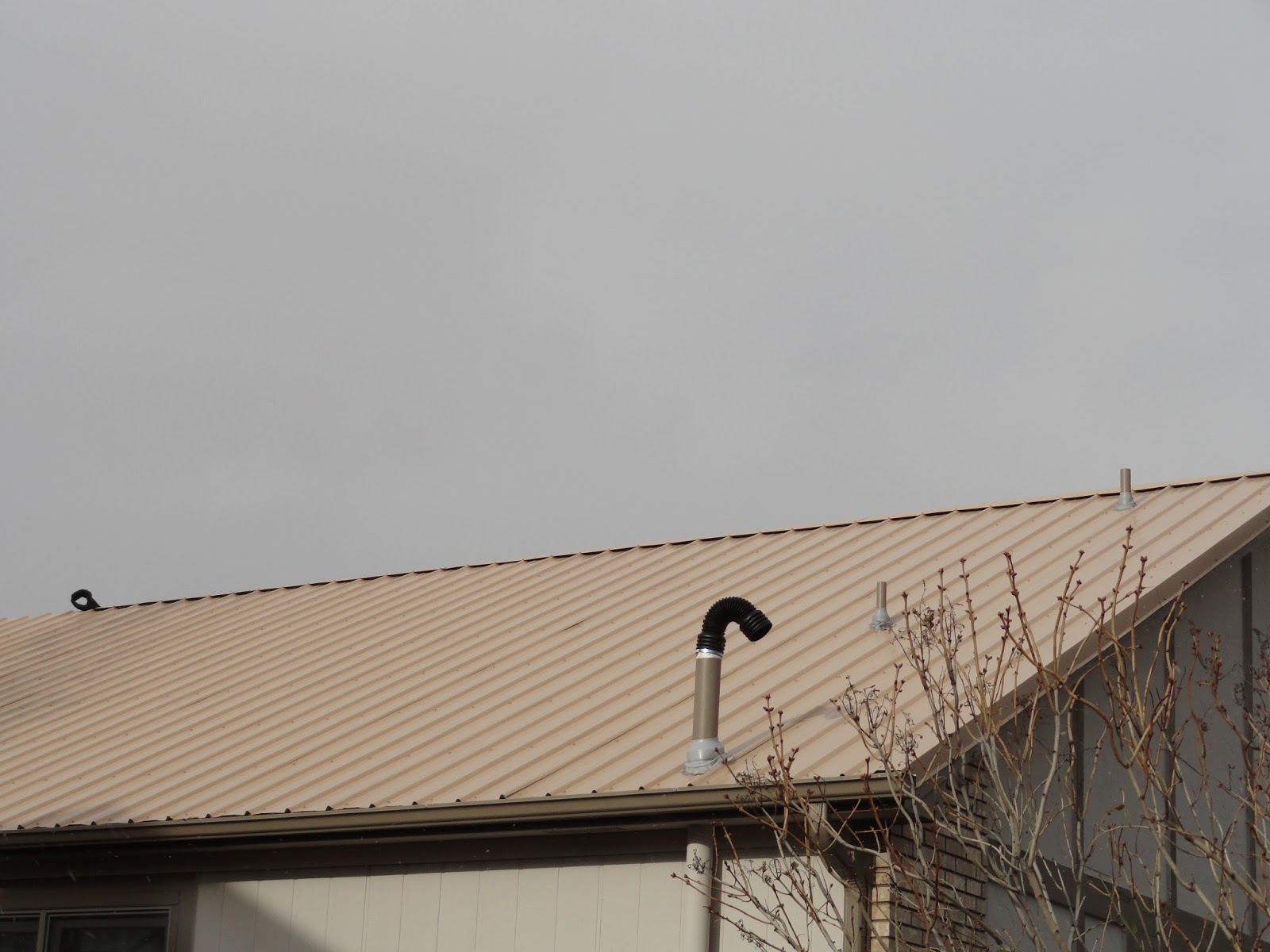
Roofing It--Again

     “I’ll never do that again!”
      Never say “never.”  You would think that a person who has spent nearly seven decades on the planet would have learned never to say “Never again.”
      The last time I uttered those two words was probably in the Fall of 2012.  I finished a roof in Atwood for a friend, Floyd.  I had reluctantly agreed to do that. A year or so earlier I had done a roof for Floyd’s nephew, Tom.  I guess Floyd thought I had done a good job on Tom’s house, so he prevailed upon me and I caved.  It was a fairly easy roof to do.
      That vow would soon be broken as I agreed to put a roof on an old one-room schoolhouse sitting in a farmyard near Achilles.  (That’s right, there is a place in Northwest Kansas called Achilles, only it’s not pronounced uh-KILL-ease like your tendon or the Greek hero of the Iliad.  It is pronounced uh-CHILL-us.) Like our own farm shop, the old schoolhouse had been moved from its original site and converted to a farm shop. 
       The school’s interior held saws, grinders, a drill press, other equipment necessary for a wood-and-metal-working shop.  The walls were covered with stamped metal such as you see on the ceilings of old buildings.  I’ve never seen walls covered thus.  The metal paneling was still in good shape, too, considering that it has been used as a shop for years.
     The old shop deserved a new roof.  Besides, it was a very simple roof to do.  The only protuberance was a brick chimney on one end of the roof.  No vent pipes, no skylights or valleys.  The only cutting was ripping the last piece to fit.
     All three of these roofs were metal.  I was able to do all three roofs because I had the help of Joe, a former student.  Joe, in a previous career, had been a lugger in a beef plant in Garden City.  Prior to that he had been a football player and a weightlifter.  Joe could lift anything that wasn’t tied down.  Lugging a half of beef around the cutting floor was nothing for him.  He insisted on doing all the heavy lifting during our three roof jobs, which was a great help to me.
     Joe loved tearing things down, or up. He was great at ripping off the old shingles.  The only problem was he didn’t like the heights or the steep slopes that much.  Tearing off wasn’t so bad because there is always gap in the sheeting or some way to get a sure foothold. 
     The old schoolhouse had two or three layers of wood shingles which probably went back to the turn of the century.  I am sure the dirt we uncovered went back to the dustbowl days of the 1930’s.  It was absolutely the dirtiest roof I have ever had the fun of tearing off.  To make matters worse, we had the misfortune to choose two of the windiest days of that Spring to tear off the old shingles and put down the fabric. 
     The dust would fly up into our faces.  The thin old wood shingles would follow the dust, into our faces, all over the farmyard.  When we cleaned up after we were done tearing off, we spent over an hour in the alfalfa field south of the farmyard picking up wooden shingles.  I know we didn’t get the half of them either.  Some poor cows probably had to spend the next winter sorting the cedar chunks out of their daily hay rations.
      We made a temporary end gate out of a sheet of plywood in the old Chevrolet truck.  The sixteen foot bed with 42 inch sides was stuffed full with the shingles from that one room schoolhouse. When I went to dump the load at the local landfill, the hoist wouldn’t raise the bed, so I emptied the entire load by hand.  Later, I learned the hoist had leaked out all its oil.  A gallon of oil would have saved me a lot of work.
     Joe and I put the new roof on the schoolhouse in pretty shorty order, with the only hang up being the “roofjack” around the old brick chimney.  I thought sure I had done my last roof.
    Then we bought the Loveland house.  Our building inspector took some pictures of the roof while doing his pre-purchase inspection.  The insurance company asked to see the building inspector’s report.  Before they would insure our house, we had to send them a “streetview” snapshot of the roof.  They insured us with the caveat that the roof was near the end of its life.  That was their way of saying that when we went to reroof, don’t call them.
     We did get a break on the price of the house for the nearly-expired roof, but if I had to do it over, I would offer the asking price with the stipulation that the seller provide a new roof.  However, at the time, we were tired of house-hunting and afraid someone would come along and better our offer.  So here we are, a year later with the same ancient roof.
    All over the cul-de-sac this summer and fall, signs sprang up in front yards advertising local roofers.  Following the signs’ appearance came truckloads of shingles on flatbeds with conveyor belt arms.  It took the trucks longer to maneuver into position where the conveyor arm could reach the roof than it did for the two-man crew to send the shingles up to the rooftop.
    Two or three days later, along would come a crew of four or five guys and by nightfall, the old roof would be gone and the new roof would be installed.  It came to pass that there was only one old roof left in the cul-de-sac: ours.  Not that I had been sitting idly by all this time.  Actually, I had been ruminating since we bought the house in October 2014.
      I wanted a metal roof, but I knew to get that, I would have to do it myself, for two reasons.  For some reason, even though the materials for a metal roof cost very little more than the materials for an asphalt roof, roofing contractors charge two or three thousand dollars more to install a metal roof.  Charging more for labor doesn’t make much sense because in most cases a metal roof goes on much faster than putting up a bunch of individual shingles.  In addition to the higher price, as I watched the crews shingle the neighbors’ roofs, I uttered such blasphemies as, “I’ll bet they get called back to redo that,” and other similar disparaging remarks.  I couldn’t really trust a roofer to do a metal roof correctly.            
     There were some hurdles to be cleared before I could take on the job myself, one being as a doctor recently suggested to me when I called on him about an eye problem, that I had enjoyed too many birthdays.  The bigger problem, however, was the homeowners association.  Would they allow a metal roof? 
    As the new roofs sprang up in the neighborhood, so did roof salespersons.  One day a lady called me and said she saw me up on my roof.  “Are you thinking about a new roof?” she asked.  Why yes I am.  She would be happy to visit with me.  I said I was thinking about a metal roof and I was thinking of doing it myself.  She assured me her company could do a metal roof, but I had better check with the HOA.  She sounded a bit incredulous.
     I assured her that I had considered the HOA , and the reason I was up on my roof was to measure, figure the cost, and send a proposal to the HOA.If they rejected a metal roof, I would be in the market for an asphalt one. She would call me twice more.  I still had not heard from the HOA the last time she called.  Another fellow caught the Goodwife when I was not home.  He followed up with her at least three times.  Finally, all calls stopped.
      To prepare my proposal to the HOA, I visited the ABC Supply company at their Fort Collins branch.  I groaned as I pulled up in front of their door.  A big sign said beside the door read, “This is not a retail business.  You will need to work with a dealer or contractor to purchase from this store.”  
     “Bein’s as how I had went this far” (to quote a graduation speaker we once had), I decided to go in and have a little talk with them.  When I was in the siding business, I got many an advertisement from ABC wanting my business.  If push came to shove, I could open an account.
     Jason, the Walt Weiss look-alike manager, said I could go through Lowe’s or Home Depot.  I said I guess I could go to Lowe’s.  Jason groaned, glanced at me, said, “Lowe’s.”  Pause.  “I’ll work with you, but it will have to be a strictly cash deal.”
      “Check or credit card?” I asked.  He was fine with either.  So I took two brochures, one showing the styles of raised-rib roofing available, the second showing various colors.  Both pamphlets had pictures of nice houses with metal roofs.  Yes, there were a few barns and sheds, too.  Maybe the HOA people would get the right picture.
     I filled out an architecture committee application necessary before doing any exterior work and included the pamphlets with our choice of roof style and  color sample prominently circled, and put it into the mail.  It went to Denver. 
      A few days later, next-door-neighbor Bryan called upon us.  It turns out he is on the HOA’s architecture committee.  He had my application, the one I sent to Denver.  He asked me a few questions about what I planned to do.  I explained as well as I could.  I dug out the computer and the thumb drive and showed him pictures of the farm roofs.  The Goodwife mentioned the mansion on a lake north of us with a raised rib metal roof.
      Brian told us the architectural committee used to have two members, but the lady had just resigned, so he is the architecture committee.  He said he didn’t see any problem.  A few days later, I got an email from the HOA head woman with an attachment containing my application and the notice it had been approved.
      Next thing to do: get a building permit.  That could be done mostly by email.  It took three tries before I understood I had to put an exact dollar amount on the total project cost.  Then I had to report to the city building office and pay the bill--$261.54.  They charge a percentage, like a sales tax, on the project cost.  I had to have two inspections, a midroof inspection with the job somewhere between 25 and 75 percent done, and then a final inspection, the lady informed me.
     Two more things to do now: finalize the order with ABC.  Once we got the order figured out, I had to go back to Fort Collins and pay him before he could submit the order.  I gave Jason my credit card.  He came back.  “Do you have a daily limit?” he asked.  “It was rejected.”  He wanted to say, “You are over your card limit, you bozo,” but he refrained.  My turn to be incredulous. 
     “Wouldn’t take it?” I asked. He nodded and looked at the credit card slip.
     Then he said, “Oh.”  He showed me the slip.  It said “$54,000.”  He had tried to charge $54,000 to my credit card.  He wadded up the slip.  “We better try that again.”  This time it went through, with one less zero on the slip.  One thing left to do.  I called the city and ordered a rollback dumpster, seven feet by twenty feet.  I couldn’t see myself making four or five trips to the landfill with the poor old Dakota. 
     Now I was committed.  The roofing materials arrived one day, the dumpster the next.  The delivery man from ABC had a forklift on the back of his trailer.  He carefully stacked the roofing sheets in the driveway where the Dakota usually sits.  He put the trim pieces on top of the roof panels.  After he left, I moved the trim pieces to the back yard and covered them with a tarp.  They were in separate packages that I could carry by myself.  The Dakota could straddle the roof panels with plenty of clearance, so I could still park in the driveway.  A couple of boards and some old newspaper protected the roof panels from the greasy drips from the Dakota’s power steering.


     A day or two before Halloween, the dumpster arrived.  The driver skillfully backed the trailer far enough to the side to avoid the landscaping and still allow for the car to get in and out of the garage.  Time for the real work to begin.
      This time, I had no Joe.  Joe moved to Michigan.  I had to rely on the family, the daughters, the son-in-law, the daughter’s boyfriend.  Brother Harry was sidelined in the beginning as he recovered from hernia repair.  The project went on long enough, however, that he could help me finish the project.
     We worked around social schedule (mostly singing jobs or practice with the quartet), doctor appointments, the family’s schedule, Bronco’s games, Thanksgiving, and foul weather.  I told the HOA I would be done in November.  I didn’t finish until the first week of December.  Nobody complained.  I think the neighbors were entertained by checking every once in awhile to see if I had fallen off the roof yet.
     We kept the place cleaned up.  With the dumpster, it was easy to do.  The dumpster had to go back before the end of November or I would be charged another $350.  As a result, the Dakota now has some metal scraps that I will have to dispose of sometime. 
      I was worried by what a roof inspection might involve.  I tried to schedule one on Friday before we had fair weather and a family crew coming for Saturday and Sunday.  I was afraid we might get more than 75% done.  As it turned out, that was a needless worry.
      On Monday morning, the guy, a young fellow, showed up.  There was still frost on the roof.  The permit info said I had to provide access to the roof.  “You’re not going to get up there are you?” I asked.
      “No,” he said. "I just need to see that you used heavy enough fabric, at least thirty pound.  It says ‘30’ all over it so that’s good enough.”  I hadn’t noticed, but it did have “30” written all over it.  The inspector dated and initialed my permit, did the same on a receipt form and gave me the receipt.  I asked him if I needed to do something I wasn’t doing.  He said he had never inspected a metal roof before, that he would have to consult some of the older inspectors.  I asked him to inform me if there was something I needed to do.  I never heard from him.


      The same fellow returned for the final inspection.  I almost missed him.  I was working on the shed roofs in the back yard.  He had put my receipt between the storm and front door.  I didn’t realize it, but I was supposed to have scheduled two inspections for the first go-around.  So he hadn’t done the final after all.  I asked him if he could do it now.  He grabbed the receipt from between the doors, added “final” to it and initialed it again.  He gave me the slip of paper and he was gone.
      I had images of having to redo something, or do something more.  I remember an inspector who made the sheetrocker go back and add a bunch of screws to the panels he had put on the wall.        
      Had I worried for nothing?  Or was it that the things I worry about don’t happen?
      I took my permit to the city office to finalize it.  The lady got on the computer and told me I still had to do the final inspection.  I showed her my piece of paper.  She made a copy and said Matt would have to sign off on it. 
     “Am I done?”  I asked. 
     “You are done,” she said.  I wanted to say, “For the last time,” but I didn’t.


Sunday, December 6, 2015

The Old Neighborhood

     The recent death of Lorena Felzien marked the passing of another milestone of sorts.  Lorena was the daughter of Billie and Minnie Paul.  Billie was an old guy when I was a kid.
     I only remember being around him once.  It was a Sunday afternoon when we kids were looking forward to calling on the neighbors and riding their horses.  Billie and Minnie showed up and spent the afternoon visiting and we didn’t get to go horseback riding.
     Billie figured in a couple of our family stories.  One “story” is the house they lived in, and Lorena lived in most of her life.  It originally sat in our farmyard.  I don’t remember the house being there.  My earliest memories are of the place where it used to sit.  It was a hole in the ground where the basement once was.
     A set of concrete steps went down into the weeds that grew rank and wild in the crater.  On the west bank, there was an open sewer of sorts that didn’t end there but served as a collection pond before the effluent passed on to an old well converted to a cesspool.  That sewer was a source of some entertainment. 
      A loose ball, baseball or basketball, could always find its way through the weeds and into the water.  It was an unpleasant task to fight your way through the six foot high horseweeds to the muddy edge, use a rake or hoe to pull the ball out, then actually grab the now-soaked ball, and return the it to the playing field.
      The ball had to be dried and cleansed before play could resume.  That process usually consisted of rolling the ball by kicking it through the dirt and smaller weeds around the yard.  Perhaps an old rag would finish the cleansing, if we weren’t in too big of a hurry.  The retriever had to wash his hands to try to remove the smell.  A basketball could be suitably cleaned that way, but somehow a baseball never came clean.  It was stained forevermore.  The first crack of the bat with the sewer-soaked ball left a stain on the bat and set a fine mist flying.  Keep your mouth shut, batter, and don’t breathe for a second or two after that hit!
     Forever associated with that sewer was our dog Snip or Snippy.  I’m not sure what breed Snip was, shepherd of some kind I think.  He was longhaired.  He loved the sewer.  In the driest and hottest time of summer, it afforded him a bathing spa where he could cool off and get a drink.  He would follow a path through the weeds down to the water, step in, lie down, take a few laps of the stinky stuff.  After a few moments in the pond, up out of the old basement he would come.  When he had cleared the underbrush and was sufficiently in the open, he would shake vigorously.  We knew to give him plenty of clearance. 
     Needless to say, Snip wasn’t a housedog, only being allowed into the back porch during the cold winter. Then he didn’t have such an air about him.  His bathing and cologne choice led a family friend, Don Covalt, to rechristen Snip as Sewer Dog.
      When old Snip died, he just disappeared.  A few days after he failed to show up, Dad discovered his remains where else?  Down by the sewer.  Dad said he had tried to dig himself a grave by his favorite water hole.  Snip was that kind of dog.  Dad finished the job for poor old Snip.
    Sometime after Snip’s demise, the basement got filled.  It must have happened during the school year, as I have no recollection of it happening.  The sewer was piped directly to the old well-turned cesspool.  Occasionally, it is has been necessary over the years to haul in a load of dirt to fill a depression where the ground has settled at the site of the old basement.
      So I don’t remember the old house ever being there.  When the present house was moved to its location and our family occupied it, the old house was sold to Billie Paul and was moved to his place three or four miles south of us.  Billie and Minnie lived there until he retired from the farm and moved to town.  Lorena and husband George took over the farm and raised their family there.  Eventually Lorena left the farm for town and her son Dale now lives in the “old house.”
      Some ten or fifteen years ago, Dale and Cleta added on to the house, probably more than doubling its size, but the old house is still there.  It’s the two-story north “half” of their home.
      The second story involving Billie Paul took place before I was born.  It was a harvest story.  It seems Dad and Uncle Walter were cutting wheat for Billie with the old John Deere Number 3.   As customary during wheat harvest time, a big ugly thunderstorm brewed up in the west and moved eastward over the western horizon, blotting out everything.
     Dad and Uncle Walter, caught out in the middle of the field, took refuge beneath the Number 3’s feeder house. A friend (Art Johnson? Can’t remember for sure) watched the storm from what is now County Road 26.  He drove out into Billie’s field in his “ragtop” to rescue Dad and Uncle Walter.  He pulled up beside the combine and yelled, “Hop in.”
     Then the hail started to fall.  Soon Art was under the combine with Dad and Uncle Walter.  His ragtop was shredded.  I can only imagine what happened to the car’s interior, or how they got it out of the soaked wheat field.  Needless to say, harvest was over for Billie after that storm.
      With Lorena’s passing, there are no more “old neighbors”.  Even she was the daughter of an old neighbor, a generation removed from the ones who were old when I was young.  All the neighbors now are “new”, from the 1950’s or later.  Gone are the Pratts, Ratliffs, Whites, Greens, McSkimmons, Moldenhauers. . . .
     Now I am the oldest of the old.  Neighborly is older, but he is new, coming to the neighborhood in the fifties.  Ratliffs followed by Hills once lived where he now lives.
     I guess Groucho was right.  Time does fly like a bird.  Fruit flies still like a banana.


Sunday, November 29, 2015

The National Anthem

      “. . . and the home of the brave.”  Cheer, clap, stomp.  There I was, standing on the ice behind and to the left of the east goal, well, not really on the ice, but on a nice piece of outdoor carpeting big enough for the four of us and the two mike stands, and extending from the cement runway onto the ice. 
     We are vane enough to believe the fans were actually cheering our performance, though we have to recognize that many times the fans begin cheering somewhere between “free” and “home of the brave” because they are relieved that the long national anthem nightmare is finally over.  This time, there was one short screamy burst as we sang “free.”  That soon died and the cheer didn’t pick up again until we were well into “brave.”  
    As our “brave” got lost in the cheers, I dared to really look up and around to see quite a few occupied seats.  People standing in front of their seats, rather.  My apprehension resolved into elation.  We were finished and we had all sung our parts well.
     Just how did I happen to be standing at the end of hockey rink where the Colorado Eagles were about to take on the Idaho Steelheads?  It was nearly a year ago when Rex mentioned the Eagles.  The singers?  The Philadelphia Eagles?  No, no, the local hockey team.  Oh.
    We had just moved into the area and I knew nothing about local sports other than the CSU Rams.  I had very little to do with hockey.  In my first sixteen years of life, you could count on one hand (excluding thumb and pinkie) the number of winters where we had the right combination of water and cold weather to make ice-skating a possibility.
     When I was in junior high school, one winter the snow melted into great puddles that stayed on the frozen ground and froze during the cold winter nights, probably late February or early March.  We didn’t have skates, but on a couple of Saturday mornings, we were able to invent a suitable puck and find clubs sufficient to hit it with.  We slipped and slid around as we attempted to whack the puck between to frozen mud protrusions that served as the mouth of the goal.  It was fun.
     We had a junior high basketball game on one of those Saturday nights.  I remember limping a bit during the basketball game because I had fallen on the ice that morning during our hockey game and bruised my left knee.
     I would be in high school before we ventured to a neighbor’s pasture where his dam held enough water to form a good-sized pond that froze pretty hard that January.  That experience was fun enough that I parted with $9 of my hard-earned summer wages to buy a pair of ice skates.  I used them all of three or four times before I donated them to the local thrift shop a year ago as we pared down our possessions to move to a new home.  That would turn out to be about once every sixteen winters, I calculate.
     My other hockey experience would be via television.  In those olden times, the Game of the Week played on CBS (I think) with Dizzy Dean, Bud Blattner, and later Pee Wee Reese on  summer Saturdays.  The Game of the Week would be replaced by ABC coverage of a Saturday college football game.  Fall Sundays presented NFL football. 
     One year (1959?) the Cleveland Browns played a series of Thursday night games.  I watched all the football I could.  Football was over New Years’ Day.  Then  Wes Unseld, Bob Cousy, and the Jones boys took center court playing in the NBA.  Wilt Chamberlain was all elbows and knees as he dipped to toss a two-handed scoop shot, trying his best to find a way to sink a free throw.   
     Oh yes, there was an NHL hockey game sometime on Saturday or Sunday.  If the weather was too bad to be outside, I would watch that.  The Avalanche would be vying for the Stanley Cup before I would ever watch another hockey game on television after I left high school.
     So here I was, basking in the cheers of the fans at a real live ECHL hockey game.  Rex had sounded his pitch pipe at precisely 7:05.  We had arrived at 5:15 to do a sound check.  That consisted of singing the anthem into the two microphones with the only audience being Eagles employees working to get ready for the game.  Otherwise, our harmonies echoed throughout an empty arena.
    We had an hour and a half to kill.  We wandered around on the cement pathway beneath the seats.  Here and there was an office or a janitorial closet.  We dodged two mini blimps, one measuring about twenty feet in length, the smaller maybe fifteen feet, both advertising some product I am unfamiliar with, one a phone company maybe.  About 6:45, a young man and a young woman would lead the blimps past us, like some airy Clydesdales, out onto the ice and the blimps would rise.  Using hand held controllers, the pilots would keep the blimps circulating around the arena spreading their commercial message. 
     We pressed on, looking for a room where we could sing a few songs without disturbing anyone.  The room where the boys were wont to sing was set up for a dinner for volunteers working with the Good Samaritan Society. So we moved on.
      Beneath the west end seats, a soccer game was in progress in an unbelievably crowded field, marred by seat supports and braces everywhere.  The ball came toward us and Dick fetched it a kick.  “Hey, good shot,” a lad exclaimed.
    “I thought we came to see a hockey game,” Rex said.
     “We have to warm up,” another fellow replied.
     “That’s right,” Rex said.  “You can’t be on the ice now.”
     “Nope.  So we warm up playing soccer.”  So that was the Eagles hockey team, eh?  They sure were young, just out of high school, maybe.
     We came to a curtain drawn across the cement path, extending from the outside wall to the where the seats came down to ground level. We could go no further without going through that curtain.  A man and a woman sat in chairs in front of the curtain.  Can’t go in there.  That is the cheerleaders’ dressing room.  Oh.
     Anywhere we can sing a few to warm up without bothering anybody?  The employees break room right here.  They will all be out of there in a few minutes.    
     We chatted with the folks in the break room as they left to go to their jobs.  The room resembled a locker room, with lockers on two sides, a counter top with a wall mirror along one side, and chairs all around the perimeter.
     When they all left, we practiced a few numbers we plan to sing in upcoming Christmas programs.  At 6:30 we made our way up to the turn styles where the lady attendant shot the barcodes on our complimentary tickets.  Then she shot the turn style and it counted us without our having to go through the line.
     Up we went to find our host, who took us back down and around the arena below the seats, the way we had come.  We stood waiting our time, watching, trying to talk above all the buzz of the pregame. 
     We would take to the wall as the reeled-in blimps passed us on their way  back to their stables and the Zamboni left the ice and crossed the oval track to its garage.  The members of the visiting team were introduced without fanfare.  The Eagles milled around on our end of the arena.  They looked a lot different in their hockey gear then they did playing soccer under the grandstands.
     We watched each player skate to our right and then to center ice as his name and number were announced.  We could barely hear the announcer with all the noise and cheering of the hometown heroes.
      We could see some folks just above us sitting at a bar set up about eight feet above the end zone.  Pretty good seats, but I would want to be sure there was a safety screen between me and the ice.  That puck comes flying, and it doesn’t stay in the rink.        
      The players, having all been introduced, removed to their box on the sideline.  Down went the carpet.  Our man carried the two microphones out onto the edge of the mat.  We followed him and took our positions in front of the mikes.
     “Ladies and gentlemen, please rise and remove your head gear for our National Anthem, performed by “Four the Good Times.”    
     Rex’s cue.  He blew a “G” on  his pitch pipe.  The echo of the “G” died away in the far reaches of the arena.  The mikes had picked it up.
    For a second there was silence.  We glanced at each other in affirmation of the pitch.  We turned to the mikes and breathed in simultaneously.  “Oh-oh-say can you see. . . .”
   How do you describe the feeling when you hear your voice in concert with three other voices amplified and filling the vast hall, the roistering fans silent and listening, waiting for the end of the song to burst into cheers?
     Briefly we stood and accepted the cheers.  As I turned to leave, a voice above me shouted, “Way to go!”  I looked up, waved to a lady in the stands to acknowledge her comment.  Then we were off the ice and back under the seats again as we made our way around to the turn styles once more and up to our seats.
    As we passed employees beneath the seats and fans on the stairways and in the stands, we heard ”Good job, boys,” “Nicely done.”  One guy even told us we did a better job than any of the other performers singing the anthem.  He was in the lounge, where we went after watching the game for a minute or two.
     In the lounge, we imbibed a celebratory beverage and watched the game on a huge television screen.  We went through the cafeteria line where there was roast pork and a very nicely done salmon.  The wait staff treated us like royalty.  We sang a couple more numbers for them and the bar patrons during the intermission.  The Eagles were ahead 2-0 going into the third period when we left.
     It took a while for the adrenalin to subside that night.  How much more could I ask for?  To be part of a team, a team that functioned well; to have your effort appreciated; to feel you accomplished something and did it well. 
     There remains only one tiny cloud on the horizon.  The Eagles sometimes send the performers a video of their appearance as a thank you.  Unedited recordings can magnify the warts and blemishes of a performance.  The tape may tell a story different from the memory.  We will see what we see, I guess.
     No matter.  I will always have the memory of the cheers and the compliments.  No, they can’t take that away from me. That memory will outweigh the pre-performance apprehension I seem to always face.        
      Hmmm, I wonder if the Rockies might be interested in a fairly good version of our national anthem?


Sunday, November 22, 2015

The Packrat and the Snake

     The packrat ran out from under the Pfizer juniper bush, rounded the corner of the house, and disappeared under a smaller bush.  From where I stood, it looked like two rat pups were connected to her butt.  They clung to her and bounced over the rocky terrain.
     Strange, I thought.  Pack rats are nocturnal.  They have to be disturbed to come out in the daylight.
     I was up on a section of scaffold working on the soffit of our Kansas house.  I was trying to get the soffit done under the wrap-around roof so I could eventually put a deck there. 
      It was 2007, the first year of my retirement from teaching.  It was late September and the Rockies were on something like a sixteen game winning streak that would come to an end in October with a four game losing streak in the World Series.  
     I could listen to the games on the radio.  The Rockies’ success made for pleasant afternoons as I worked on the soffit.  Then came the snake.
     Seeing the packrat was unpleasant enough.  It meant that the overgrown juniper probably had a collection of twigs, garbage, and anything else the rat could carry.  It wouldn’t be the first time I had to trim up the bush underskirts and dispose of a nasty collection. 
      Once I found a dozen cabinet hinges in a rat’s nest.  They had been taken from a paint bucket of old nails and other metal pieces waiting for a trip to the landfill’s metal pile.  The thought of cleaning out a rat nest was only a minor smear on the otherwise perfect Fall afternoon.
     Then came the snake.  I stopped to watch him glide out from under the bush.  I was glad I was still on the scaffold.  I watched at least three feet of him pass beneath me in approximately the same path the rat had taken.  I eyed the snake’s tail.  No rattles.  That was a relief.
     He disappeared around the corner of the house and went under the same bush the rat had.  I finished fastening the piece of vinyl soffitting to the plywood strips beneath the rafters.  I took my time measuring for the next piece.
    Then I had to get down.  I gave the bushes a wide margin as I headed for the saw.  I measured, marked, and cut another piece of soffitting.  I was all eyes as I approached and mounted the scaffold.  No sign of any of the beasts.  I could concentrate on the baseball game again.
     I fitted the vinyl piece into its slot and held the electric screwdriver over my head as I fastened the vinyl to the wood strips.  Out of the corner of my eye I caught the movement.  The rat with her trailers came back around the corner and scurried beneath the Pfizer from whence she originally appeared. 
     I put down my screwdriver and watched.  I didn’t have to wait very long.  Around the corner came the snake’s head, then the rest of him smoothly gliding along, apparently not in too much of a hurry.  Again he followed the rat’s path and disappeared underneath the Pfizer bush.
     As my work progressed, I had to move the scaffold.  Each relocation took me farther into the jungle of the Pfizer, which ran about a third of the way along the west end of the house and wrapped around the northwest corner. Needless to say, I kept an eye on the bush and the ground when I moved the scaffold.
     It would take another day or two, but eventually I reached the north end of the overhang and the soffit job was done.  There remained the rat’s nest to be removed. 
       After some careful searching, I found the rat nest in the tangle of branches.  Very carefully I trimmed a hole in the bush’s base.  I remembered seeing the bull snakes climb high in the branches of the cottonwoods in Walks Camp park when I was a kid.  I kept an eye on the branches overhead while I knelt and whacked with loppers. 
     I raked the trash that made up the nest out from under the bush and sorted it.  The combustibles went to the burn barrel.  The rocks went back around the house’s foundation.  Everything else went to the landfill.    
     I never saw either of those creatures again.  Upon reflection, I realized that for all my suspicion and loathing of the snake, he had really done me a great favor.  He had ridded me of a great nuisance.  Whether he digested her or she simply departed for safer ground, I don’t know.
     Still, I find myself hard-pressed to love that kind of neighbor, no matter the benefits.