Sunday, February 1, 2015

A Snake in the Tarp

     “Ha, ha, ha!  Just like in As I Lay Dying.”
     We were stopped on Evans Street in the midst of the University of Denver Campus.  It was a little after noon. The street was narrow, no parking on either side, the traffic lanes running right next to the sidewalk.  Front line pedestrians stood literally within a foot of the trailer we were pulling.  We all were waiting for the traffic light to change.
     The day began before 6 a.m.  It was pick-up-kitchen-cabinets day.  The new cabinets were in Denver.  We were in Kansas.  It was cloudy and threatened rain.  We had borrowed a ¾ ton pickup and a 20 foot trailer.  I grabbed the three or four tarps from the garage and threw them into the back of the pickup.  We were going to need the tarps.
      One of the tarps smelled funny.  I suspected a dead rodent so I partially unfolded and shook out the tarp.  In the early morning darkness, I couldn’t see if anything fell out or not.  I refolded and tossed the tarp with its fellows in the back of the pickup. 
     Five hours later we were parked in front of the cabinet shop somewhere near South Santa Fe.  The forklift operator had loaded three or four cabinets onto the trailer when the rain drops began to fall.
     I grabbed the tarps and began covering cabinets.  I flipped the big tarp out on the driveway as you would spread a clean sheet on a bed.  I jerked the edge of the tarp above my head, then immediately back down below my waist as I stepped back and pulled.   The last fold of the tarp spread across the cement, and out tumbled the remnants of a snake about 24 to 30 inches long. 
     Skeleton and some skin were about all that was left of the poor creature.  The rest of him stuck in a two foot smear on the tarp.
    The Goodwife, the salesman, I, we all stepped back from the carcass.  I was torn.  Clean up the mess I had made on the cabinet shop’s driveway to hide my embarrassment?  The thousands of dollars of cabinets getting wet on the trailer won out.  I clambered over the trailer pulling the odiferous tarp, stained side up, over the new cabinets.  No one helped me.
     The salesman finally brought out a dust pan, one with a handle so you don’t have to stoop to collect the trash, and a short broom.  He scooped up the snake remnants.  He was going to take them to a trash can inside the shop.  I suggested that the shop crew wouldn’t care for the perfumery.  He should dump it into the neighbor’s dumpster a few yards away.  He compromised by dumping it into the shop’s outside dumpster. 
       Almost immediately the story inflated.  The cabinet guys said it was a rattlesnake.  I tried to belay that.  If it were a rattlesnake, the rattles would still be on the tail.They would not have decomposed, I told them.  It wasn’t a rattlesnake.  But it was a snake.
        Having found a place on the trailer for all the cabinets and the trim pieces, we started on our return journey.  The tarps I had brought barely covered the cabinets.  We pulled into a Home Depot nearby.  I parked the truck on the northern outskirts of the parking lot so I wouldn’t have to back up.  The Goodwife ran into the store to buy tarps and straps while I adjusted the load and the tarps and made ready to add the new covers to the load. 
     “Oh my gosh!” she said as she wheeled up the new tarps and straps in the shopping cart.  “I could smell that thing when I stepped out the door!”  The door was several yards downwind from where I had parked.
     “It will wear off in the wind and rain when we get going,” I said.
     “It better not make my new cabinets smell,” she warned.
     “It won’t,” I tried to assure her.
     Part of the deal of borrowing the pickup-trailer combo was that we would pick up and haul a roll of carpet back to Kansas.  The carpet had been delivered to our daughter’s house.  To get there we went east on Evans. 
     It was noon hour.  There were lots of pedestrians out.  There was traffic.  When we stopped for the red light, we barely cleared the intersection behind us.  The crosswalk was partially blocked by the trailer.  The wind blew from the north.  The pedestrians were a captive audience as they waited to cross the street. 
    I checked the right mirror.  I couldn’t see anybody throwing up or people covering their noses.  They had to be wondering what kind of cargo was born by the trailer.  I was unable to help them.  I couldn’t move until the light changed and the traffic cleared.  Nothing to do but laugh.       
             
      In As I Lay Dying Addie, the “I” in the title, extracts a promise that her family will bury her in town in a proper cemetery rather than in the Mississippi boondocks where she spent her life.  Encountering many a mishap, the husband, four sons and one daughter take over a week to make the trip to town with the decomposing body in the homemade coffin.  A hovering handful of buzzards chart their course from above.  Fellow travelers and bystanders press handkerchiefs to their noses and back away when they encounter the wagon bearing the coffin and the family members.

      It was a long day.  Having loaded the carpet, we were ready to head for Kansas.  It took several back and forths to get the trailer and pickup turned around in the residential dead end street.  We negotiated stops for food and fuel.  It rained.  We made a few stops to check our precious load and adjust tarps.  Some of the cabinets got a little wet caused by the splash from the trailer wheels.  I couldn’t protect the cabinets from that.
       However much it rained or splashed, the dead-snake smell never went away.
     We moved all the cabinets from the trailer into the garage that night after we got home.  We uncrated and checked for damage, dried off those that got wet.  It was a long day.
    I took advantage of the three-day rain.  I spread the odiferous tarp out on a grassy slope.  I mixed up an ammonia solution and scraped, mopped and brushed the tarp.  It was clean, but it still stunk.  I tried a bleach solution.  I supplemented the rainy weather with garden hose and nozzle.  It all helped.

      Several days draped over the clothes line in the sun helped.  But nothing completely removed the odor.  Recently, I spread that tarp over tomato plants to protect them from frost.  Sure enough, as I unfolded the tarp, that snake’s essence wafted up my nostrils to remind me of its torturous death in my arid summer garage.  

Sunday, January 25, 2015

3-21-70

     “That’s only the second mistake I’ve ever made in my life.”
     It was my stock response when the kids in class delightedly pointed out a mistake I had made either on a handout or something I had chalked on the board.
     “What was the first one?” 
       I removed the plain silver band from my left ring finger, held it up to the light and read the inscription, “3-21-70.”  They laughed.  I laughed.  But down the hall, someone was not laughing.
     My classroom wasn’t Las Vegas.  What happened there didn’t stay there, I found out.
     One of the few in-services that I remember was a standup comedian who entertained the faculty from a dozen or more schools at a “Collaborative In-Service”.  Many of the schools in the area combined their resources and hired a high-powered consultant to come enhance our abilities to educate.  One time the great guru Madeline Hunter spent six hours sharing with us strategies for dignifying incorrect answers that students might give in the course of a class discussion.
     The standup comedian humorously stereotyped the various faculty members in the typical school.  I remember two of his descriptions, the shop teacher who was on the bottom rung of the faculty social ladder, who may not have dressed very well to come to work, for you never saw his “school” clothes because he always wore white coveralls to class.
     On the other end of the spectrum was the home-ec teacher.  She would always be so well coiffured and dressed that she resembled an iced cupcake or an ice cream cone.  Like a small boy who can’t resist sampling the icing, you wanted to leave a small imperfection on the home-ec teacher’s appearance.  She was the purveyor of good manners, the one whose frown let you know you had trespassed with some form of bad taste.
     It was funny because the stereotype was so accurate.  I don’t remember what he said about English teachers, or math, science, or social studies teachers, either, for that matter.  But I had firsthand knowledge of that frown, a frown that went around corners and up the stairs. 
     One time after I made my “second mistake” comment, the girls in the class chortled and one gleefully informed me that Mrs. **** said that was a very poor attitude to have towards marriage.  It seems in home-ec class they were doing a unit on marriage and family.  Something that came up in class prompted the girls to share with Mrs. **** my referring to my wedding ring to reveal my “first mistake.”  Mrs. **** did not hesitate to inform her class that viewing marriage as a mistake was certainly not a correct attitude, especially if one wished to succeed in marriage.
   I was amused and annoyed.  My gut reaction was to say my attitude towards marriage really wasn’t any of Mrs. ****’s business.  By some stroke of good luck, I managed to stifle my natural reaction.  Instead, I said something like, “Mrs. **** said that, did she?”
     The girls assured me that she had indeed emphatically stated that.  They leaned forward on the edge of their seats, waiting eagerly for me to react.  I saw they were trying to start a war between faculty members.  I saw a never-ending string of pointed comments between me and Mrs. **** ferried by the sophomore girls.  I wanted nothing to do with that, so I stifled myself.
     That incident fairly well ended my wedding ring act to detract attention from my grammatical errors.  Mrs. **** won that battle pretty easily.  I soon forgot the whole thing and probably would not have remembered it.
      But then the 21st of March really did roll around. 
     At every faculty meeting, we were reminded to get into the hall as soon as we could after the dismissal bell chimed at the end of each class period.  Most of the discipline problems the principal had to handle occurred in the three minutes between classes when every student was in the hallway.  That’s when students sniped at each other and occasionally a fight broke out or someone was reduced to tears by an insult.   Faculty presence prevented many of those problems.
     I was standing by my door as usual between second and third hours.  I never noticed that the girls spirited a large bundle past me into my classroom.  Had they set up a decoy to distract me?  No matter.  They got past me without my notice.
     When the bell rang to start class, I entered the room to find on my desk, a rectangular cake, chocolate icing, with the inscription, “Happy Anniversary Mr. Ottem” in contrasting colored icing.   
    I was surprised and flattered.   I told them I was flattered that they had remembered my anniversary.  The girls were delighted. I avoided asking if they had treated Mrs. **** on her anniversary.  I skirted the reason why they remembered that day, too.  Make love, not war. 
      Of course, the students wanted to dig right in, but disciplinarian me insisted that we finish our work first and spoil our lunch second by enjoying the cake at the end of the hour, which we did.  We carefully cleaned up after the feast, for in those days it was against the rules to have refreshments in the classrooms.  No sense starting a war with the janitor.


Sunday, January 18, 2015

Book Test Cheater

     There was a knock at the door.  Book in hand, I moved to the door and opened it.   I don’t remember what I was trying to explain to the class, but room, students, everything became wall paper.
     Outside my door in the hallway, students talked while they rummaged in their lockers.  It was game day and those in the hallway were released early from class.  They were supposed to be quiet since classes were being held in the rooms up and down the hallway.
     Early-release game day meant that the game was out of town. Athletes had to leave during afternoon classes in order to get to the game on time.  They also dressed up on game day.
     I saw the neatly curled and arranged hair as she, head bowed, looked down at her polished dress shoes that almost touched as she stood there.  Her hands at her waist worried a wrinkled handkerchief.  Her knees, just visible below the hem of her skirt, alternated back and forth. 
     “Mr. Ottem, can I talk to you?”  I stepped far enough into the hallway to close the door, then backed until my heels nearly touched the door.  Almost without pause she continued. 
     “I cheated on a book test today.  I’m sorry.  It won’t ever happen again.”  The words poured out rapidly without hesitation.  Briefly she glanced up at me as she spoke, then back down again.  In the brief glance I saw not tears, but the pain and anguish that filled the eyes.
     At the end of her speech, she glanced up and waited briefly for me to speak.  I could say nothing. I had no words.  No clichés from previous experiences jumped to mind.  I was totally taken by surprise.   I smiled stupidly.  At least that kept my mouth from dropping open. 
     Then head still bowed, she abruptly turned and wove her way amidst her fellow students.  I watched her until she was out of sight around the hallway corner. 
     I didn’t have the luxury to stand in the hallway and reflect on what happened.  Even if I had come up with a proper reaction, I couldn’t follow her down the hall to talk to her.  There was the class I was trying to teach, the lesson to be completed.  The entire experience had to be tucked away for later rumination.
     Ruminate was all I ever did.  I had already graded the tests.  I knew she had failed it.  It was the first book test that I gave where I had changed the answer sequence from the original test.  It went to her class because it was the one I suspected had the most cheaters.  The trap worked.  About half of the class had gotten a zero on the 30-question test.
      As soon as I could, I revisited her answer sheet.  She didn’t get a zero on it.  She had erased some of the first few answers and replaced the wrong answers with correct ones.  I knew she had read some of the book, enough to know that the “cheat” answers were not correct. 
      What should I do?  Punish her because she had had the integrity to confess her crime?  Try to find out from her who was at the bottom of the scam?
     She had punished herself enough.  Being a cop was a part of teaching I disliked.  I had temporarily stopped yet another attempt to work the system. Would it do any good to find out who was the instigator? 
     Something else occurred to me.  I had always thought of her as a good person.  That was one reason her confession left me speechless.  But I didn’t respect her less because she cheated.  I respected her more. Because of the incident, I saw the depth of her honesty and self-respect.  She was a person who had set high standards for herself and would probably live up to them. She had the fortitude to face the person she had offended and admit her wrongdoing.  She was a good person, a person worth knowing.
       So I did nothing.  Way led onto way.  The year came to an end.  She did not take A-P English, the only class I taught for seniors.  She graduated and went to a junior college. 
      Since then I have met her a couple of times.  She acknowledged my greeting, but I had the impression that she really would prefer not to talk to me.  I think for her I have become a pain stimulus; the sight of me reminds her of a painful episode in her life that she would prefer to forget.
     So I found a person worth knowing and I lost her at the same time.  Someday, maybe I’ll be able to explain to her that things happen for a reason, that we learn more from our failures than from our successes, all those other clichés that apply.  Someday, maybe I will be able to understand all that myself.


Sunday, January 11, 2015

Book Report


    To be an English teacher, you have to believe that knowing how to read is one of the most useful skills a person can have.  By reading you can learn anything, go anywhere, experience what it is like to be another human being, another creature even.
    So God invented book reports.  (In an attempt to buy time to finish reading before he had to hand in a report, Moses dashed those early stone pages to the ground.)
     The idea behind book reports was that each student would get independent practice at reading comprehension without the help of instructor and fellow students.  Each person could choose a subject in which she was interested.
    Something there is that doesn’t love a rule, to paraphrase Mr. Frost.  That seeks, like water descending, the pin hole or rent in the fabric that will allow it to escape the container, to circumvent or nullify a rule.  Or is it to follow a higher rule, like the law of gravity?
      Suffice it to say that always there will be he (or she) who attempts to con the system, in this case, to find his way around reading a book.  They didn’t tell us in education classes that we would spend a lot of time trying to combat cheating.  The English teacher who wants to be able to look at himself in the mirror with some semblance of self-respect will have to deal with cheating on vocabulary tests and book reports.
      I was never very comfortable with the oral report because I always felt for the shy bashful one who hated standing up in front of the class giving a speech.  Then you never knew what sewage would flow from the mouth of certain characters in the room.
    So I depended on the written report.  It killed two birds—giving the student the chance to practice writing in addition to reading comprehension.  They were a pain and took time to grade, especially if I wasn’t familiar with the book being reported on.   I was still shaving using the mirror until colleague Joe relayed a tidbit of information to me.
     Students somehow think teachers are deaf. They self-incriminate at every turn, never in front of the one who will convict, but in front of any-and-everybody else.
     Maxine is charging $10 for a book report, Joe tells me.  What?  Yes, she reads the book (Maxine loved to read), writes the report, sells it to the cheater. 
     She has her rules.  The purchaser has to copy the report in his own hand and destroy the report—no selling it second hand.  Not only does that prevent duplicate reports being handed in by other students (a sure indication someone didn’t read the book).  It keeps the profit in Maxine’s purse.  (As Americans, you have to admire Maxine’s ingenuity and ambition to turn a buck or two with a beloved hobby.)   
     Joe turned to teaching late in life.  He did his student teaching in Nebraska.  His supervising teacher had a shelf full of books for which he had made tests.  The student had three weeks to read the book and then take the test to prove she had read the book.  Joe brought the system with him.  He persuaded me to adopt the system.
     The downside:  making the tests.  It takes a lot of time to make a valid check of comprehension.  The upside:  grading took little time.  Joe used short answer and completion questions.  I opted for multiple choice.
     One day after we had taken a book test, I was straightening chairs after everyone left.  Under a desk I found a slip of paper with numbers 1-30 and a letter beside each number.  A quick check showed that the pattern of numbers and letters matched the answers to the test we had just taken.  The water had found its way through the membrane.  The rule had been subverted.  Some earlier test-taker had copied the answers and had passed them on to another person or persons.
      I could:  make new tests (a lot of work), rearrange he questions, rearrange the correct answers.  I opted for option three.  With computers, it wasn’t too hard to change the answers around so that what was once correct answer “C” was changed to “A”, etc.  Before computers, the test had to be completely retyped.  Before Xerox established itself in the workroom, a new ditto master had to be typed and run through the spirit duplicator.  With computers and saved documents, it wasn’t too hard to change the answer sequence and print new copies.
    Then I had at least two different versions of each test with a different answer key.  I avoided labeling the test because that would make it easy for the cheater to figure out.  Each version had to look like every other version so the cheater would have trouble figuring out which cheat sheet to use.  I had to be able to identify which test key to use to grade each test.
     For many years I numbered each copy of every test so I could be sure nobody swiped one.  I asterisked the last test so I knew how many copies there were.  I made the even numbered tests one version, the odd-numbered another version.  The student put her test number on her answer sheet (if you mark on the test you are in trouble and I will know by the number on your answer sheet who marked on the test) and I would stack all the odd numbered answer sheets in one pile, the even numbered ones in another pile and could grade with the correct answer key.
     Life got a little easier when the library subscribed to a service that provided books AND tests for each title.  I had my own books with tests recommended for students headed for college.  If a student found a book impossible to read, she could, with my permission, substitute another book from the library’s many choices.  I also allowed extra credit for reading books off the library list.  (I had a fair-sized extra credit list with my own tests, too.)
      The library tests were taken and graded on computer.  Each test was ten multiple choice questions.  There were several questions for each book, but only ten were used.  Each time you brought the test up, you got different questions, so that prevented cheating by passing answers to another “reader”. 
      So that stopped cheating?  No.  The librarian had student assistants for every hour of the school day.  Students got an elective credit for working as a library assistant.  One brighter-than-average assistant found a way into the test program.  He brought up people who had read a book.  That person would take the test under someone else’s name.
     To stop that method of cheating, the librarian put the test program under lock and key and administered the test herself.  But we’re not done yet.
     When the student completed the computerized test, the program would grade the test.  The librarian would print out a copy of the test result which showed the student’s name and the title, author, number of points the book was worth (determined by length, reading difficulty, vocabulary, some other factors) and the number of correct answers out of ten.  The student brought me the copy to be filed and received either extra credit or substitute credit for an assigned book.  The computer kept a record of all the tests a student took over his four years in high school.  A student couldn’t get credit for reading a book a book more than once throughout her high school career.
     One bright energetic fellow worked pretty hard to duplicate that print-out with his computer.  He had the facts right, in the right order.  He couldn’t quite manage the company’s “letterhead” which appeared at the top of every test result.  His fraud was soon discovered.  Thereafter, the librarian personally signed each print out.  No library-lady’s signature, no credit.
     Then I retired.  Did the attempt to work the system end when I left?  I doubt it.
     Were my citizens more dishonest than most Americans?  I doubt it.  Something there is that doesn’t love a rule.  It seems human nature to try to get around a rule, to work the system.
     Just ask the IRS.  They could write a book. . . . 


Sunday, January 4, 2015

Rattlesnakes I Have Known


     The Ford pickup rolled ever so slowly across the flat farmyard.  Dad tried to stop the forward roll of the ’50 Ford pickup by pressing his hands on the driver-side door and pushing rearward, his legs angled toward the front of the pickup, his upper body slanted toward the pickup’s rear, every muscle straining.
     He had come rolling into the yard, stopped abruptly and jumped out in a hurry.  The door slammed.  The pickup either never came to a complete stop, or it started rolling forward on the gentle incline that was our farmyard.  Dad apparently forgot to leave the thing in gear.  He didn’t want to take the time to open the door, jump in and engage the transmission.  He was in a hurry.  It is an indelible picture in my mind.
    I was riding my tricycle in the yard.  I didn’t see the snake.  I was pretty close to it, too.
    The other mental image of that day is Dad again, this time with some kind of flexible metal tube raised in an arc over his head, about to come down on the rattlesnake.  The tube was a piece of exhaust pipe for a Maytag gas-powered washing machine.  He killed the snake by whacking it with the flexible exhaust pipe.
     The earliest washing machine in my memory was a white with red trim ringer machine powered by electricity.  The exhaust pipe must have been in the dead-metal pile near the shop.  It must have been the nearest thing for Dad to grab.  There would have been shovels and bars in the shop, or a gun or two on the back porch.  He must have been in a hurry.
     I don’t remember being removed from the scene, but I bet I was, before anything else happened.  I don’t have a clear picture of the snake or the disposal of its dead carcass.  From that time on, I have had a fear of snakes that I have never completely conquered.  It was my first experience with a rattlesnake.
     Most of my rattlesnake experiences happened in Kansas, in my front yard.   November of 2007, I came home from a day of helping a contractor tear off and replace shingles.  There he was, a rattlesnake stretched out in the driveway tracks.  Jesse the dog was visiting.  She spent the day in the pickup while I was on the roof.  She got a little more pickup time while I went into the house and grabbed the shotgun.  I let Jesse out after I had the snake safely interred.
    Sometime early in the 21st century, the Goodwife and I were coming home in the old Buick we had bought from the church.  This snake was lying on the west edge of the driveway, about 30 yards south of the garage.   The Goodwife was driving.  She stopped and backed up.  I tried to convince her that I should get out and make sure it was a rattler.  But no, back and forth we went five or six times over the hapless critter.
     Finally, I said, “Do you think you killed it?”  Turned out not to be as facetious as I intended it.  I waited till we were safely garaged before I got out of the car.  I walked back to where the mangled snake lay. The rattle portion was pretty badly damaged.
    I put in a call to Brett.  He was one time a custodian at school.  He was also a taxidermist who made some spending money with his hobby.  His specialty was lifelike rattlesnakes coiled and ready to strike on pieces of weathered lumber.  He once brought a trailer out to the farm to take a load of weathered boards left over from the destruction of the old tin barn that went down to make room for the current red barn.  He also used some of the wood to make rustic picture frames.
     Brett decided it might be worth his time to take a look at the mangled snake.  I warned him that the rattles were damaged, but he said that was okay, he had lots of rattles.  He showed up about an hour after the execution.  I followed him out to the site.  He picked up a good size rock from the road and tossed it at the snake.  Never assume it’s dead, he warned.
     Sure enough, the rock landed by the snake, and faster than you can blink an eye, that snake did a 180, the head facing north as it lay “dead”, now facing south, and us.  We both backed up, but the snake held his position.
     I brought a gallon ice cream container, the closest thing I could come up with for the bucket Brett requested.  He got a stick about a yard long and very carefully ran it under the snake’s midsection.  Carefully he lifted the snake.  It held the same posture as it had on the ground.  I thought it might hank limply over the stick like a rope, but it came up still stretched out.
    Carefully, Brett let the snake tail first down into the pale.  He worked the upper body and head down until the snake was all curled up in the bucket.  Then very, very carefully, with his hands at about four and eight o’clock on the ice cream lid, he started it up from the ground beside the bucket, worked it slowly over the top of the bucket, keeping his hands out of the way as much as possible.  He got the lid on and snapped it firmly in place.
     “Now what, Brett?” I asked.  How you gonna get him out of there?”
     “I’ll put him in the freezer for four or five days.  Then he’ll be safe to handle.”  Brett said he could get up to $375 for a mounted rattler if he left it on display in the local gun shop during pheasant season.  
     One rattlesnake I almost thought was pretty.  Brett had begun working for K-Dot, the state highway folks and was out of town.  It was summer and I was in a hurry to get back to the farm.  I needed some kind of lumber for a project at the farm, and I knew right where to get the lumber.  It was under the overhang on the west side of the house. 
      I walked along the south side where the deck is now.  As I crossed the west sidewalk, I came to a sudden halt and slowly backed up.  About two paces in front of me, stretched out in the grass, was the rattler.  It was a hot summer day, but I was chilled.  As I sighted the rattler’s head over the bead on the 12 gauge, I saw that he really had a pretty pattern and a slightly different color than most of his breed.  Too bad Brett was out of town.
     I went about my business of getting lumber from the pile beneath the overhang, but I found it very difficult to back up.  I had to be eyeing where I stepped all the time.  In the back of my mind was the story in Huckleberry Finn where Huck coils the dead snake near Jim’s bedroll for a joke.  The dead snake’s mate came along and waited patiently by the corpse all day and bit poor old Jim when he went to crawl into bed.  A snake as pretty as the one I had just dispatched had to have a mate somewhere near.  (It never showed up, that I know of.)
      The case of the woodpile rattlesnake had a sort of gallows humor to it.  It was spring and I was cleaning up around the yard.  I was carrying remnants from the near the garage where I had used the table saw, across the driveway to the woodpile.  A bunny, one of a ubiquitous supply, lay twitching in the grass near the woodpile. 
    I didn’t think too much of the sight because of experiences I had a few times during the winter.  The first time I saw the “dead” adult bunny, I dug a hole in the road ditch near the driveway.  When I went with the shovel to pick up the “dead” bunny stretched out in the yard, he jumped up and took off running.
     The Goodwife didn’t entirely believe my story of an epileptic bunny, so after one or two more seizures, the bunny had one just outside in front of a west window.  I went inside and took the Goodwife to the window.  We watched for maybe five minutes.  The bunny sat up, shook his head a few times, and finally loped off.  My story was suitably corroborated.
     So when I saw the young bunny twitching in the grass by the woodpile, I just said to myself, “Hmm, epilepsy handed down to the next generation.  Another epileptic bunny.”  I turned with my armload of wood scraps to the pile I had been visiting all morning.  I stopped in midstep with the sudden hissing and rattling coming from near the pile.
      This one was a young snake, not very long, but apparently hungry, judging from the size of meal he had chosen, and apparently suitably poisonous.  He crawled under the woodpile where he could watch me.  I was afraid to take my eye off him because if he disappeared, I’d never be able to pick firewood off the pile without a ten foot pole.   I hollered until the Goodwife came to see what was the ruckus.  By the time she arrived on scene, the little bunny had ceased twitching.
     She returned with shotgun and shell, and I dispatched the snake under the woodpile.  This time, neither bunny nor headless snake took off when I approached with the shovel to bear them to their grave.
     The most exciting rattlesnake story was also our first rattlesnake adventure at our rural Kansas home.  One of the advantages of moving out of town was the girls could have dogs.  I wouldn’t let them have a dog in town.  It wasn’t fair to have a dog penned up in a yard or dog run.  So we had two dogs who roamed free of fence or leash.
     It was fall, we had returned from Colorado to start the new school year, and I had plenty of yard work to catch up on after a summer of neglect.  One afternoon after school, I was running the lawn mower on the north side of the house.  The Goodwife came running around the east side of the house, obviously in great distress, yelling something I couldn’t hear over the roar of the lawn mower.
     When I shut the mower off, she informed me there was a rattlesnake in the front yard.  Then I could hear the dogs barking.  I came around the house to see a good sized rattlesnake coiled under the bush near the sidewalk in the front yard.  He was rattling furiously, his head swiveling back and forth to keep an eye on all the potentially harmful creatures in his vicinity.
     Licorice, the little black dog, was nervously running back and forth near the garage, a good, safe thirty feet away from the snake.  His bark had reached hysterical pitch.  The girls stood on the porch watching.  Iko, the hyper lab mix, was very uncharacteristically sitting on her haunches in the shadow of the house, watching the snake, barking occasionally.  She looked like a sunflower plucked from the earth about an hour ago and left in the sun.  Her leaves were all wilted and her usual vibrant joy of life had left her.
     Iko had “killed” a huge bull snake a few days earlier in the right-of-way that runs east of the yard and allows access to the pasture and the many utilities therein.  Apparently, the bull snake had grown accustomed to our traffic pattern of coming up the driveway and turning into the garage.  When a pickup towing a trailer full of horses came up the drive and didn’t turn into our garage, it ran its four axles over the snake stretched across the roadway.  Iko found the wounded snake and finished it off.  The rattlesnake had proved to be a more vigorous opponent. 
      I thought briefly of shovel or hoe.  Then I thought of the shotgun leaning in the corner of my closet, the box of shells on the floor near the butt.  That would be easier on both the snake and me.
     Having fetched the shotgun and shells, the Goodwife joined the gallery on the porch.  I circled around the snake, finding a path that would allow me to hit the snake and not the bush, nor spectators, nor any cattle in the nearby pasture.
     The shotgun blast provided the exclamation point to the uproar.  The headless snake went limp, its rattling ceased.  The dogs stopped barking.  A moment of silence ensued. 
      The danger of the snake over, its poisonous head blown into oblivion, our attention turned to Iko.  She was bleeding from the tongue
     The Goodwife put in a call to the local vet.  In his usual laconic style, the vet bluntly stated that if Iko was a big dog, she would survive, a little one, she would die.  Bleeding from the tongue didn’t mean she got bitten on the tongue.  The poison breaks down the capillary walls.  A bite anywhere on the muzzle would cause the tongue and nose to bleed because the capillaries are close to the surface in the tongue and mucous membranes.   He didn’t keep antivenin because it was $100 per dose and had a shelf life of 30 days.  Bring her in and he would give her an antibiotic and an antihistamine.
     So Iko, who loved to ride in the back of the pickup and would easily jump in anytime the tailgate was lowered, had to be helped into the pickup for a fifteen minute visit to the vet’s office.  By the next morning her energy had returned.  The only ill effects beyond the first night after the bite, was a swelling that affected first one jaw for a day, the other jaw on the second day, and her entire face on the third day. 
     By the fourth day everything was back to normal.  After that, any snake that crossed Iko’s path was a dead snake.  She would grab them behind the head where they couldn’t bite her and shake them with her powerful neck and jaws.  They would pop like a bull whip and they would be dead.         
      There would be no more snake problems as long as Iko was on the premises.
      In the annals of the earth, man and dog surpass the rattlesnake’s ability to kill.


Sunday, December 28, 2014

Christmas Joy


     “Merry Christmas and I wish I could help you,” the passerby lady said.  There was real sympathy in her voice.
     “Thank you.  You aren’t the only one who wishes you could help me,” I replied as I straightened up and turned to face her.
        The lady just came from the post office building and walked past my car to get to her car, both parked at the curb in front of the building.  She got into her car and drove away.  I turned to my car with the engine hood raised, tool kit lying on top of the motor along with various pieces of plastic moldings, a few screws, and various screw drivers and wrenches.
     It was December 23, the day we had chosen to celebrate Christmas with the girls and families.  I had gone Christmas shopping early (8:30) that morning.  I left the gifts covered with jacket, gloves, scraper, other paraphernalia that collects on the seat of the pickup while I helped with preparations for the anticipated evening. That included vacuuming and cleaning a bathroom or two. 
      About one p.m., the Goodwife left for the post office with a couple of items to send to her mother for Christmas.  I finished my brief repast, retrieved the items from the pickup and just about finished wrapping the first one when the call came. 
     “I’m at the post office and the car won’t start.”
     I did what you should never do, assumed.  The day before, I had trouble getting the switch to turn.  I urged her to wiggle the steering wheel right and left as she turned the key.  Nothing.  Try shoving the shift lever up as you turn the key.  Still nothing.
    I left unwrapped gifts lying on the couch loosely covered with wrapping paper and other stuff.  I grabbed an extra set of car keys and took off for the post office. 
     The Goodwife got out and I slid behind the wheel.  Bells dinged and lights flashed as I inserted the key into the ignition.  The switch turned without difficulty.  The dinging stopped, the lights went out, and there was a barely-audible click, click, click. 
     Instantly it dawned on me that I had made a wrong assumption and should have fished for a few more symptoms.  I had brought not tool one.  Well, not one I needed, anyway, to clean corroded battery cable ends and battery terminals, or to replace a battery.
     I popped the hood to see how bad it would be.  In the good old days, this would be a ten or fifteen minute fix.  The battery would be easily accessible in one of the four corners of the engine compartment.  Remove and clean cables.  Clean battery terminals and replace cables, and you are on your way.
     In newer vehicles, 2001 in this case, so many plastic covers and cases have to be stowed in the engine compartment that the battery has had to find other places to hide.  In the dearly departed Aurora, for instance, cleaning cable ends would have meant removing the back seat to find the battery lurking in its covered box.  That almost sounds inviting in comparison to what was ahead of me.
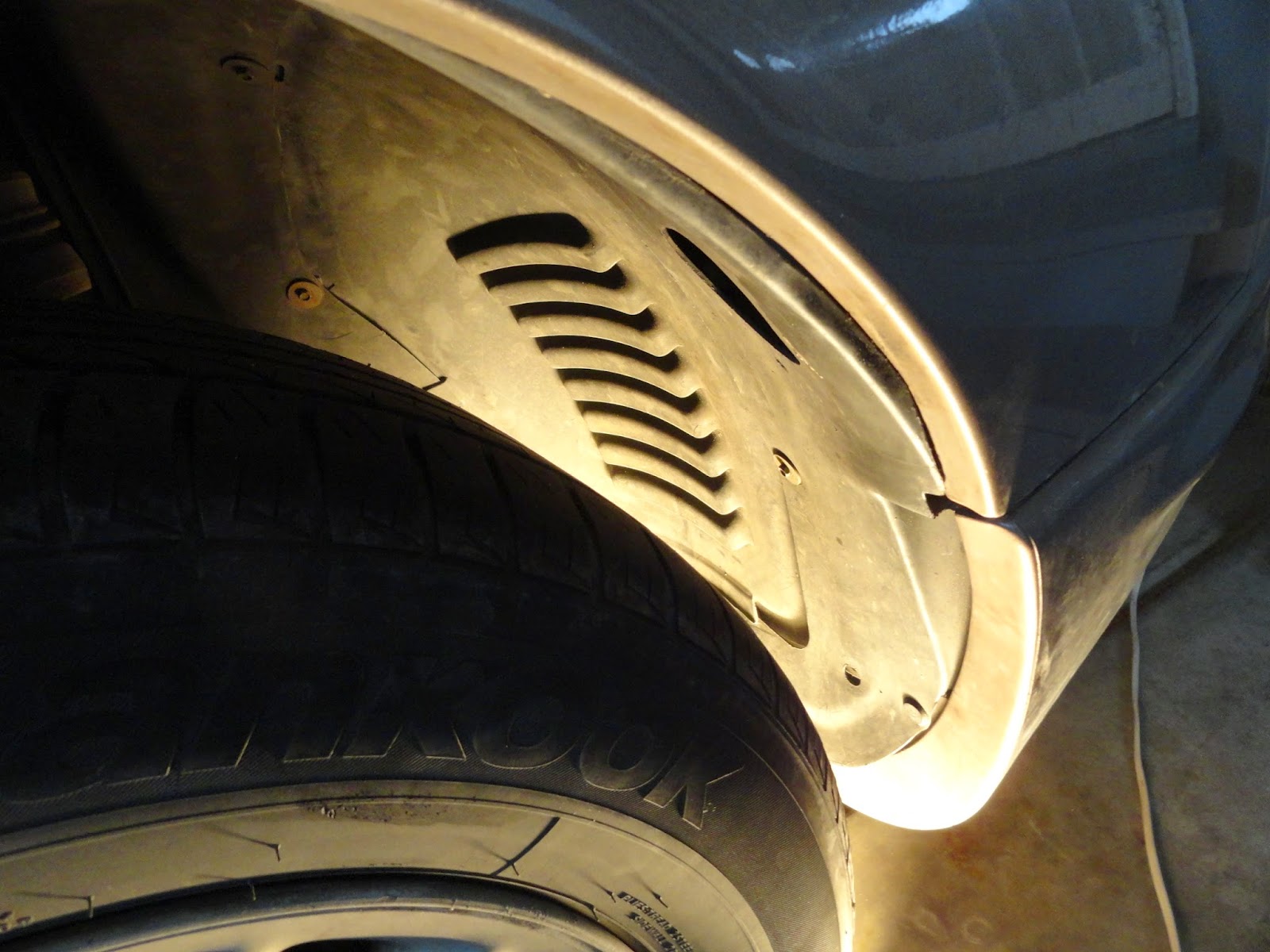
     Chrysler engineers interred the battery beneath the air filtering apparatus in the right front corner of the engine compartment.  By looking closely you can barely see the positive terminal hiding in the dark below and between the air filter housing and the right front headlight housing.  See, yes.  Reach with hand or tool, no. 

     (See it?  Top center-to-right is the air filter housing.  The hexagonal bolt head in the center is the hood support.  The battery terminal is the two little bolts in the crevasse between the air filter and above left of the hood support.)

      Still not thinking clearly, we went home in the pickup.  The Goodwife prepped the prime rib for the oven as I gathered socket wrench set and screw drivers, finally a whole tool box.  Having stood in the sharp wind for a few minutes while studying the situation under the engine hood, I also donned my Carhart insulated coveralls.  The prime rib went into the oven, the timer set to go off in one hour.  Would anyone be there to hear it?  It was 3 o’clock.  Back to the post office we went.
       The air filter box came off with only one broken plastic ear.  The positive battery terminal was now accessible.  A thorough cleaning took about fifteen minutes.  The negative terminal?  Still hidden beneath the headlight housing.  The battery has to be “slud” (thanks to Dizzy Dean for that wonderful word) back to get to the negative side.
      The fender well is about an inch behind the battery, leaving no room to slide the battery back.  There is a removable plastic panel in the plastic fender well.  If I remove that panel, will the battery run into the right front tire?  I have heard that to change batteries on these cars, you have to remove the tire.  I really didn’t want to do that there in the parking lot.

  
     Then the idea hit me.  Why not try jump-starting the thing?  If cleaning the positive terminal didn’t work, I could jump-start it and take it home to the privacy of my own garage to disassemble the thing and screw it up out of public scrutiny.  That seemed a better idea than tackling the removable panel and maybe a tire.
      I reassembled everything.  Behind the steering wheel, the start attempt was rewarded with a repeat performance, bells, lights, clicks, but no start.     This time, when I removed the key, the instrument panel continued to flash and click.  Oh no, what did I do to the thing now?
     The parking spot on the Chrysler’s left opened up, so I stood in the space while the Goodwife backed the pickup out of its space, backed up going the wrong way, and pulled into the vacancy to Chrysler left.  The jumper cables were behind the Dakota seat the whole time.  Why did it take so long to think of them?
      The battery in the Dakota is on the left side.  The cables were about five feet short of reaching across both engine apartments and the space between vehicles.  So we waited and waited for the driver of the car on the Chrysler right to appear.  Finally he showed.  The Goodwife stopped traffic by backing up and poising the poor old Dakota in position to take the soon-to-be vacated parking spot.  Eventually, the guy pulled out, the Goodwife pulled in, the traffic cleared, and we were ready to try again. 
       It took a few trips between vehicles to get good enough contact to run the Chrysler starter.  It started.  And died.   (Later: starting and dying seem to be part of the computer readjusting things, as it died all three times when I started it after breaking the electric contact.)
      No matter how I tried, I was never able to get good enough contact with the jumper cables to get the starter to run again.  It was nearing 4 o’clock.  The stove timer would be sounding soon.  The very careful cooking instructions said an hour on, then off, do NOT open the oven door EVER until ten minutes before meal time.  (Heat for another hour before mealtime, no matter when that time comes, but do NOT open the oven door.)
     The Goodwife vacated the coveted parking spot and headed home to shut the oven off and do a few other things preparatory to Christmas dinner.  I would try one more time, and if that attempt failed, we would have to abandon the Chrysler to the post office parking lot for the approaching night.
      The air filter stuff jumped right off, being used to the routine by now.  I was tackling the removable panel in front of the tire when the lady walked by, apparently for the second time, and wished me Merry Christmas.  She was the second of three of all the people who came and went during my predicament who spoke or acknowledged that I was there.  The first person was an old guy who asked if I needed a jump.  I explained we were waiting for the parking spot we needed.  He nodded and left. 
     The plastic fender well panel came off without breaking anything.  After removing the hold-down, the battery would slide back.  By lifting it slightly and resting the back end on the tire, I could just get a wrench on the negative cable clamp.  I could bring the cable out far enough to clean it thoroughly.  The battery post was a little more difficult.  I wasn’t sure the battery could come out without removing the tire, so I gave the terminal a fair scouring with it in place.
      I was getting the air filter back in its place when a lady parked on Chrysler left.  She came around her car to see if I was okay.  I assured her I was okay and explained I was about to finish the repair and check the results. 
     The Goodwife arrived while the lady was in the post office.  The lady returned just as I was getting behind the wheel to give it another whirl.  She got in her car and rolled down her right window so she could hear the results of my attempt.
    The Chrysler started.  And died.
     I tried again and this time it continued to run, roughly and smellily for a little while, then normally.  The lady gave me a thumbs-up and departed.
     It took a while to clean up, gather the tools, put the removable panel in the trunk.  The Goodwife got in the car, but she advised me to follow her just in case.  So home we went in tandem.  The Chrysler was safely in the garage and we could rush about getting Christmas supper ready to go.
      I walked into the house and glimpsed the unwrapped presents scantily clad in wrapping paraphernalia on the couch.  Oh well.  If someone snooped, that was her shauri.
       Our guests arrived a bit late, the prime rib got a little overdone due to our imprecise guess as to meal time, not due to subpar cooking instructions, I’m sure.  (No, we did NOT open the oven door until we removed the beef from the oven.)
  We had ourselves a Merry Little Christmas, in spite of the day’s imperfections.


Sunday, December 21, 2014

Hauling Wheat


     The price of wheat crossed the $6 mark a week or so ago, on the way up from the $5.50 range.  The weather felt more like October than December, reaching into the sixties at midday.  I was growing soft, lazing around till the sun gets up before I rise, taking a nap in front of a boring tv show in the evening. 
     In the back of my mind lurked a binful of wheat and the specter of a huge blizzard roaring down the plain, leaving unnavigable drifts across the yard.  (I inherited the ability to worry about every imaginable catastrophe from my mother.)  The price of wheat would rise with the drifts and ebb as the obstructing snowbanks slowly melt in the spring, and I would be unable to take advantage of the bad weather market rise.
      Add the chainsaw sans fuel or chain oil, leaving me no real excuse to get outside into the sunlight.  The weather, the wheat market, the mental irritants, all got under my shell enough to provoke a little action.  We shall have to wait to see if the result is a pearl or some other less worthy secretion.
     The factors all came together with enough critical mass to overcome the winter inertia.  I took the next step.  I put it on the calendar.  I would be gone, hauling wheat from Tuesday till Saturday, probably. 
     Monday was already taken.  The barbershop “boys” (I’m pretty sure I was the youngest singer) sang Christmas carols at two Fort Collins assisted living facilities.  Otherwise, I could have given myself another day to meet the challenge of man and machine versus Murphy’s law.  You do have to have priorities straight.  By leaving on Tuesday, I still made a mighty sacrifice, the first barbershop gathering in my new residence where we would do something other than Christmas carols (Bathless Groggins shudder.) (If you understood that allusion, I know two things about you:  You are older than dirt, and you read the Sunday funnies.)
     Off I went early (9 o’clock) Tuesday morning.  I had a few calls to make in Limon, insurance agency, barbershop (the real haircutting kind, there were five guys in there, I’m still shaggy), e-waste stop, hardware store for a dust mask for when I have to enter the grain bin and scoop—pretty optimistic, eh?
     Around one p.m., I pulled into the farm and set the house to warming—started a fire in the stove, turned up a couple of heaters.   I ate a little lunch which I had thoughtfully provided, and I tended the wood fire.  Then I turned to the matter at hand, hauling wheat.
    I had four motors to get started.  Three might be difficult but doable.  One was very questionable.  It was the Willie Suchanek Lawson auger engine.  It hadn’t run for at least ten years.  It must be fifty years old. 
     No sense in doing anything until I got that engine started.  It was still mounted onto the sprayer deck on the “water trailer” in the red barn.  Off the engine came and out into the warm midday sun where I attempted to start it.  Priming it by putting a few drops of gas down the air intake produced no result. Neither did a few drops of gas in the spark plug hole.
      This is serious.  No spark.  The flywheel has to come off to get to the breaker points.  Remove fuel tank, cowling, then the flywheel.  It can be difficult, but with a gear puller putting pressure on it, it popped right off with a pry from a screw driver.  I filed the points flat and reinstalled everything.  It now sparked.  I couldn’t see the spark, but I could hear it snapping. 
     This time it took off when I primed it.  After two hours of work, that was a positive.  But it would only run as long as I dripped a little gas down the air intake when it sputtered.  Carburetor time.  Pulling the carburetor off reminded me that once while transporting the engine from sprayer to auger, it bounced off the golf cart and broke the bracket that holds fuel tank, air intake and carburetor mount.  That repair involved a weld, some silicone gasket goop, and some JB Weld.  I ended up having to redo the silicone and the JB Weld.
      That ended day one of the wheat hauling adventure.  Time to let the goo dry.
      Wednesday morning the thing started right up and ran a little better.  I drug out the sixteen foot auger from the combine shed and hauled it to the grain bin with the golf cart.  Some digging was required to open the channel under the granary floor.  That auger got a lot heavier over the past ten years, but I got it into place and mounted the engine.
     The Mayrath auger took a little work, but started right up.  Add belts and it was ready to go.  Both trucks cooperated.  By about 1 p.m. I was set to give it a try.  For a while, I would start one auger engine.  When I went to start the other auger engine, the first one would die.  Finally, the Briggs decided to keep running so I could attend the Lawson.  It would run just fine as long as I stood right by it.  When I left to open the grain slide under the granary, it would die.
    Finally I got the slide open, both engines running, and some grain actually hit the truck floor.  The Briggs decided the load was too much, so it died.  While I was starting it, the Lawson died.  Back and forth I went.
     During this time Neighborly drove up, unnoticed by me.  He saw the open door on the east end of the combine shed and thought he better investigate.  When I failed to notice him, he yelled.  I jumped, a big.  He caught me totally by surprise.  We had a short visit and back I went to rope-pulling wind sprints.
     When it came time to move the truck, the Lawson would stop when I left it.  I must have pulled that starting rope a mile if you add up all the three foot tugs.
     As the truck filled I had to move it four or five times.  About two more moves and it would be full.  The Lawson died again.  I shut the truck off, restarted the Lawson, went to move the truck one last time.  It wouldn’t start.  Quickly I released the tension on the Lawson belt, stopping the flow of wheat.  Now I had leisure to find the problem with the truck, but with both engines running, I couldn’t hear what the truck was doing.
     So I had to shut both auger engines down.  A corroded battery cable was soon diagnosed and cured.  (I just realized how dependent a mechanic is on hearing—better he should lose his sight than his hearing.)  “Pulling dem ropes” yet again, I topped off the load and tarped it.          
     The truck loaded, I got to town about 4 o’clock.  The boys at the elevator had a tomorrow deadline to get ten train cars loaded, so I had to be worked in.  It was dark when I got about halfway home.  Pulling the truck light switch lit the instrument panel, the tail lights, the clearance lights, but nary a headlight.  I carefully felt my way home the last three miles.
     Day two, one load down.  Thursday morning, the Lawson was back to stage one, no spark, no fire, not even a pop when treated to a little ether.  This time flywheel removal revealed that I had not tightened the flywheel onto the crankshaft tight enough during the first surgery.  What running it did had completely chewed up the square key that holds flywheel to shaft.  Worse the key ways in both the flywheel and shaft were buggered.
      I began to entertain the thought that I would need a new engine before I could haul a second load of wheat.  I had no eighth inch key stock, so a trip to town was necessary.  I cleaned up the key way on the shaft and flywheel, but I hadn’t a lot of hope that I could hold the flywheel in time with the shaft.  J B Weld to the rescue.  Hey if it was good enough for the carburetor, why not the flywheel?
       I put some goop around the key way and mounted the flywheel.  No spark.  Quickly I removed the flywheel before the glue set up.  I filed the points again.  They may have been fouled by metal flecks from the disintegrating key.  Reglue and reassemble.
     While I waited for the glue to set up, I found another thing on the carburetor to clean.  Fortunately, I could remove the jet without removing the carburetor.  A brief soak in some solvent followed by some good air blasting and a light wire brushing returned the jet to a normal state.
       This time, priming with a few drops of gas followed by a tug on the rope resulted in a smoothly running engine.  A miracle!
       Mount the Lawson on the auger again.  It started right up again.  The Briggs gave me a little trouble, but when I went to attend to it, the Lawson kept running.  I got loaded and headed for town between 2:30 and 3:00.      
      By four o’clock, with the sun threatening to die on me (starter rope not long enough to reach it) I was in position for a first.  When I started both engines, they both ran straight through, getting the truck fully loaded without once having to restart something.  Tarp the truck and call it a day.            
      Friday morning I scaled the truck a few minutes after eight.  I was there again at eleven.  I returned the third time about 1:30.  So I should have tried for a fourth load?  A check of the bin revealed I would get about 100 bushels loaded, maybe 200, and then the rest would have to be shoveled.  I wasn’t up to that.  Besides, I wouldn’t be done.  It will take two trips to town.
       I was faced with removing the auger from the bin, putting everything away, and starting all over again another day.  The elevator keeps no Saturday hours this time of year.  The weather is predicted to take a nasty turn for the weekend.  I really didn’t want a truckload of wheat sitting in the shed for who knows how long.  Remember that vision of a blizzard roaring down the plain?
    So I used the remaining afternoon to put everything away.  Next time it will be easier to get everything running because I know it can be done.  Well, unless I have to pull that Lawson flywheel again.  JB Weld can be pretty strong.
      Maybe I’ll take what’s left to the farmer’s market.  Let’s see, about 800 bushels equals 48,000 pounds, about 4,800 ten pound bags.  The old Dakota pickup can haul about . . . .